


Good morning,
A woman’s tyre burst on the Third Mainland Bridge, and before she could reach for the spare, the agberos had surrounded her car. They wanted money. She was alone. Then a dispatch rider in a white T-shirt stopped, stood between the men and the car, and refused to move. They backed off. She drove away. He did not know her. He owed her nothing. In a city where the roadside economy runs on extortion, and the police are never there when the bridge takes your tyre, one young man on a motorcycle did what the state could not. Praise him. Praise him loudly, because heroism on that bridge is rarer than the traffic. But heroism is not a policy. The agberos remain; no arrests were reported, and the next stranded driver will be alone unless another rider stops. In Lagos this week, residents marched against Band A tariffs, paying three times the old rate for power they do not receive.
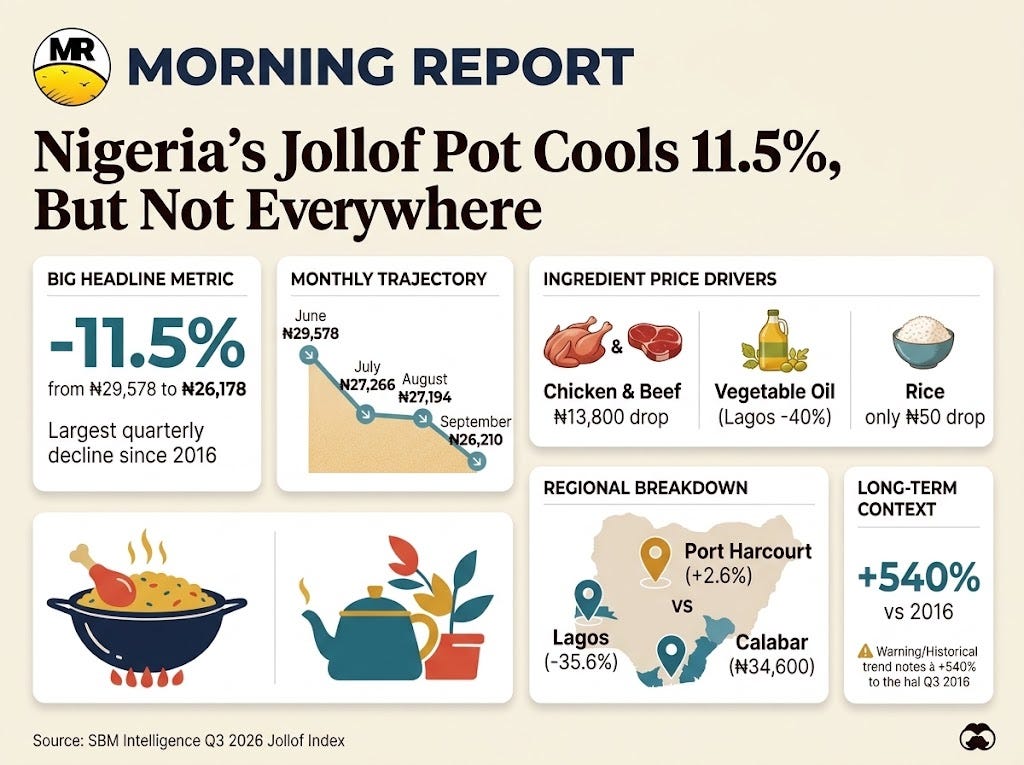
The finance minister, Taiwo Oyedele, went to Chatham House and made the case with numbers. Headline inflation is 14.63 per cent, down from 21 per cent a year ago. Reserves are at $55 billion. Then he conceded the part that matters: food inflation at 19.6 per cent remains too high. The Jollof Index agrees. A pot of jollof fell 11.5 per cent to ₦26,178 between June and September, the sharpest quarterly drop since 2016, driven by chicken and vegetable oil, not rice, which barely moved. That is welcome, and it is still 37 per cent of a minimum-wage worker’s monthly pay. The NBS September report puts food inflation at 19.59 per cent, with month-on-month prices down 1.55 per cent. The pot is cooling. It is not full.
The state police amendment is moving faster than the thinking behind it. Twelve assemblies approved it in two days, taking the total to 17 of 36, with seven more needed. Adamawa approved 24 of 26 clauses and rejected two. Ekiti approved it “subject to” an amendment, when Section 9(2) allows assemblies only to approve or reject. The funding question was raised in Benue and left unanswered, deferred to a law that does not exist yet. State police without money is a duplication of weakness, and governors with their own forces are a danger nobody wants to name. Meanwhile, the G-100 coalition says it is making “significant progress” towards a single candidate, with Atiku, Obi, Duke and Adebayo under consideration. They have been here before. In 2019, the unity pact collapsed. In 2023, they split and handed the APC a plurality. If they were serious, they would have settled this long ago. Serious people do not announce progress. They produce a candidate.
Elsewhere, the numbers are being fixed, and the systems are not. Dangote has bought 24.76 per cent of Kenya Pipeline for about $327 million, extending his reach from refining into distribution. Lagos Water Corporation has revised its coverage from 1.03 per cent to 8.3 per cent, saying its 34,424 plot-based connections serve 1.65 million residents, not 206,444. One per cent or eight per cent, the state still produces 210 million gallons a day against demand of 540 million. The revision changes the figure, not the pipes. A Kaduna court sentenced a 22-year-old POS operator to sweep the court premises for 40 days for stealing ₦250,000. And a food critic implied that one ethnic group leads fake drug production, without a statistic, while NAFDAC destroyed ₦22.73 billion in counterfeits this year. The regulators are the ones who failed.
A rider who stopped. A pot that cooled. A bill that is moving. An opposition that is talking. These are not separate stories. They are the same story: a country where the figures improve, the systems lag, and ordinary people keep filling the gaps the state leaves open.
Warmly,
Lolade