


The cost of cooking a pot of jollof rice has fallen. The National Average Jollof Index dropped from ₦29,578 in June to ₦26,178 in September. That is an 11.5% decline. It is the largest quarterly drop since SBM Intelligence began tracking the index in July 2016. The report is titled “The Pot Cools, but Not Everywhere.”
Since 2016, the Jollof Index has tracked the cost of one pot of jollof rice across 13 markets in Nigeria’s six geopolitical zones. The index prices fixed quantities of rice, chicken, beef, tomatoes, vegetable oil, red pepper, tinned tomatoes, onions and seasonings. The index is a proxy for household food costs. It has risen steadily since its inception. The 2022 floods, the 2023 subsidy removal and the naira float pushed costs higher. The current decline is the first significant reversal in years.
The decline was driven by protein and cooking oil. Chicken and beef together accounted for ₦13,800 of the fall. Vegetable oil prices dropped in nine of the 13 markets. In Lagos, the price of 90 centilitres of oil fell from ₦5,000 to ₦3,000. Rice prices contributed little. Rice prices moved by just ₦ 50 across the 13 markets. The sharpest decline occurred between June and July, when the index fell by ₦2,312. That coincided with the main harvest. Prices were stable in August before falling by ₦984 in September.
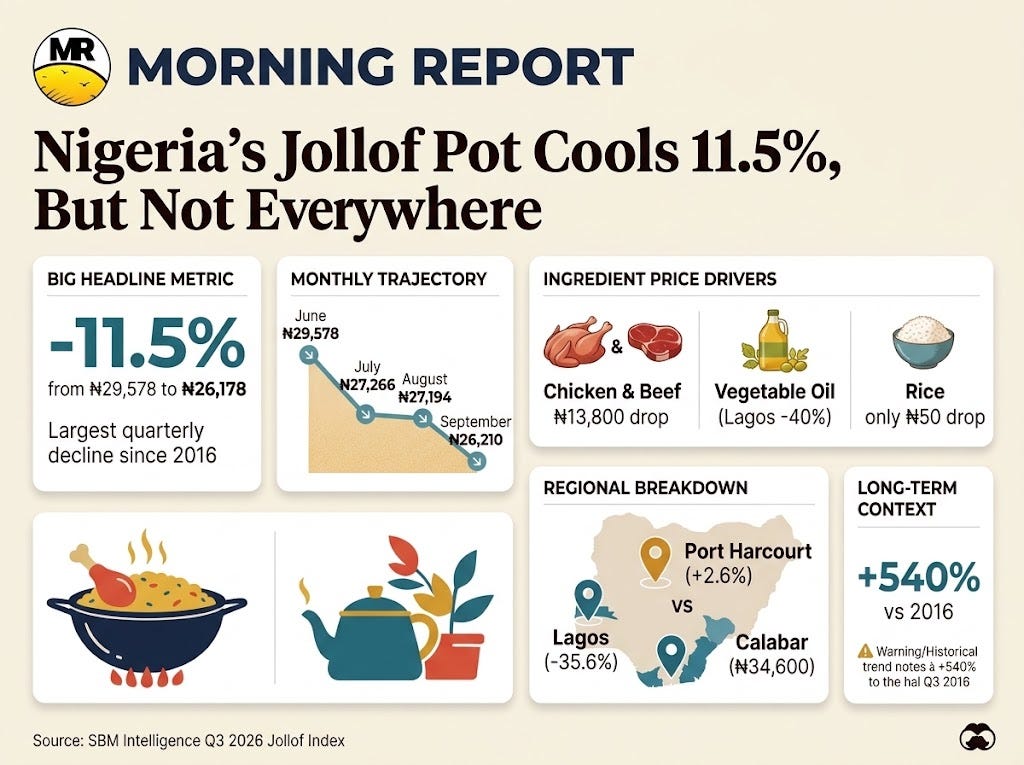
The decline was uneven. Lagos and Ibadan accounted for much of the reduction. Nine of the 13 markets recorded declines of less than 10%. Two barely moved. Port Harcourt was the only market where the cost increased. It rose from ₦31,200 in June to ₦32,000 in September, a 2.6% increase. SBM attributed the rise to flooding in Port Harcourt and Obio/Akpor in late September.
The movement aligns with inflation data. Food inflation eased to 19.57% in August from 20.31% in July. That was its first decline in six months. Headline inflation fell to 15.39%.
Winners: Households, who face lower food costs. Chicken and beef sellers, who gain volume if prices are lower. SBM Intelligence, which demonstrates the value of its index. The Federal Government, which can claim progress on inflation. Losers: Poultry and beef farmers, if lower prices squeeze margins. Port Harcourt residents, who face higher costs due to flooding. Markets outside Lagos and Ibadan, which saw smaller declines. Nigerians who still cannot afford a pot of jollof. Rice farmers, whose prices barely moved.
Bottom Line: A pot of jollof rice now costs ₦26,178. That is 11.5% cheaper than in June. It is still 37% of a minimum-wage worker’s monthly pay. The decline is welcome. It is not relief. The index fell because chicken and oil got cheaper, not because incomes rose. The pot is cooling, but not everywhere. Port Harcourt is flooding. Rice is not falling. The harvest helped. The next harvest may not.