


Good morning,
My researcher’s neighbour knocked on her door on Tuesday evening and asked a question about garri. “The price has finished me,” she said, laughing the way people laugh when they are not really joking. A bag that cost ₦18,000 last year is now ₦35,000 in her market. She is not the only one doing this arithmetic. A man was caught on camera at Nnenna Otti Bus Terminal in Umuahia last week, stealing a bag of garri. He did not seem to have considered the CCTV. The joke writes itself until you check the price. What was once too cheap to steal is now worth a criminal record. At what price does petty theft stop being petty?
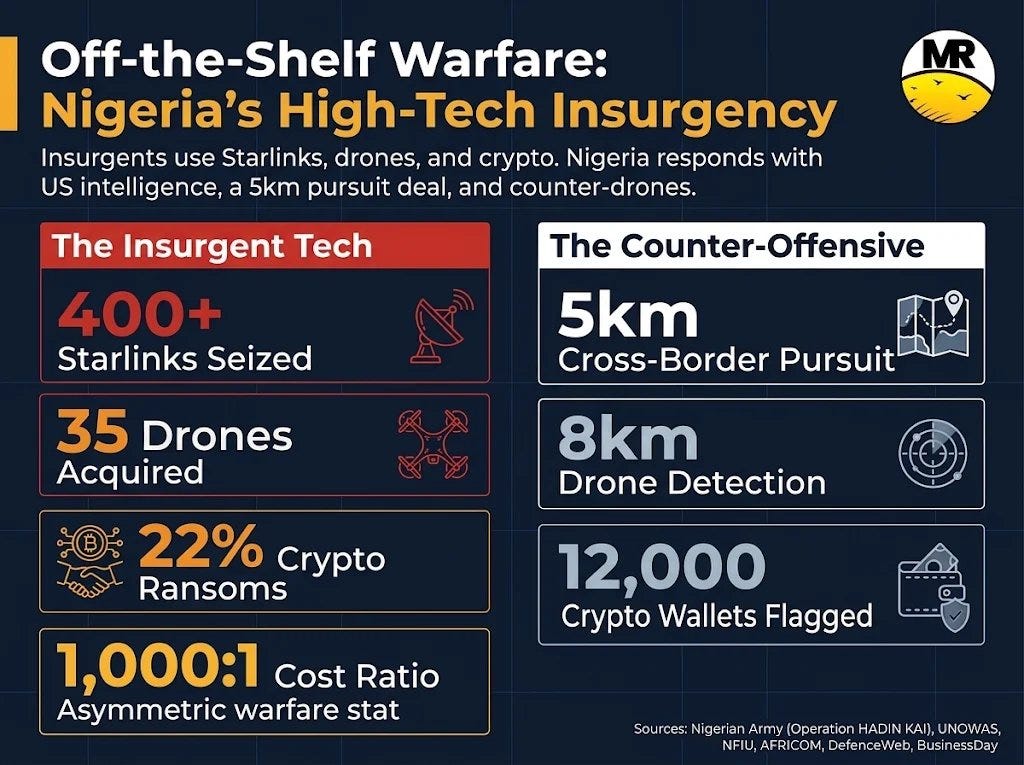
The state’s authority is being tested on several fronts, and the results are uneven. All 36 state assemblies have now approved the constitutional amendment for state police, and President Tinubu holds a bill that could reshape policing or simply reproduce what we currently have at a lower level. The funding and command-and-control questions remain unanswered, and the risk of governors using local police as instruments of political coercion is real. Meanwhile, in the forests of the North-West, bandits are buying Starlink kits, commercial drones and crypto wallets. Defence Minister Christopher Musa confirmed that security agencies are tracking this, working with US intelligence, but the asymmetry has narrowed because the tools of coordination have become consumer goods. A Starlink kit bought with a credit card puts broadband in a forest camp beyond the reach of any terrestrial tower. On an Abuja street, a video showed an FRSC officer refusing to return a woman’s car key, and bystanders refusing to have it. The Court of Appeal in Owerri has already ruled that the corps lacks authority to confiscate documents without lawful justification. The pattern is consistent: an agency acts first, a court corrects it later, and the citizen pays the cost in the interval.
The economy is producing its own contradictions. President Tinubu announced mortgages of up to ₦100 million at 9.75% fixed rate over 20 years, and more than 2,300 Nigerians have already drawn ₦160 billion from the fund. For a formal-sector worker earning ₦300,000 a month, a ₦10 million property is manageable. For the majority who earn in the informal economy, with no payslip and no verifiable income, the product is invisible. The housing deficit is over 20 million units. A 9.75% mortgage is a real improvement. It is not a housing policy. The man at the bus stop was not making a political statement. He was hungry.
The human cost of these failures is not abstract. In Kano, police have arrested a co-wife and three others over the killing of 14-year-old Mahmoud Auwal. The alleged motive was to eliminate her husband’s four children from another marriage so that her only son would inherit the family properties alone. The husband is still alive. Where the formal legal process is slow or distant, succession disputes migrate to informal enforcement. Sometimes that enforcement is a court. Sometimes it is a gang. Former President Goodluck Jonathan has warned that political intolerance, violence and conflicting court judgments could trigger a crisis after 2027. INEC has moved 186,277 BVAS machines to state offices and scheduled a mock exercise for 28 November. But the commission admits the core weakness was at collation centres, not polling units. A machine that accredits correctly cannot fix a result that is altered after accreditation.
My researcher’s neighbour returned the bowl the next morning, washed and dried. She had found sugar elsewhere. “We will manage,” she said. That is the phrase you hear everywhere now. We will manage the fuel queue, the mortgage we cannot access, the police that protect the governor’s convoy but not the market. We will manage the warnings about 2027 and the cameras in the bus terminal. But managing is not the same as fixing. And this morning, as you read this, someone is doing the arithmetic of survival, one bag of garri at a time.
Warmly,
Lolade