


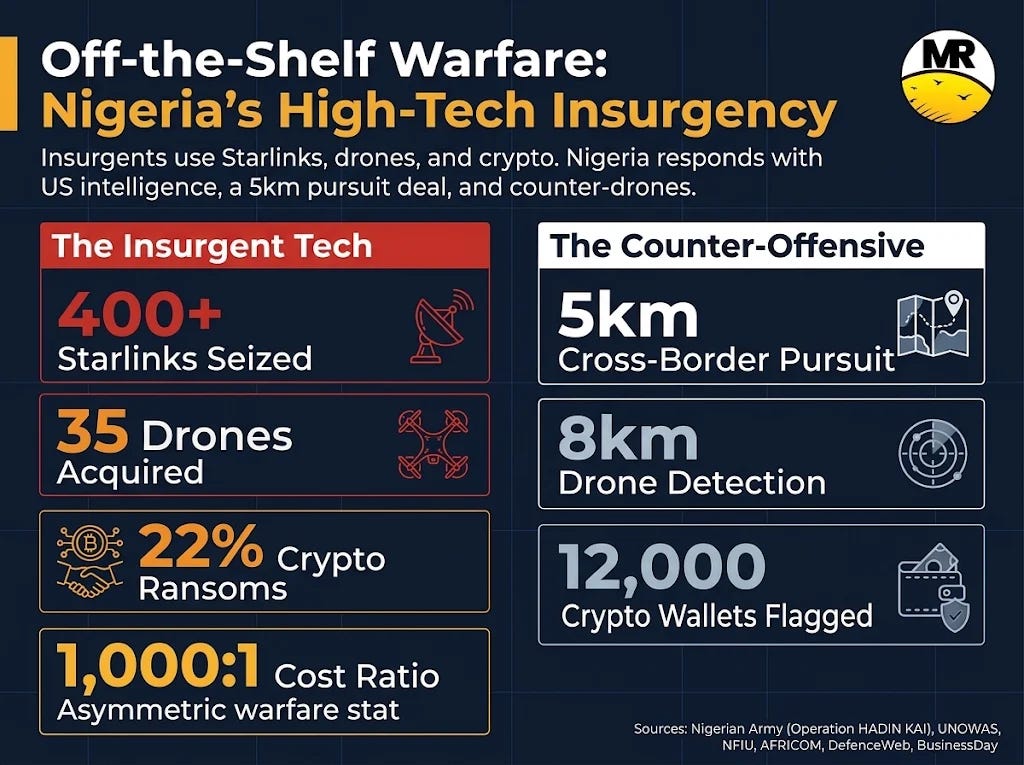
Defence Minister Christopher Musa confirmed in mid-November that Nigerian security agencies are tracking the use of Starlink terminals, cryptocurrencies and commercial drones by armed groups, working alongside US authorities to disrupt their financing. He said American intelligence support has underpinned near-daily operations, including overnight raids across the North-West and North-East that killed several gang and insurgent leaders. He also disclosed a five-kilometre cross-border pursuit arrangement with Cameroon, Niger and Chad. “We don’t want them to develop that capacity,” he said. The admission is remarkable less for what it reveals about the enemy than for what it concedes about the state.
A decade ago, the military’s edge over insurgent factions rested on signals interception, electronic surveillance and air power. Fighters who went off-grid had to use predictable radio frequencies or human couriers, and both left openings. That asymmetry has narrowed, not because the army stopped fighting, but because the tools of coordination became consumer goods. A Starlink kit bought with a credit card puts broadband in a forest camp beyond the reach of any terrestrial tower. A quadcopter ordered online gives a gang the ridge view that once required state hardware. A crypto wallet moves ransom across borders without touching a bank.
The mechanics of this shift are mundane, which is what makes them dangerous. Procurement cycles in Abuja run through committees, budgets and approvals. Procurement for a kidnapping ring runs through a browser and a delivery address. When one side upgrades in months and the other in budget cycles, the gap closes regardless of who has more soldiers.
This is not new in kind, only in speed. During the early Boko Haram years, commanders frustrated a military trained for conventional doctrine by using satellite phones, encrypted messaging and hawala transfers that bypassed the banking system. The Lake Chad smuggling corridors that carried weapons, fuel and contraband through marshlands and porous borders then serve the same function now for terminals, batteries and drone parts. The playbook is old. The hardware is not.
Dr Kabir Adamu, a security analyst and managing director of Beacon Consulting, calls it adaptive opportunism. “Groups that once struggled with basic communications can now move money digitally and look over the next ridge with a commercial drone bought for a few thousand dollars,” he said. “When a non-state actor can buy capability off the shelf while state procurement moves through slow bureaucratic cycles, the tactical balance shifts unless intelligence and inter-agency tracking adapt just as fast.”
Major General Garba Wahab (retd.), a former commander who now commentates from Kaduna, makes the same point through history. “In the early days of Boko Haram, satellite phones and informal money transfers gave them agility that conventional tactics alone could not neutralize,” he said. “Today it is Starlink, commercial drones and crypto, layered onto old smuggling and border routes around Lake Chad and the Sahel.”
Both men are arguing for speed. Others are arguing that speed is not the binding constraint. Officials at the Defence Headquarters have pointed to improved kill rates and leadership decapitation as evidence that intelligence-led operations work. The Nigerian Financial Intelligence Unit has pressed for faster information sharing with exchanges and foreign counterparts, and argues that financial tracing produces better results per naira than another armoured convoy. Those are the voices for the current approach, and they have a case.
The voices against it are less quoted but no less serious. Civil liberties lawyers and digital rights groups warn that the same surveillance architecture built for insurgents will be pointed at journalists and political opponents, and that the absence of a data protection regime with teeth makes that inevitable rather than hypothetical. Community leaders in the North-West argue that a raid kills a commander and recruits two replacements, because the economic desperation that feeds the gangs does not respond to airstrikes. Development economists make a third version of the argument: the North-East has absorbed more than a decade of kinetic operations and foreign intelligence support, and ISWAP still holds territory.
The neutral assessments sit between them. The International Crisis Group and similar bodies have long argued that military pressure and political settlement are complements, not substitutes, and that Nigeria has over-invested in the first. Security sector researchers note that the five-kilometre pursuit arrangement is a modest instrument against an adversary that crosses borders in kilometres, not metres, and that it works only where the neighbouring force is willing and able.
The uncomfortable part is the American dependency. A US strike on Islamic State fighters in Sokoto State in late December 2025, expanded ISR engagement, talks with US Africa Command leadership and the deployment of American personnel and unmanned surveillance assets have all moved Abuja closer to Washington’s intelligence architecture. That arrangement has delivered targets. It has also made Nigerian operations contingent on a partner whose attention shifts with its own politics, and whose interests in the Sahel are not identical to Nigeria’s.
Tracking the money is the sharper lever, and the harder one. Pseudonymised blockchain transactions are traceable in principle. In practice, tracing requires forensic capacity, cooperation from exchanges and foreign financial intelligence units, and information moving between military intelligence and law enforcement fast enough to matter. Ngozi Eze, a Lagos-based financial crime specialist, puts the case plainly. “Kidnapping syndicates and militant networks are businesses at their core, and like any business, they need liquidity to buy weapons, fuel and supplies,” she said. “Cryptocurrency gives them speed and cross-border reach, but blockchain ledgers are also traceable when investigators have the right tools, partnerships and intelligence.”
The recruitment pipeline is where the two theatres converge. Musa has warned that Islamic State elements in the Sahel are attempting to recruit criminal gangs in the North-West. If that succeeds, profit-driven kidnapping networks harden into ideological insurgency, and the North-West acquires the North-East’s problem with better geography for concealment and worse governance to resist it.
The winners in the current arrangement are Washington, which gains a foothold in a region it had partly withdrawn from, and the military units that receive better targeting data. The winners also include the defence contractors and satellite operators whose products now sit at the centre of a war they did not design. The losers are the villagers in Zamfara and Sokoto caught between gangs who tax them and airstrikes that miss, and the soldiers who fight an adversary with better broadband than their forward operating base. Also losing are the civil liberties groups who will spend the next decade litigating surveillance powers granted in an emergency that never formally ends.
The larger loser is the state’s monopoly on coercive technology. That monopoly was never absolute, but it was real, and it rested on a price barrier: the tools of coordination were expensive and controlled. That barrier is gone. Anyone with a card and a delivery address can buy it.
This echoes the 2014 period, when Boko Haram’s capture of territory forced a state of emergency and a foreign mercenary influx, and the lesson drawn was that Nigeria could rent capability when its own failed. The difference now is that the adversary can rent too, and rents faster.
Bottom Line: The army does not need better weapons to win this. It needs to buy faster than a teenager with a browser, and to give the North-West a reason to stop selling its sons.