


Good morning,
A Bolt driver in Lagos worked all night, bought ₦80,000 worth of fuel, and earned ₦60,000. He went home with nothing for his wife and four children. That is not a shift. That is a subsidy he pays to the platform. He is not alone. Drivers across Lagos, Abuja, and Port Harcourt report the same arithmetic: fuel costs rise, fares stay flat, commissions stay fixed, and drivers absorb the difference. The platforms are not charities. They are businesses. Passengers want cheap rides. Drivers want living wages. Both cannot be satisfied at current fares. Something has to give, and it will not be the algorithms.
The government’s own arithmetic is not faring much better. The Lagos-Calabar Coastal Highway, a ₦15 trillion flagship project, has been rerouted through the East-West Road corridor after the original alignment was found to cross pits over 100 metres deep with no suitable sharp sand for 300 metres, raising questions about whether feasibility studies were done before construction began in March 2024. The Ilaje community says the reroute denies them access to the economic benefits. Atiku Abubakar has demanded the publication of contract documents and raised concerns about a fresh $20 billion loan. Meanwhile, Nigeria’s agricultural export bans and Lagos port delays are pushing cashew, soybean and shea butter through Seme and Lomé instead of Lagos. Togo exported 168,372 tonnes of cashew in 2024 while producing only 8,405. Niger’s soybean shipments to India went from zero to 380,868 tonnes. The crops are Nigerian. The revenue is not. And the World Bank reports that the Federal Government spent ₦7.7 trillion servicing interest in the first half of 2026 against ₦6.2 trillion in revenue, a ₦1.5 trillion shortfall. Interest and personnel costs consumed 73.9% of total spending. Capital expenditure fell to ₦700 billion. The government is borrowing to pay interest. That is a treadmill, not a budget.
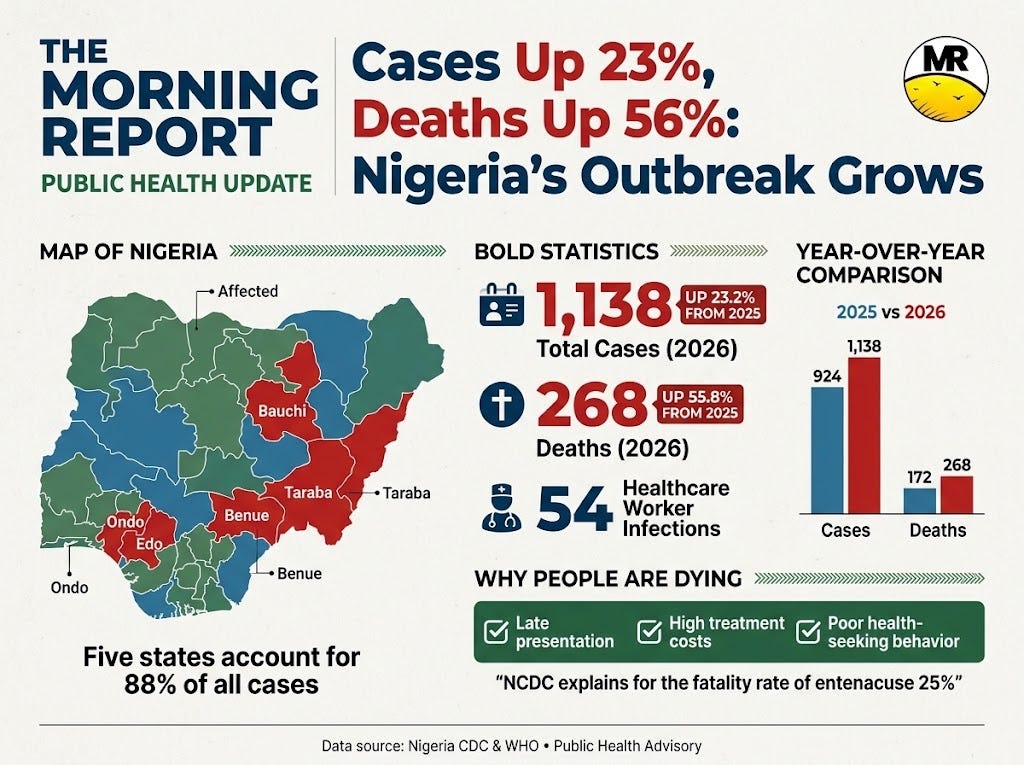
The cost of that arithmetic is measured in lives. Nigeria has recorded 268 Lassa fever deaths in 2026, with a fatality rate of 23.6 per cent, up from 18.6 per cent last year, and five states carrying 88 per cent of all cases. Late presentation kills because treatment costs are high and awareness is low. A female corps member died in Ibadan when the motorcycle she was riding collided with an articulated truck near Agodi Gardens. The rider fractured his leg. She lost her life. In Niger State, bandits killed Assistant Superintendent of Immigration Ibrahim Babagiwa during a surveillance operation along the Tungan Waya-Woko axis. His body was found burnt two days later. His colleague escaped with machete wounds. The borders remain porous. The officers remain unprotected. And in Oyo, police arrested a man who travelled from Anambra with a pistol and a live cartridge to avenge his brother’s death, a case that says less about his rage than about a justice system that left the original murder unsolved.
The institutions meant to hold the line are trying, at least on paper. The Chief Justice of Nigeria, Justice Kudirat Kekere-Ekun, has warned judges against political association and forum shopping ahead of the 2027 elections, urging them to avoid conduct that creates an appearance of partiality. It is a necessary warning. Enforcement is the harder part. The Federal Government has filed fresh charges against Adeniyi Adeyemi, the alleged Director-General of the fictitious Presidential Foreign Intervention Promotion Council, after the Federal High Court struck out the original charge on procedural grounds. He allegedly forged a presidential appointment letter, obtained office space in a federal secretariat, secured a $1 million budget allocation, and tried to open accounts with the Central Bank. He says the agency is legitimate. Meanwhile, the Minister of Information, Mohammed Idris, has defended rising fuel prices as a global challenge, pointing to alternative energy and domestic production. Petrol sells for ₦1,450 to ₦2,500 depending on where you live. The 30-day NNPC discount ends in November. The pain will not.
A driver losing ₦20,000 on a night shift. A highway rerouted after construction began. A corps member dead on a motorcycle. 268 Lassa deaths. Interest payments exceeding revenue by ₦1.5 trillion. These are not separate stories. They are the same story: a country where the arithmetic of survival keeps landing on the same people, and the systems meant to carry them keep falling short.
Warmly,
Lolade