


Good morning,
Desmond Elliot knelt. The Nollywood actor-turned-lawmaker knelt before Femi Gbajabiamila, the Chief of Staff to the President, begging for forgiveness and reintegration into the Lagos APC. He admitted he was misguided during the primaries. He accepted the verdict of the people of Surulere, where he lost by 11,115 votes. He pledged loyalty to the Governance Advisory Council. It was a public spectacle of submission, a reminder that in Lagos politics, the machine does not forgive those who defy it. The hierarchy he challenged is the same hierarchy he now begs to rejoin. It also tells us a lot about politics in Nigeria. I won’t say more, for now.
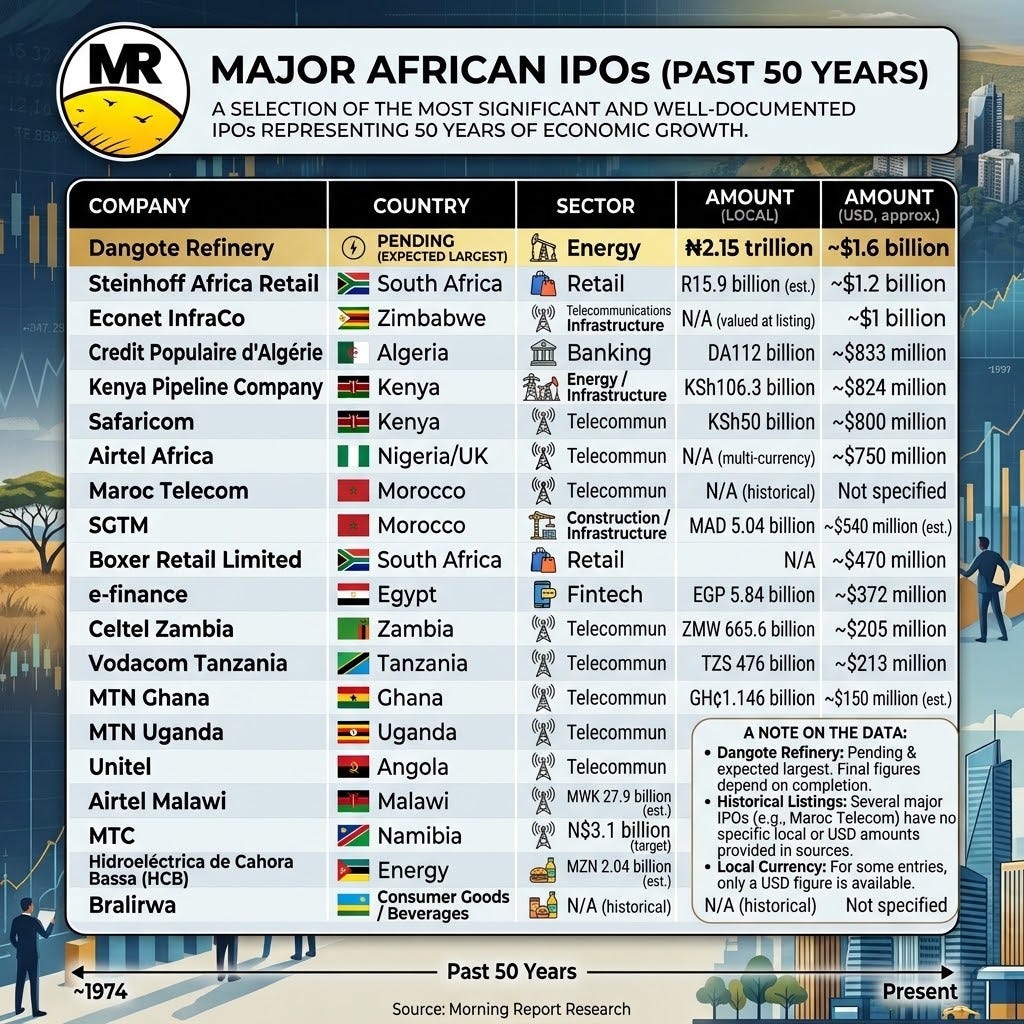
While one man kneels, a nation is invited to buy. Dangote Petroleum Refinery will open its ₦2.15 trillion Initial Public Offering today, placing 4.1 billion shares at ₦525 each. The minimum block of ten shares costs ₦5,250, a threshold low enough for a trader in Kano or a civil servant in Abeokuta. If it completes, it will be the largest equity listing in African history, and the first time an industrial asset has topped that table. For fifty years, Africa’s biggest listings have been telecoms. Dangote breaks the pattern. But analysts warn that scale is not the same as cash flow. Refining margins swing with global crude. The feedstock deal with NNPC will decide whether the refinery buys at a discount or pays import parity. Retail buyers should treat it as a commodity-cycle asset, not a risk-free engine.
And while the refinery goes on sale, the system that handles your money nearly stopped. A service outage hit mobile banking platforms across Nigeria last week. Transactions failed. Transfers stalled. Customers could not access balances. The disruption lasted hours. Banks blamed technical faults. The CBN has not issued a detailed statement. The NIBSS has not explained the cause. Mobile banking now handles salaries, school fees, market transactions and transport payments. When it fails, the economy does not pause. It jams. The structural problem is concentration. A few platforms handle most transactions. Redundancy exists on paper. In practice, it is not tested at scale.
In Enugu, democracy was met with bullets. Gunmen disrupted an NDC voter sensitisation meeting in Nkanu West, injuring eight members. Canopies, chairs and party materials were destroyed. The police confirmed two injured. The party said eight. No arrests have been announced. The same day, hoodlums disrupted a PDP rally in Agbani. Enugu is an APC-controlled state. Opposition activity is growing. Violence against political gatherings is a symptom of competition without institutional restraint.
And in Kaduna, the police raided a radio station. Amnesty International has condemned the invasion of JKD TV and Hamada Radio, calling it unlawful and outrageous. Police arrested the station’s manager, Charles Abah, and a security guard. They were looking for journalist Zainab Yabagi, who had questioned how a presidential adviser could gift away ₦300 million. The message is not subtle. It is intended to chill newsrooms.
Meanwhile, the NHS is counting its Nigerian staff. A total of 10,494 Nigerians are listed among NHS workers, the largest African nationality. Nigeria ranks sixth overall. The UK actively recruits from Nigeria to fill chronic shortages. In 2024, over 20,000 Nigerian health workers relocated abroad, including 3,919 doctors and 7,487 nurses. Nigeria trains them. The UK employs them.
A man kneels. A refinery opens. A banking system stumbles. Democracy is attacked. A newsroom is raided. The NHS cashes in. These are not separate stories. They are the same story: a country where power demands submission, where wealth is offered to the people, where infrastructure is fragile, where opposition is met with violence, where scrutiny is punished, and where the best and brightest keep leaving. The question is whether we will build a country that works, or simply keep kneeling and hoping.
Warmly,
Lolade