


The prospectus is out. Dangote Petroleum Refinery and Petrochemicals will place 4.1 billion ordinary shares at ₦525 each when the offer opens on Monday. The minimum block of ten shares costs ₦5,250, a threshold low enough for a trader in Kano or a civil servant in Abeokuta. At that price, the industrial complex carries a valuation of roughly $62.5 billion. If the float completes at its projected ₦2.15 trillion, it will be the largest equity listing in African history. It would also be the first time a single industrial asset has topped that table.
That last detail matters more than the headline number.
For fifty years, Africa’s biggest listings have been telecoms. MTN listed four times across Ghana, Uganda, Nigeria and, indirectly, through Airtel Africa. Vodacom and Celtel followed similar paths. Of the twenty largest floats recorded on the continent, eleven belong to telecoms operators or the infrastructure that carries their traffic. The pattern is not accidental. Telecoms scaled faster than any other sector, reaching hundreds of millions of subscribers while manufacturing stayed fragmented and banking stayed national. When governments sold their state monopolies in the 1990s and 2000s, those privatisations became the anchor floats of their exchanges.
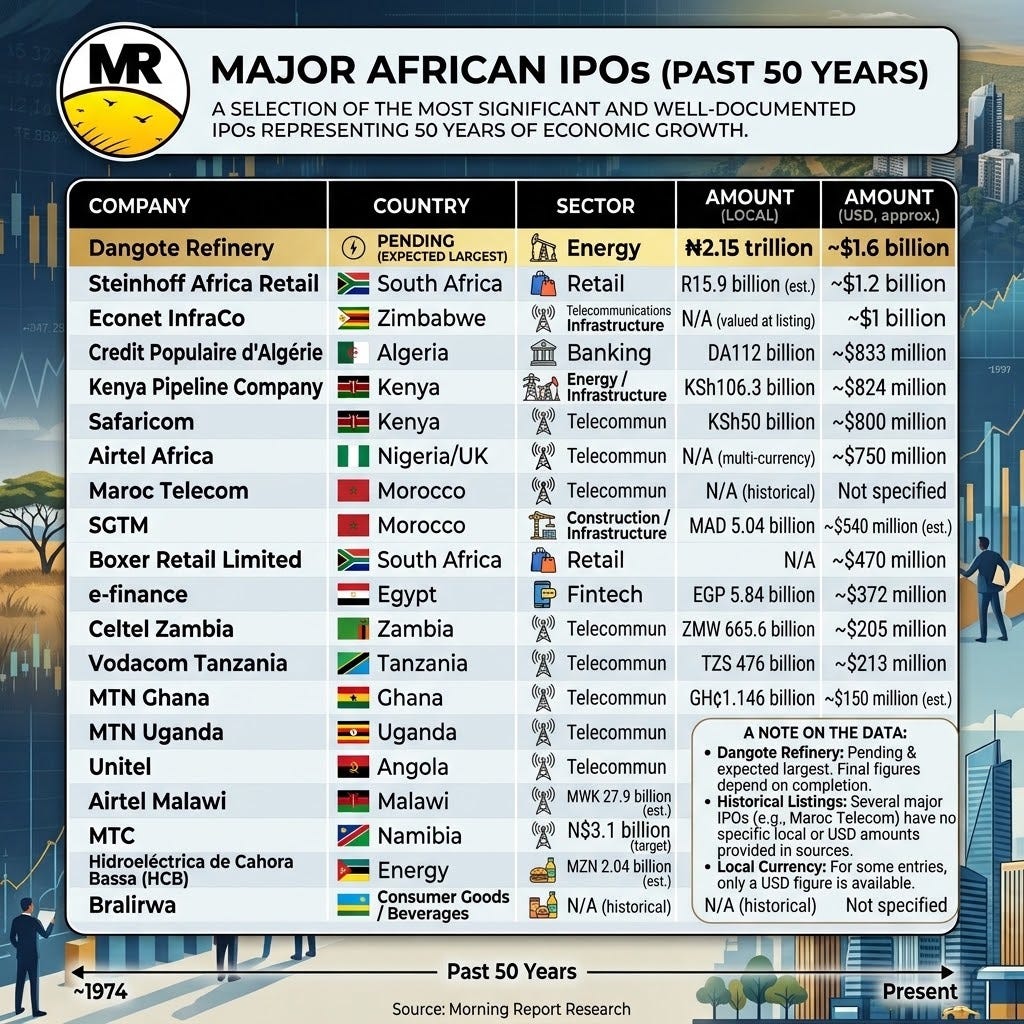
The Dangote offer breaks that pattern. It is industrial, single-asset, and Nigerian.
Babatunde Lawal, managing director of Horizon Capital Advisory, calls the pricing strategy a deliberate attempt to broaden the investor base. He said on 9 September 2026 that the low entry bar lets ordinary citizens move from buying fuel to owning the infrastructure that produces it. Lawal points to the 2021 MTN Nigeria offer, which used digital platforms to onboard tens of thousands of first-time retail buyers. The mechanics differ, he argues, but the intent is the same: convert public interest into liquid retail participation on the Nigerian Exchange.
Mallam Kabiru Usman, a Kano merchant who trades stocks on the side, is exactly the investor Lawal has in mind. He said on 12 September 2026 that the ₦5,250 floor removes the barrier that kept northern traders out of the capital market. For him, the shares represent a tangible stake in the country’s industrial future, not a position to be flipped.
The prospectus makes the bullish case in its own words, framing the refinery as the asset that ends West Africa’s dependence on imported refined products. Fuel self-sufficiency, the document argues, converts a structural import bill into domestic margin.
Not everyone shares the enthusiasm. Engr. Dr Mustapha Bello, a senior downstream analyst at African Energy Insights, warns that scale is not the same as cash flow. He noted on 10 September 2026 that running a single-train refinery processing 700,000 barrels per day proves engineering competence, not profitability. Refining margins swing with global crude benchmarks. The refinery’s feedstock deal with the Nigerian National Petroleum Company Limited will decide whether it buys crude at a discount or pays import parity. Foreign exchange volatility sits on top of that. Bello’s conclusion is blunt: retail buyers should treat the refinery as a commodity-cycle industrial asset, not a risk-free engine.
Then there is the debt. Building the world’s largest single-train refinery required syndicated loans, export credit facilities and corporate bonds. Mrs Funmi Adeyemi, head of retail wealth management at Apex Capital, said on 11 September 2026 that a large share of the proceeds will go to balance sheet repair, debt restructuring and working capital. She cautioned that investors expecting aggressive dividends in the first year or two may be disappointed. Debt service covenants take priority over equity distributions during a post-listing consolidation phase.
A Lagos-based pension fund manager with direct knowledge of the book-building goes further. Institutional demand, he argues, may absorb the float before retail orders are filled, leaving small buyers with smaller allocations than the marketing suggests. The ₦5,250 entry point guarantees access, not quantum.
Ethical screening adds another filter. Dr Aliyu Abubakar, a Shari’ah financial board consultant, explained on 11 September 2026 that the refinery’s core activity, turning crude into PMS, diesel, aviation fuel and petrochemicals, is permissible under Islamic law. The balance sheet is the problem. Under Accounting and Auditing Organization for Islamic Financial Institutions standards, conventional interest-bearing debt must stay below 33% of market capitalisation or total assets. Given the construction debt, strict Halal investors must read the finalised ratios in the prospectus. Or they can wait for a credible refinancing roadmap into Sukuk and other non-interest instruments.
Beyond the company sits the market itself. Africa’s exchanges are small. MTN Uganda raised about $150 million. Airtel Malawi raised about $35 million. These are dominant operators in their home markets, yet they raised less than a mid-sized Nigerian bank. A capital markets consultant who has worked on listings in Nairobi and Lagos puts it plainly. The exchanges cannot absorb large floats, so companies either list small or list abroad. Airtel Africa chose London alongside Lagos. Many others skipped African exchanges entirely.
That is the real test the Dangote float sets. If it succeeds, it proves a domestic exchange can absorb a genuinely large industrial issue. It also proves retail investors will show up for one. If it stumbles, the old pattern holds. Africa’s biggest companies list where the capital is, not where they operate.
Winners: Dangote Group, which raises capital for expansion and gets a public market valuation for the asset. Retail investors, who gain entry at ₦5,250 where previous mega-floats priced them out. The Nigerian Exchange, which hosts the continent’s largest float and deepens its liquidity profile. Telecoms-era investors, whose privatisation bets look vindicated by comparison.
Losers: Investors expecting quick dividends, who will queue behind debt service. Downstream competitors, who face a better-capitalised rival. Smaller African exchanges, which the float quietly exposes as unable to host their own champions. Strict Halal investors, if the published debt ratios breach the 33% threshold. Retail buyers, if institutional allocation crowds them out.
Bottom Line: The offer opens Monday at ₦5,250. If it fills, Africa’s listing table stops being a telecoms table.