


Good morning and happy new week.
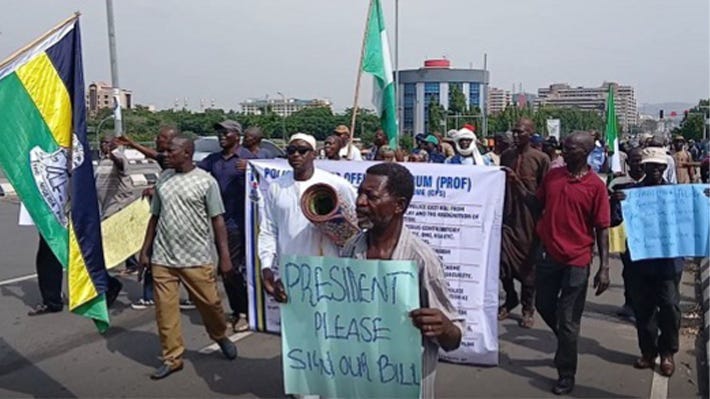
The retired police officers who stood their ground in Abuja last week were not asking for a favour. They were asking for the pension they were promised. Army personnel reportedly threatened to shoot, and the retirees did not move. The Inspector-General has since proposed a 200 per cent gratuity increase, but it is a proposal, not a policy, and it awaits a presidential committee. These are men and women who spent their careers guarding a state that now treats their retirement as an administrative inconvenience. The pension crisis is not new. Retirees blocked the National Assembly in 2021 and disrupted Lagos traffic in 2023. Each time, a proposal is made. Each time, the wait continues. A state that cannot pay the people who kept its peace has no business asking anyone to trust its promises.
The same week, some people outside Chatham House in London held placards that said “INEC, save our democracy.” Their anger is real, and I understand it. But a placard in London does not transfer to a polling unit in Kano or Ondo. Go home and vote. If you cannot go home, call ten people in your village and make sure they do. High turnout is the only anti-rigging technology that works at scale. And while the protesters shout, the president has set a 1.2 million vote target for Ondo State, which has roughly two million registered voters. As we argued in “The fallacy of the 10-million-vote target,” this spreadsheet mentality reduces voters to digits and strips them of agency. As “Okpebholo shouts APC, crowd stays silent” showed in Edo, promising every registered voter is a confession that you have no idea how to earn a single real vote. The placard is not a ballot. The target is not a turnout.
The violence is now national. Thugs attacked Rabiu Kwankwaso’s convoy in Bichi, Kano, injuring team members and damaging seven vehicles, and the police had not reacted. A day after protesters stoned President Tinubu’s convoy in Abuja, Plateau residents booed his motorcade at an APC rally. Two hostile receptions in two days is a pattern, not an accident. The president has ordered a crackdown, but the test is whether opposition convoys get the same protection as his own. An attack without arrests is an invitation for the next one.
The governance failures stack up like the refuse in Iyana-Iba, where mountains of garbage have annexed the verges and the state’s response remains reactive while Lagos generates over 13,000 tonnes of waste daily. Opposition parties are navigating internal rifts that could cripple any credible third force before 2027. The AKK pipeline is 95 per cent complete, but a Kano firm is protesting a land takeover worth over ₦2 billion, a reminder that a pipeline can deliver gas but cannot deliver trust if the land it crosses is taken without fair compensation. S&P has cast doubt on Nigeria’s ability to reach investment grade by 2029, citing a thin revenue base that no reform slogan can wish away. The Senate has set a 15 November deadline for the remaining six state assemblies to vote on the State Police Bill, after 30 states approved it.
So here is where we are. The retiree waits for a pension that is always a proposal. The protester shouts into a London wind while the vote target is manufactured in Abuja. The convoy is attacked, the crowd boos, and the crackdown is ordered. The pipeline is built, the land is taken, and the rating agency does the maths. And the foreign ministry warns that the air in Addis Ababa is thin, because even the altitude is a reminder that some journeys require preparation this country has not made. The ballot is louder than the placard. The pension is louder than the proposal. And the queue at the polling unit, when it is long enough, is louder than both.
Warmly,
Lolade