


Good morning,
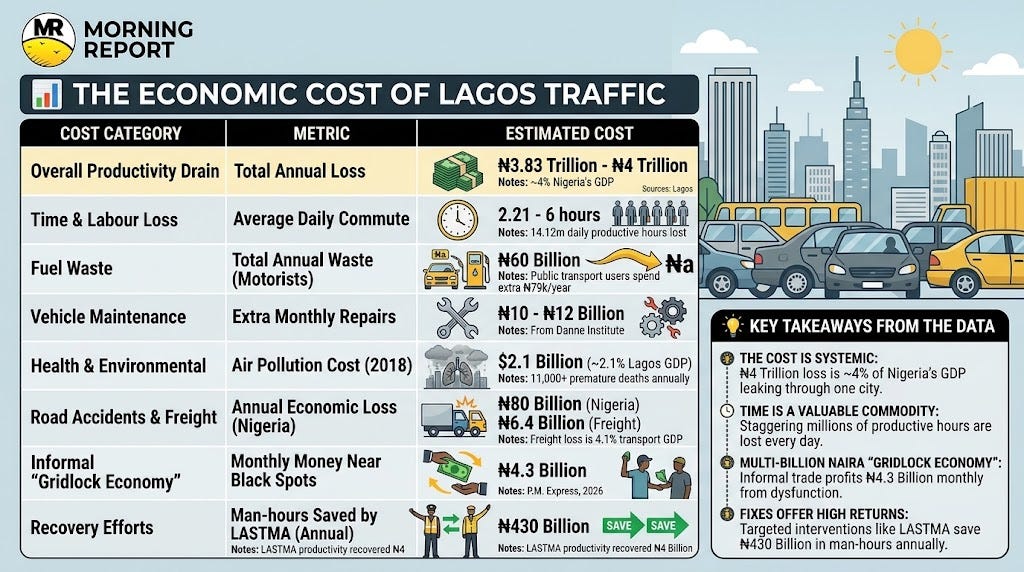
A container truck crashed at Kara Bridge on Tuesday afternoon. The bridge was already narrowed by expansion joint repairs, both directions squeezed through a single partitioned section. The truck suffered brake failure. The container slammed into concrete barriers and overturned, blocking the corridor outward Lagos. Three casualties. Between four and five hours to clear the wreckage. By the time the steel was hoisted away, the backlog had bled past Berger, swallowed the Longbridge and reached Alausa. The corridor carries 250,000 vehicles daily. It was reduced to a single, immovable knot. Drivers abandoned their lanes and drove against oncoming traffic. Within an hour, both sides were wedged into a physical knot. Stranded commuters stepped out to direct traffic. When citizens become the state, the state has already failed.
While the expressway was collapsing, the National Assembly was packing up. Both chambers resume on September 29 after renovation works that have dragged on through leaking roofs, abandoned contractors and a 2022 fire. The optics are not lost on Nigerians. This is one of the most expensive legislatures in the world relative to the size of the economy. The 2022 Electoral Act was a genuine reform. The 2024 and 2025 sessions saw minimal high-impact legislation. Security, tax reform and electoral integrity sit on the table. So does the Foreign Aid Bill, which civil society opposes over its implications for civic space. A renovated complex is a small thing. A functioning one is the test.
Inflation eased marginally to 15.39 per cent in August, down from 15.43 per cent in July, according to the National Bureau of Statistics. Food inflation slowed sharply, offering some relief to households that have watched the cost of rice, tomatoes and garri climb relentlessly. The naira remained relatively stable. On paper, the direction is right. In practice, the gap between headline statistics and household survival remains wide. A 0.04 percentage point decline is not a rescue. It is a pause.
In Lagos markets, Igbo traders are protesting Chinese nationals selling directly to consumers. Their slogan is blunt: “Chinese must leave our market and go back to their country.” The complaint is structural, not ethnic. Nigerian retail operates on layered distribution: importers, wholesalers, retailers, each taking a margin. Chinese traders bypass the chain because they have direct access to manufacturing in China. The cost gap is about supply chain integration, not nationality. Expelling the Chinese will not fix it. Regulating retail and building direct import capacity for Nigerian traders might. And there is a political dimension. Igbo traders are a significant voting bloc in Lagos. The 2027 elections are approaching. The risk is that economic grievance becomes ethnic mobilisation. Nigeria has seen that film before.
And in Bauchi, Senator Shehu Buba has submitted himself to the DSS, police and DIA over banditry and terrorism financing allegations. The senator, who represents Bauchi South and is the PRP governorship candidate for 2027, challenged his accusers to produce evidence. “I have nothing to hide,” he said. The allegations first surfaced in 2014, were investigated and debunked, and resurfaced during an election cycle. The pattern is familiar. Unresolved allegations damage Nigerian politics more than any verdict. If the agencies find nothing, his accusers should face consequences. If they find something, he should face prosecution.
A truck paralyses the economy’s main artery. Legislators return to a renovated complex while agencies evade scrutiny. Inflation pauses but does not retreat. Traders protest competition they cannot match. A senator submits to investigation while his accusers stay hidden. These are not separate stories. They are the same story: a country where infrastructure is fragile, institutions are performative, the economy treads water, competition becomes ethnic, and allegations replace accountability. The question is whether we will build systems that work, or simply keep directing traffic while the bridge collapses.
Warmly,
Lolade