


The Lagos-Ibadan Expressway did not slow on Tuesday, 15 September 2026. It suffered a catastrophic systemic failure. A 40-foot container truck crashed at Kara Bridge. The bridge was already narrowed by expansion joint repairs. The crash turned a routine afternoon commute into a multi-kilometre parking lot. Tens of thousands of commuters lost their day. Billions of naira in productivity evaporated. The corridor that carries 250,000 vehicles daily was reduced to a single, immovable knot.
The mechanics
The crisis began shortly after 1:00 pm. A truck loaded with a 40-foot container suffered brake failure near an expansion joint. It careened out of control on the right-hand side of the corridor inward Mowe. The container slammed into concrete barriers and overturned. It blocked the corridor outward Lagos and violently constricted flow.
The Lagos State Traffic Management Authority (LASTMA) documented three casualties. They were taken to an emergency centre. Recovery teams took four to five hours to right the trailer and clear the debris. By the time the steel wreckage was hoisted away, the damage was irreversible. The backlog had bled past Berger, swallowed the Longbridge and reached Alausa.
The crash did not occur in a vacuum. On 8 September 2026, the Federal Ministry of Works began a two-week rehabilitation of Kara Bridge expansion joints. To accommodate contractors, authorities introduced lane restrictions and a counterflow arrangement. Both directions squeezed through a single partitioned section of carriageway. When the container overturned across the open section, the diversion collapsed instantly. The roadway had zero buffer capacity.
Dr Olufemi Damilola Oke-Osanyintolu, Permanent Secretary of the Lagos State Emergency Management Agency (LASEMA), said preliminary investigations revealed a mechanical fault. “The Agency immediately activated its incident management protocol,” he said. He urged operators of articulated vehicles to maintain their vehicles and comply with roadworthiness regulations. The appeal was correct. It was also late.
The anarchy of impatience
As minutes stretched into hours, discipline disintegrated. Commercial bus drivers, private motorists and haulage operators abandoned their lanes. They veered onto the median and drove against oncoming traffic to bypass the bottleneck. The counterflow gamble backfired. One-way drivers drove head-on into vehicles emerging from the designated diversion at the foot of Kara Bridge. Within an hour, both sides were wedged into a physical knot. Emergency recovery vehicles found themselves hemmed in by four parallel lanes of vehicles facing the wrong direction.
Babatunde Akinbiyi, spokesperson for the Ogun State Traffic Compliance and Enforcement Agency (TRACE), identified driver indiscipline as the accelerant. “Aside from the ongoing construction works, the acute impatience on the part of drivers has resulted in total gridlock,” he said. He called on motorists to adhere to designated lanes rather than compounding the crisis.
When commuters become the state
By late afternoon, the paralysis overwhelmed official deployments. Stranded alongside LASTMA wardens, TRACE operatives, Federal Road Safety Corps units and police personnel, ordinary citizens stepped into the breach. Corporate executives in business attire, commercial drivers and artisanal workers disembarked to direct traffic. They stood in the middle of the highway and forced counterflow motorists to back down.
Broadcast journalist Igbalaniyi Omoniyi, reporting live for News Central TV, described the scene. “Stranded commuters themselves had to step out and act alongside officials to untangle the bottleneck,” he said. For these commuters, taking to the asphalt was not civic idealism. It was survival. Fuel tanks were running dry. Radiators were overheating. Evening was falling on a corridor notorious for robberies when traffic halts.
The human toll
A journey that normally takes 20 minutes between Ojodu-Berger and Mowe became a five to eight hour ordeal. Families were stranded without water. Corporate workers watched their hours evaporate inside unmoving vehicles. Supply chain logistics between Lagos ports and Ogun State industrial zones ground to a halt.
One exhausted commuter said: “We have been stuck here since early afternoon with nowhere to turn. A single vehicle breakdown has paralysed an entire region, and thousands of us have lost our entire working day to the asphalt.”
Where municipal mobility failed, a predatory shadow economy surfaced. Commercial motorcyclists, known as okada riders, threaded the gaps between concrete barriers and unmoving bumpers. Fares for distances under a kilometre, normally ₦200 to ₦300, exploded. A stranded private driver said okada riders demanded between ₦1,000 and ₦2,000 to carry a passenger from the Longbridge across Kara to Berger. “You either paid their ransom or remained trapped in the fumes until midnight,” he said.
The systemic reckoning
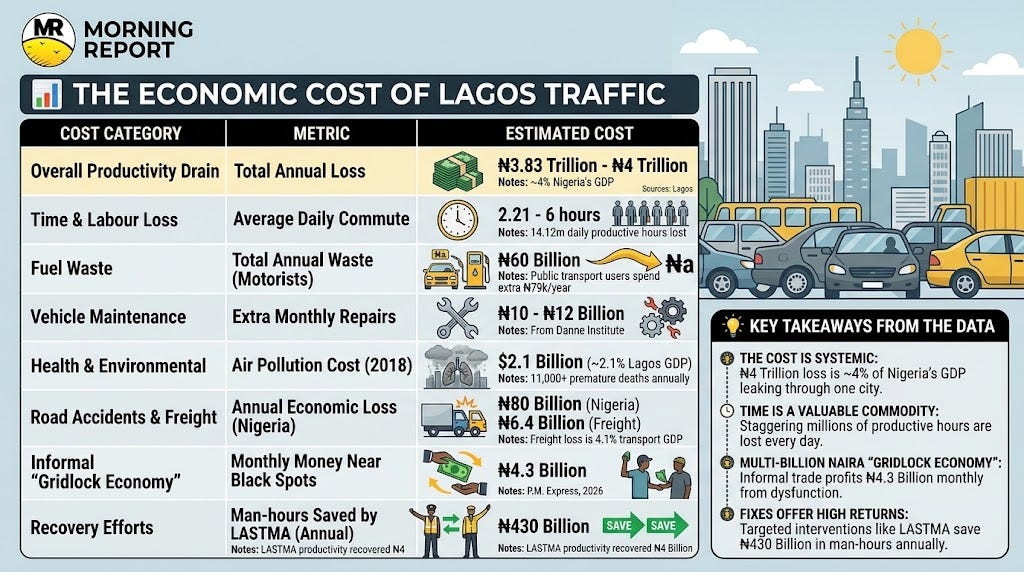
The paralysis of 15 September 2026 was not a freak incident. It was an inevitable stress fracture. The Lagos-Ibadan Expressway carries an estimated 250,000 vehicles daily. It is the primary pipeline for maritime cargo from Apapa and Tin Can Island ports heading into the hinterland. It serves hundreds of thousands of white-collar commuters who live in Ogun State border communities and work in Lagos.
The disaster laid bare three policy failures. First, infrastructure work schedules are unforgiving. Conducting bridge repairs on a national artery without paved auxiliary diversions invites disaster whenever a vehicle breaks down. Second, road-unworthy haulage remains an unregulated menace. A single brake failure should not shut down interstate commerce for a third of a day. Third, counterflow enforcement is absent. Without immediate impoundment of vehicles driving against traffic, minor incidents spiral into immovable gridlocks.
This is not the first time the Lagos-Ibadan Expressway has failed its users. In 2018, a tanker explosion at Otedola Bridge killed dozens and paralysed the corridor for days. In 2020, the #EndSARS protests blocked the expressway and exposed how quickly logistics chains collapse when the artery closes. In 2023, flooding at Mowe submerged sections of the road. Each incident followed the same pattern. Emergency response. Public outrage. Promises of reform. Then the next failure. The difference now is the compounding factor of active construction. The bridge was already vulnerable before the truck hit it.
Winners: Okada riders, who extracted extortionate fares from desperate commuters. Recovery contractors, who earn fees for emergency operations. Politicians who can claim to have responded, without addressing the structural causes. The informal economy, which fills the gap when the state fails.
Losers: Commuters, who lost an entire working day. Logistics firms, whose cargo sat idle. Manufacturers in Ogun State, whose supply chains stopped. Families stranded without water or shelter. The Lagos and Ogun state governments, whose traffic management systems collapsed under pressure. The Federal Ministry of Works, whose repair schedule lacked contingency planning. Every Nigerian who pays for the productivity lost on that bridge.
Bottom Line: The Lagos-Ibadan Expressway is one blown brake pad away from total collapse. Until structural maintenance is paired with stringent haulage roadworthiness enforcement and absolute lane discipline, the Kara Bridge disaster will repeat. The bridge is not the problem. The system around it is.