


Good morning,
Fifty-nine years is a long time to wait for an apology. The Federal Government is set to formally acknowledge the 1967 Asaba Massacre, where federal troops rounded up hundreds of men and boys and killed them during the civil war. Estimates range from 500 to over 1,000. Delta State has recognised it. A memorial centre is planned. The Asagba of Asaba says the community has forgiven but will not forget. What they want now is a public apology from a sitting president. The declaration may not include one. Recognition without repentance is a document, not a reckoning.
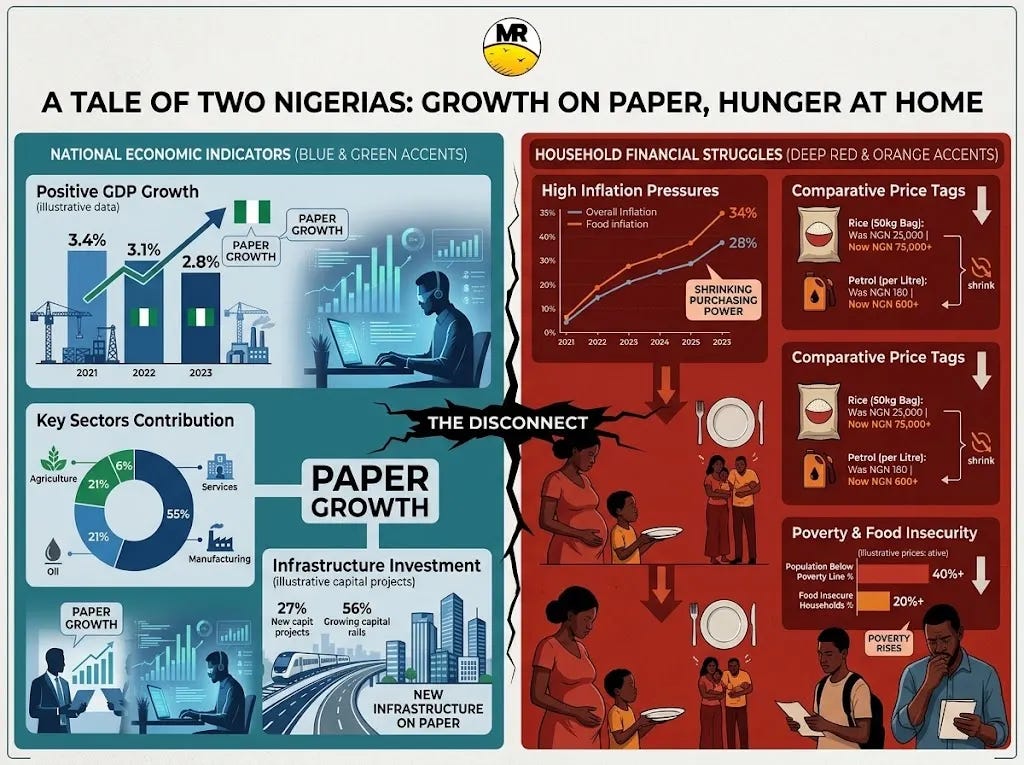
Last week, Odunayo Eweniyi stood before a packed auditorium at OpenHouse Lagos and told us what we already knew but rarely say out loud. Only one in ten Nigerians can raise ₦156,000 in a week for an emergency. The naira has stabilised. Reserves are up. GDP grew 4.43 per cent in the second quarter. And yet 58 per cent of Nigerian adults earn below ₦100,000 a month or have no fixed income at all. A pot of jollof rice consumes 42 per cent of a minimum-wage worker’s monthly pay. Nigerians spend ₦6 out of every ₦10 earned on food, the highest ratio the USDA tracks anywhere. Savings have collapsed. Six in ten have zero emergency reserves. We are told the economy is stabilising while families fight a daily war of attrition.
And the petty cruelties continue to pile up. A Nigerian woman abroad paid over ₦2 million to ship dry fish from home and opened the package to find more sticks than fish. The diaspora sends billions home and buys Nigerian goods because they cannot get the taste abroad, and the trust that trade depends on is being sold for the price of a few sticks. The National Peace Committee logged more than 60 violations of the electoral Peace Accord in a single month, thuggery and destruction of campaign materials and inflammatory rhetoric, and it can document but cannot enforce. Richard Mofe-Damijo told a civic forum that Nigerians must offer constructive solutions, not just criticism. It is a fine sentiment from a man who has never had to spend 60 per cent of his income on food while being told to attend more town halls. Solutions require bandwidth. Complaint is sometimes the only tool the hungry have.
The civil service and the football federation are competing for the same trophy. Monsuru Musa, 33, was caught at NOUN Abuja writing a promotion exam for his father, a 67-year-old FCT Fire Service worker. The father later claimed he would be 60 in 2027. The son said he finished secondary school in 1982. The maths does not math. Meanwhile, the NFF’s petition against DR Congo for fielding an ineligible goalkeeper was delayed because it was sent to an unmonitored FIFA email address. FIFA’s lawyers later found the player ineligible, but dismissed Nigeria’s complaint on a technicality. So FIFA, an organisation that has spent decades perfecting the art of looking away, got to punish Nigeria for not filling in the right form. The NFF sent a World Cup petition to the wrong address. FIFA knew the player was ineligible and did nothing. One is incompetence. The other is corruption. Both cost Nigeria a World Cup. On the brighter side, the 19 kidnapped corps members abducted on the Owerri-Onitsha road have been released from Amakohia Ubi-Ndegwu Forest. The police identified the camp but delayed the operation over fears of explosives. The victims are out. The circumstances are not yet known. Ransom may have been paid. The kidnappers may have walked free.
A high chief in Ondo, Akinwalere Akinola, was shot dead during funeral rites in Ayeka, a stray bullet from a ceremonial firearm discharge striking him in the head. One suspect is in custody. Traditional ceremonies involve guns. Safety is informal. Accidents recur. And Air Peace stranded Lagos-Kano passengers for over 24 hours, postponing a single flight from 7 am to noon to 4 pm and then again, leaving people sleeping on airport chairs. The NCAA reported a 59.9 per cent delay rate in August. Air Peace recorded 71.4 per cent. The regulator publishes the data and rarely sanctions. Passengers have no recourse.
59 years to acknowledge a massacre. A son writing his father’s exam. A petition sent to the wrong email. A flight delayed for a day. A country that has learned to call endurance progress. These are not separate stories. They are the same story: a nation that has normalised the abnormal, and calls it resilience.
Warmly,
Lolade