


Odunayo Eweniyi stood before a packed auditorium at OpenHouse Lagos on 2 October 2026. The co-founder and Chief Operating Officer of PiggyVest delivered a keynote titled “A Tale of Two Nigerias.” She opened with a statistic. Only one in ten Nigerians can comfortably raise ₦156,000 within a single week to meet an unexpected emergency. The room went quiet.
Nigeria has published strong macroeconomic data through 2026. Reserves are at $55 billion. GDP grew 4.43% in the second quarter. The naira has stabilised after the J.P. Morgan and FTSE reclassifications. The Jollof Index by SBM Intelligence has tracked the cost of a single pot of rice for a decade. It has risen 624%. Household income has not kept pace. The gap between national accounts and family ledgers is now the defining economic fact.
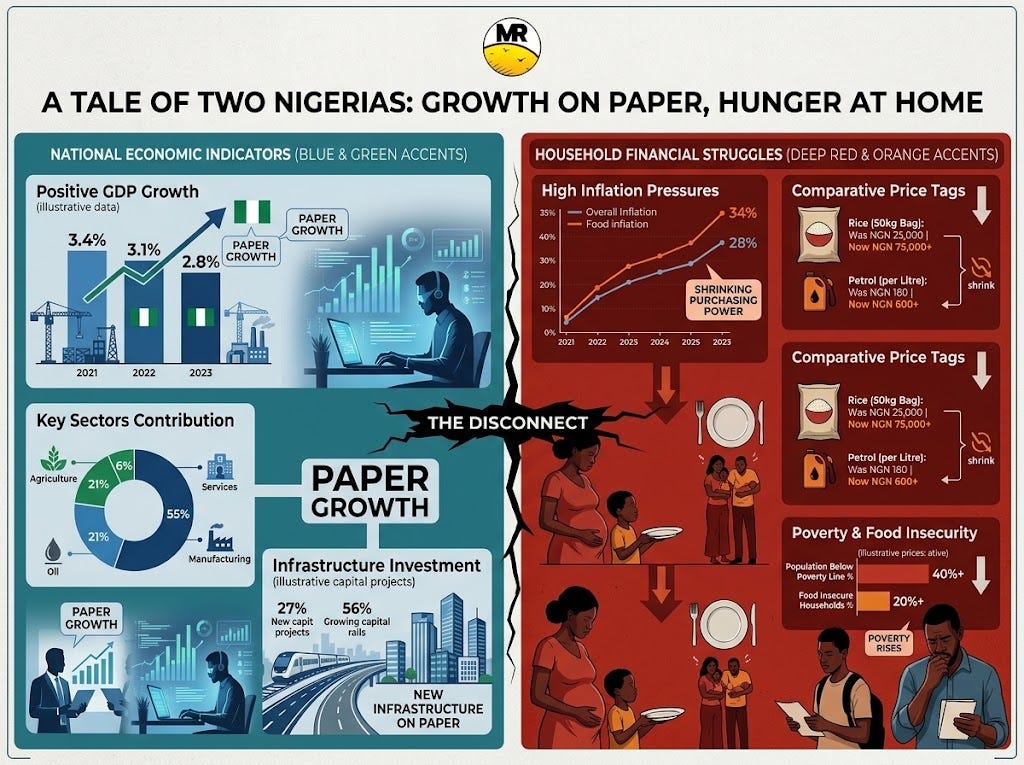
The decoupling
“We are witnessing a profound decoupling between economic metrics and human lived experience,” Eweniyi said. “When you look at the top-line numbers, the foreign reserve balances, or the corporate earnings reports, you see an economy undergoing structural stabilization. But when you look at the household ledger, you see families fighting a daily war of financial attrition. The average Nigerian is earning numerically more money than at any point in history, yet feeling systematically poorer every time they step out to purchase basic goods.”
Dr Temitope Babalola, a Senior Development Economist at the Lagos Economic Study Group, offered context on 3 October 2026. He said nominal wage increases without price stability create a psychological illusion of progress. When energy, transport and food costs rise faster than wages, household capital drains. Routine events become catastrophes. That is the reality for nine in ten Nigerians.
The wage illusion
In 2024, the federal government raised the minimum wage to ₦70,000 a month. It was double the previous ₦30,000. The gain was wiped out. In 2023, ₦30,000 was worth about $65. Today, ₦70,000 translates to roughly $53. Real international purchasing power has fallen. Worse, 58% of Nigerian adults earn below ₦100,000 a month or have no fixed income at all.
The dinner table shows the damage. A standard pot of jollof rice now consumes 42% of a minimum-wage worker’s monthly pay. The United States Department of Agriculture tracks food-to-income ratios. Households in advanced economies spend under 10% of income on food. Nigerians spend ₦6 out of every ₦10 earned. That is 60%. It is the highest ratio of any nation the USDA tracks.
“When you spend sixty percent of what you earn just to keep food in your children’s stomachs, you are no longer living; you are operating in a permanent state of triage,” said Adeleke Ojo, a private-school teacher and father of two, who attended the conference. “You buy a bag of rice today, and by next week the market price has shifted again. How do you plan for your children’s future when dinner tonight consumes nearly half your monthly wage packet? You end up cutting out meat, cutting out fruit, and praying nobody falls ill.”
The savings collapse
The PiggyVest Report shows savings behaviour has broken down. The share of Nigerians actively saving has fallen from eight in ten a few years ago to barely five in ten today. The reason is simple. People do not earn enough to leave anything behind. Six in ten Nigerians have zero emergency reserves. With 63% of the population, roughly 140 million people, living in multidimensional poverty, there is no cushion left.
Mrs Yewande Akintola, a textile retailer in Balogun Market, described how this ripples through commerce. She spoke on 3 October 2026. Working-class customers who once bought clothes for celebrations now spend everything on food and transport. Her own business savings have gone to electricity tariffs and shop rent. She has no buffer if sales slow for a week. “Market women are no longer taking out daily contribution loans because nobody is certain they can generate enough sales to meet the repayment schedule,” she said.
The Black Tax retreat
One cultural casualty stands out. “Black Tax,” the voluntary support urban earners send to extended family, has dropped by 80%. The reduction does not signal a decline in filial responsibility. Over half of earners still try to support relatives. It reflects depleted capacity.
“It breaks your heart to tell your family that you cannot send money for baseline medicine or a sibling’s school fees,” said Nkechi Nwosu, a mid-level marketing executive in Ikeja, on 2 October 2026. “In the past, you worked, saved a little, and shared the rest. Today, after paying ₦60,000 for estate electricity, buying basic food items at inflated prices, and paying commuting costs to the office, there is literally nothing left in your account by the third week of the month. You want to fulfill your duties as a child, but you cannot give what you simply do not have.”
The Japa pivot
The Japa wave has changed shape. More Nigerians want to leave. The share expressing a wish to emigrate has risen. But savings earmarked for Japa have cratered. The cost of foreign tuition, visa fees and air tickets has risen beyond reach. For millions, emigration is no longer a plan. It is a fantasy.
Chuka Ezekwesili, a 27-year-old software developer in Yaba, spoke on 3 October 2026. He said the era of casual migration planning is over. Airfares and foreign tuition quadrupled in naira terms. Young tech workers realised fleeing was not realistic. They are now building local startups, forming buying clubs and investing in skills. “Young people are choosing to fight for their space in Nigeria rather than remaining in a state of perpetual paralysis,” he said.
The hopeful anomaly
Amid the grim data, the report found an anomaly. Six per cent of Nigerians report feeling genuinely financially secure. Their stability does not come from high earnings. It comes from saving a fixed amount every month, regardless of market volatility. Discipline, not income, separates them from the rest.
Winners and Losers
Winners: The six per cent who save consistently. Fintech platforms like PiggyVest, which profit from savings habits. Food importers and traders, who benefit from inelastic demand. Landlords in prime areas, who collect rent from the formal sector.
Losers: The 90% who cannot raise ₦156,000 in a week. The 140 million living in multidimensional poverty. Minimum-wage workers, whose pay buys less than it did in 2023. Extended families, who lose remittances. Market traders, whose customers have no disposable income. Aspiring emigrants, who cannot afford to leave. Parents cutting protein from meals. The economy, which depends on consumption that households can no longer afford.
Bottom Line
Eweniyi closed with a warning. Nigeria is two countries. One shows structural growth and rising corporate yields. The other spends 60% of earnings on food while savings vanish. Policy has not bridged the gap. Until interventions translate into real purchasing power, lower food costs and stable living expenses, resilience will rest on the quiet determination of Nigerians saving what little they can and insisting on hope against daunting odds.