


Good morning,
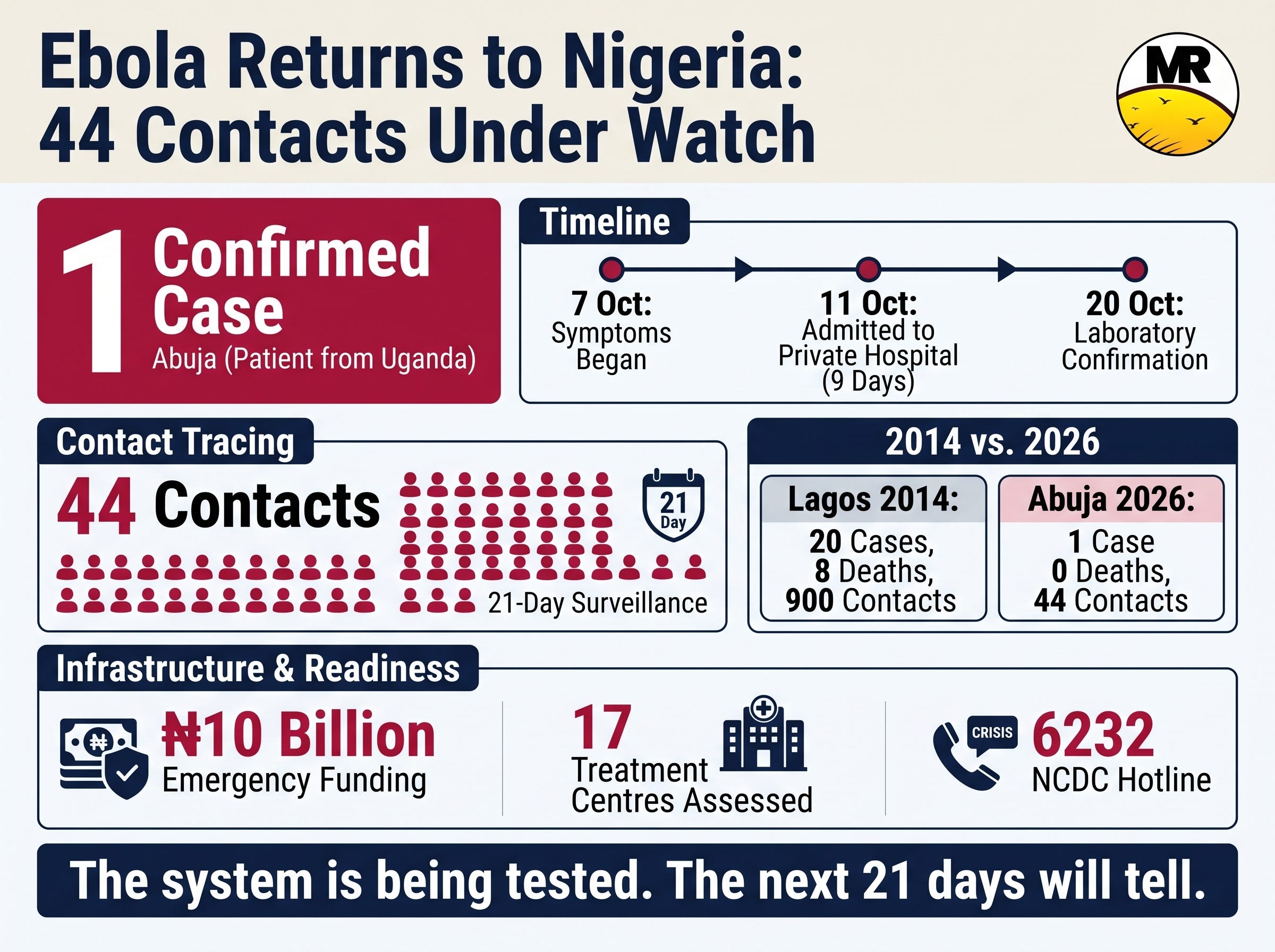
The word does something to Nigerians of a certain age. Ebola. It brings back July 2014. The whispers in market squares. The hand sanitisers at every door. The realisation that a man had landed at Murtala Muhammed with a virus that kills most of the people it touches. On 20 October 2026, the federal government confirmed a new, isolated case in Abuja. A woman arrived on a flight from Uganda, sought treatment at a private hospital, and spent several days there before anyone tested for Ebola. Forty-four contacts are now under surveillance for twenty-one days. Screening at points of entry catches temperatures, not incubating viruses. The system depends on a doctor asking the right questions. In 2014, it was Dr Stella Ameyo Adadevoh who recognised the clinical picture, blocked Patrick Sawyer from leaving, quarantined him, and died on 19 August. Her decision contained the index patient in one facility. Nigeria recorded 19 confirmed cases, mostly healthcare workers, and eight deaths. The question now is whether the machinery is strong enough, and whether anyone still remembers what it cost the last time we got it right.
Six years after the Lekki Toll Gate shootings, the state still cannot face the dead. On Tuesday morning, police fired tear gas at the sixth anniversary memorial, scattering the Enough is Enough procession before the wreaths could be laid. Gbadebo Rhodes-Vivour and Funso Doherty, both governorship candidates, were caught in the gas. Journalists were obstructed. The Lagos police have offered no explanation. And as the anniversary unfolded, an old clip resurfaced: President Tinubu, four days after the shootings, asking, “Those who suffered gunshot at Lekki toll gate, need to answer some questions too. Why were they there? What kind of characters are they?” The panel confirmed at least eleven deaths. The victims cannot answer. They are dead. The state treats remembrance as a security threat, and the rest of us are left to wonder what that says about a government preparing to ask for votes in 2027.
In Kano, the doctors who are supposed to save us are dying younger. The Nigerian Medical Association’s state branch warned this week that long hours, heavy caseloads and thin resources are pushing physicians towards burnout, cardiovascular disease and premature death. The ratio is about one doctor to 9,000 patients. The WHO recommends one to 600. About 16,000 doctors left the country in five years. Those who remain carry the weight of those who left. “Saving the savers is not merely a professional welfare issue; it is a patient safety and public health priority,” Dr Abubakar Nagoma Usman said.
Meanwhile, JPMorgan Chase has deposited ₦50 billion, about $38 million, with the Central Bank as one of the final steps towards a merchant banking licence. It has been in Nigeria since 1961, operating only a representative office for decades. Now it wants deposits, trade finance and corporate lending. Foreign capital sees a stabilised naira, reserves above $55 billion, and a recapitalised banking sector. The money is confident. The doctors are exhausted. That is the shape of the recovery we are being sold.
The smaller stories carry the same contradictions. In the FCT, Police Commissioner Ahmed Sanusi met farmers and herders in Dabiri and Paiko after a security breach, urging dialogue and asking community leaders to hand over the attackers. The meeting is a start. The attackers are still at large. On a Lagos bus, two passengers traded insults until the driver parked, let everyone out, and allowed them to settle it with a brief fight before continuing the journey. Nobody was hurt. Lagos laughed. The city’s stress is real, and so is its ability to absorb it. But the electoral system is less funny. Former INEC commissioner Mike Igini warned that politicians infiltrate NYSC lists with fake identities, sew uniforms for impostors, and deploy them as presiding officers. And a lawmaker has alleged that Section 63(2) of the Electoral Act could allow presiding officers to accept ballots without INEC security marks. One claim is unproven. The other is a hole in the law. Both point at 2027.
A virus that arrived on a plane. A memorial dispersed with gas. A doctor burning out. A bank paying its way in. A bus that stopped so two men could fight. These are not separate stories. They are the same story: a country that remembers what it should forget and forgets what it should remember, and keeps moving because standing still is not an option.
Warmly,
Lolade