


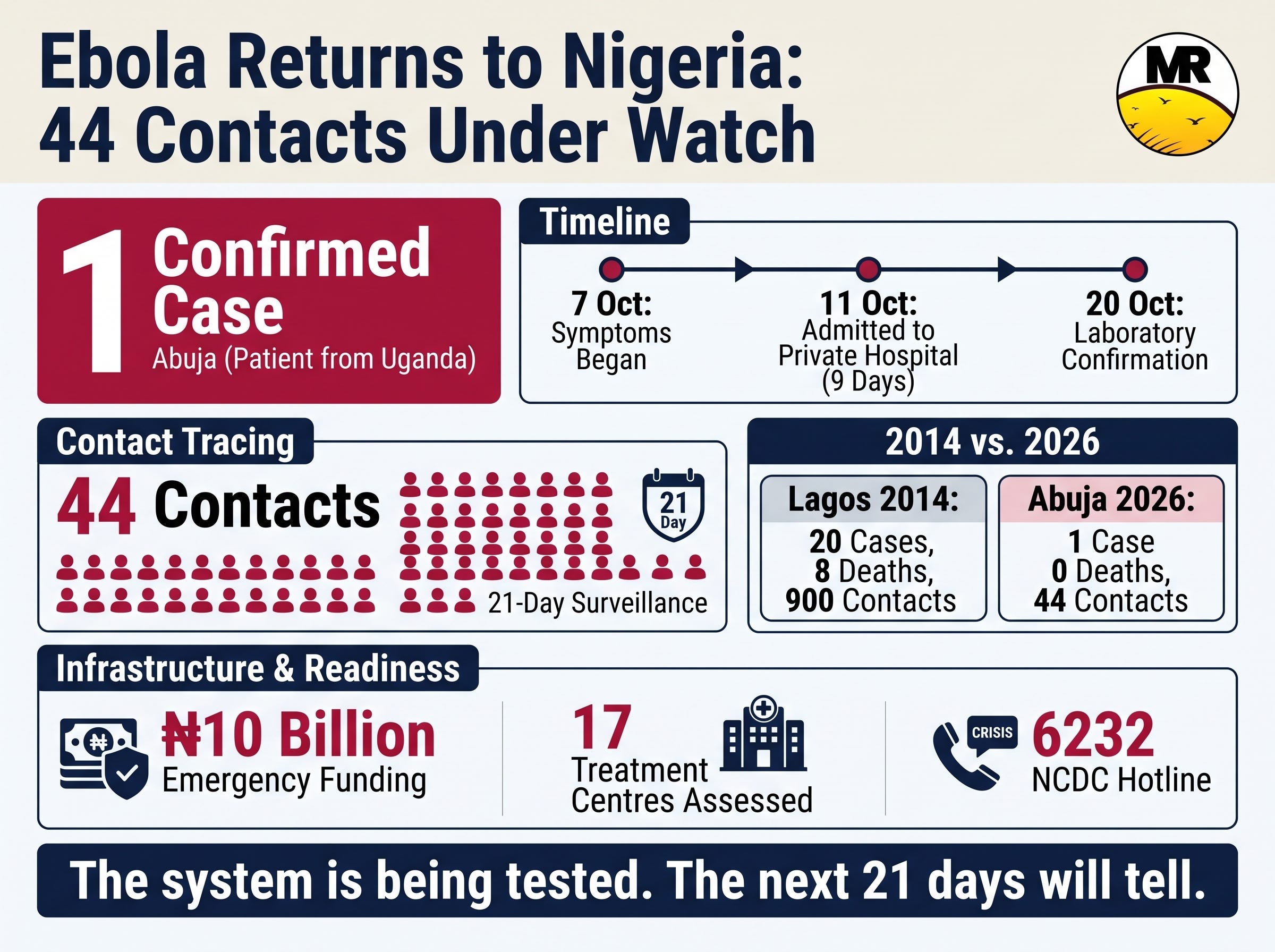
The word does something to Nigerians of a certain age. Ebola. It brings back July 2014. The whispers in market squares. The hand sanitisers at every door. The realisation that a man had landed at Murtala Muhammed with a virus that kills most of the people it touches. On 20 October 2026, the federal government confirmed a new, isolated case of Ebola Virus Disease in Abuja. The memory came back with it.
The Coordinating Minister of Health and Social Welfare, Professor Muhammad Ali Pate, announced the case. He said the patient is a woman who arrived on an international flight from Uganda. She sought treatment at a private hospital in the Federal Capital Territory before her diagnosis was confirmed. She is now in isolation. The machinery of the state has been activated. The question is whether the machinery is strong enough.
The case
Officials describe the infection as imported, not community transmission. That distinction matters. It means the virus arrived on a plane, not in a neighbourhood. The patient passed through standard entry points. Port Health Services and the NCDC had been on heightened alert following a regional outbreak in East Africa. The alert did not stop her. She spent several days in a private facility before anyone tested for Ebola.
That gap is the first lesson. Screening at points of entry catches temperatures, not incubating viruses. A patient can walk through an airport and into a hospital with no symptoms that trigger alarm. The system depends on clinicians asking the right questions. Travel history. Fever. Fatigue. Vomiting. Unexplained bleeding. If a doctor in Abuja does not ask, the virus moves.
Officials have not published the flight details or the name of the hospital. They have not said how many days passed between arrival and isolation. Those are the details that determine whether this remains one case or becomes a cluster. The public should get them.
The 44 contacts
Health authorities have placed 44 people under surveillance and isolation for three weeks. That is 21 days, the maximum incubation period of the virus. The contacts include healthcare workers, patients, caregivers and people who travelled with the patient. They remain in contact with their families by phone. Their physical movement is restricted. The government has ramped up infection prevention and control support at the private hospital where the patient was first treated. Medical personnel who interacted with her before isolation are among the 44.
The NCDC has reactivated its public advisories. It has urged citizens to report unexplained symptoms or potential exposure through its toll-free line, 6232, which runs 24 hours a day. That line is only as good as the public trust behind it. In 2014, trust was built by transparency. People believed the updates because the officials sounded like they knew what they were doing. The same is needed now.
The ghost of Obalende
It is impossible to discuss Ebola in Nigeria without discussing Dr Stella Ameyo Adadevoh. In July 2014, Patrick Sawyer, a Liberian-American, collapsed at Lagos airport. He was taken to First Consultants Medical Centre in Obalende. He denied he had Ebola. He was hostile. He tried to leave. Adadevoh, a senior endocrinologist, recognised the clinical picture. She resisted diplomatic pressure to discharge him. She physically blocked him from leaving the premises. She quarantined him. She contracted the virus herself. She died on 19 August 2014.
Her decision contained the index patient in one facility. Nigeria recorded 19 confirmed cases and seven deaths. The World Health Organisation called the response exemplary. Without Adadevoh, West Africa’s most populous city could have become an urban catastrophe. She is the reason the word Ebola does not automatically mean mass death in Nigeria. She is also the reason the current case feels so personal to so many people.
The parallels are uncomfortable. Both cases arrived by air. Both were first seen at a private hospital, not a public infectious disease centre. Both depended on a clinician’s alertness. The difference is the system around the clinician.
What has changed
In 2014, Adadevoh and her colleagues operated with improvised protective gear and primitive screening. They had no national rapid response teams. They had no digitised contact-tracing network. They had no NCDC with a standing mandate. They had courage and clinical instinct, and that was nearly not enough.
In 2026, the FCT hospital operated inside a national framework. The NCDC exists. Rapid response teams exist. Molecular laboratories exist. Contact tracing can be mapped within hours of a laboratory confirmation. The 44 contacts were identified and placed under surveillance quickly. That is progress. It was built after 2014, tested by COVID-19, and hardened by recurring Lassa fever and cholera outbreaks.
But progress has gaps. A patient spent days in a private facility before diagnosis. That suggests either the clinician did not ask about travel, or the patient did not disclose it, or the symptoms were ambiguous. Each possibility requires a different fix. Continuous training in infection prevention and travel-history interrogation is not optional for every clinician in the country. Private hospitals are the first port of call for middle-class Nigerians. They are also the weakest link in the surveillance chain.
Winners and Losers
Winners: The NCDC, which activated surveillance early. The Federal Ministry of Health, which moved quickly once the case was confirmed. Health workers at the private hospital, who are now under monitoring but who also triggered the alert. Port Health Services, which had been on alert. The public, if containment holds. Dr Adadevoh’s legacy, which is honoured every time a clinician asks the right question.
Losers: The patient, who faces a dangerous illness. The 44 contacts, who face three weeks of anxiety and restricted movement. The private hospital, whose infection control practices will be scrutinised. Nigerians who remember 2014 and feel the old fear return. The health system, if the case exposes gaps it has not closed. The economy, if travel restrictions follow. Public confidence, if the government withholds details.
Bottom Line
One case is not an outbreak. The patient is isolated. The 44 contacts are under watch. The system is stronger than it was in 2014. It is not perfect. A woman with Ebola passed through an airport and spent days in a hospital before anyone tested her. That is the lesson. Screening must be followed by clinical vigilance. Travel history must be asked every time. Private hospitals must be trained and equipped. Nigeria contained Ebola once with courage and improvisation. This time it must contain it with systems. The next three weeks will tell. Dr Adadevoh is watching.