


Good morning,
Queen Joseph ran onto Oluwakemi Adegbuyi’s through ball in the 56th minute and put Nigeria ahead. Awawu Bashiru added two more; Brazil pulled one back with their only shot on target, and the Flamingos beat them 3-1 in Rabat to become the first African team to reach a FIFA U-17 Women’s World Cup final. They face Japan on Saturday. On the same day, Enugu Air secured approval for the Lagos-London Gatwick route, with Omni-Blu Aviation as operator, four weekly frequencies, and flights starting in December. A state-owned airline has found a way to reach Europe without owning a fleet. Two things worked this week. Hold onto them.
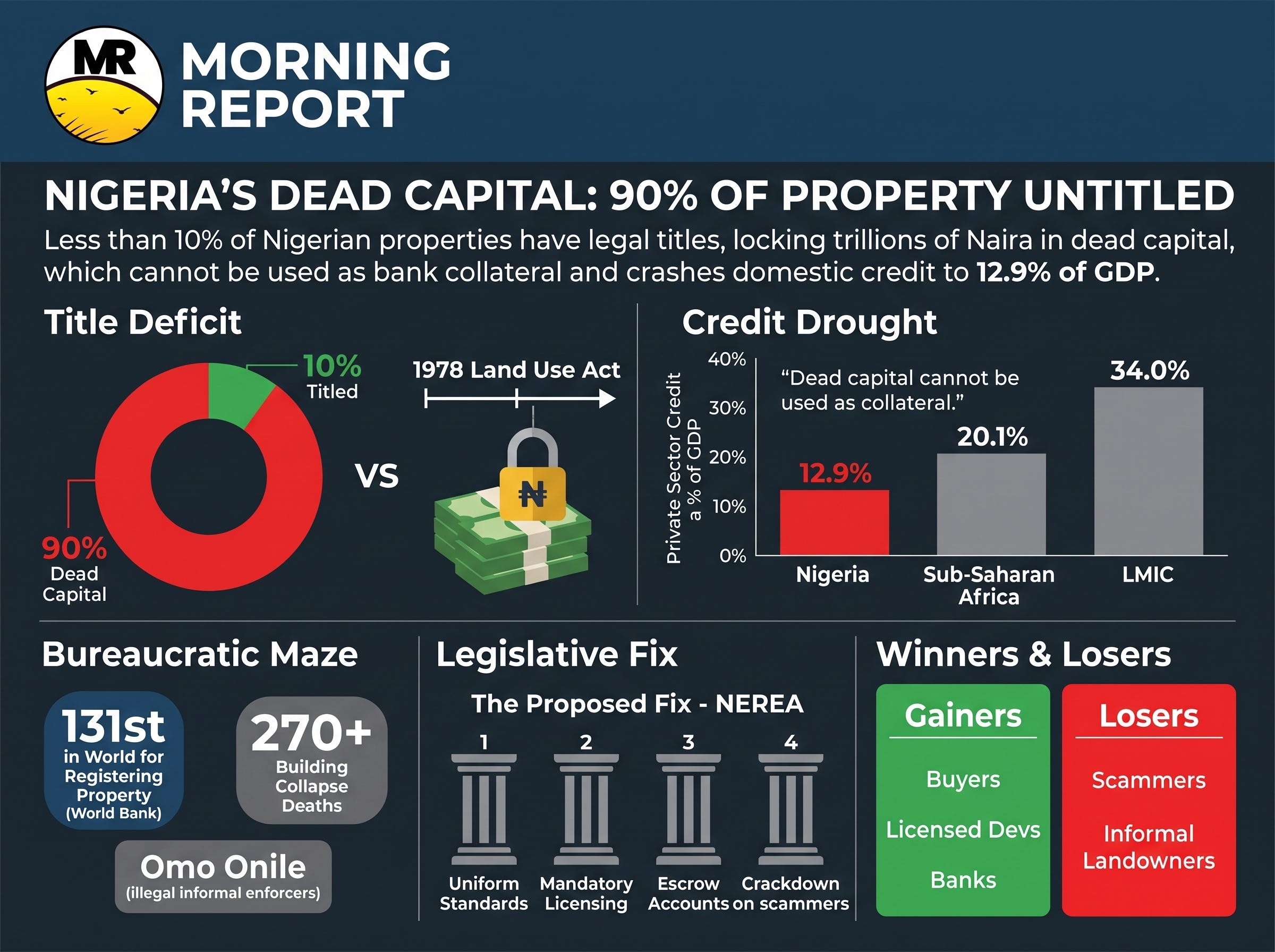
Now the thing that is not working, and has not worked for decades. Fewer than 10 per cent of Nigerian properties have proper, legally verifiable land titles. Armstrong Takang of the Ministry of Finance Incorporated said this at a House of Representatives conference on the proposed real estate regulator. The Land Use Act 1978 vested all land in governors, held in trust, and the effect was to centralise control behind a wall of Certificates of Occupancy, planning clearances, survey maps and local government consents. The World Bank ranked Nigeria 131st out of 190 for registering property. Domestic credit to the private sector stands at 12.9 per cent of GDP, against a sub-Saharan average of 20.1 per cent and 34 per cent for lower-middle-income countries. Banks cannot lend against what they cannot verify, so millions of Nigerians sit on valuable assets and remain cash poor. A factory owner with a building but no title cannot expand. A homeowner cannot access equity. A developer cannot pre-sell legally. The state loses a tax database, the banks lose a safe asset class, and the economy loses jobs. More than 270 people have died in building collapses because unregulated transactions bypass planning laws. The buildings are real. The paperwork is imaginary. The wealth is dead.
The rest of the week was the usual inventory. Peter Obi and Rabiu Kwankwaso drew thousands in Calabar, paid homage at the Obong’s palace, and had their convoy attacked before suspects were caught and market women intervened to protect the visitors. A video showed an elderly man begging his family to pay ₦500 million in ransom, while troops killed three kidnappers in Kogi’s Edimogoro and Obele forests, and six mourners in Benue paid ₦2.5 million to walk free. Police cybercrime operatives raided a student hostel in Ede in daylight, in mufti, without producing warrants, and the Complaint Response Unit has opened file #CRU100965. And Nasarawa State University’s ambulance is a battered white Peugeot serving 40,000 students, in a state that received ₦16.68 billion in September and whose officials travel in new Prados.
Then there is the Senate President. Godswill Akpabio stood at plenary and shared his burden: politicians cannot find private jets to hire ahead of the 2027 campaigns. “Common campaigns, we cannot see even private jets to hire,” he said, warning that December would bring further confusion. One imagines the nation reaching for its handkerchief. The aviation sector collapsed under the stewardship of men like him, Nigeria Airways died in 2003, and nobody noticed until the campaign calendar required a charter. The candidate who must fly commercial is now a national emergency. The student who must ride in a Peugeot is not.
The State Police Bill is with President Tinubu, transmitted after 29 assemblies approved the amendment, five more than the constitutional threshold. Supporters promise local intelligence and faster response. Critics warn that governors will weaponise the forces, and the safeguards are not written yet. The bill can protect or oppress. Oversight is the difference, and oversight is the thing this country keeps postponing. The Flamingos play Japan on Saturday. The ambulance still needs replacing.
Warmly,
Lolade