


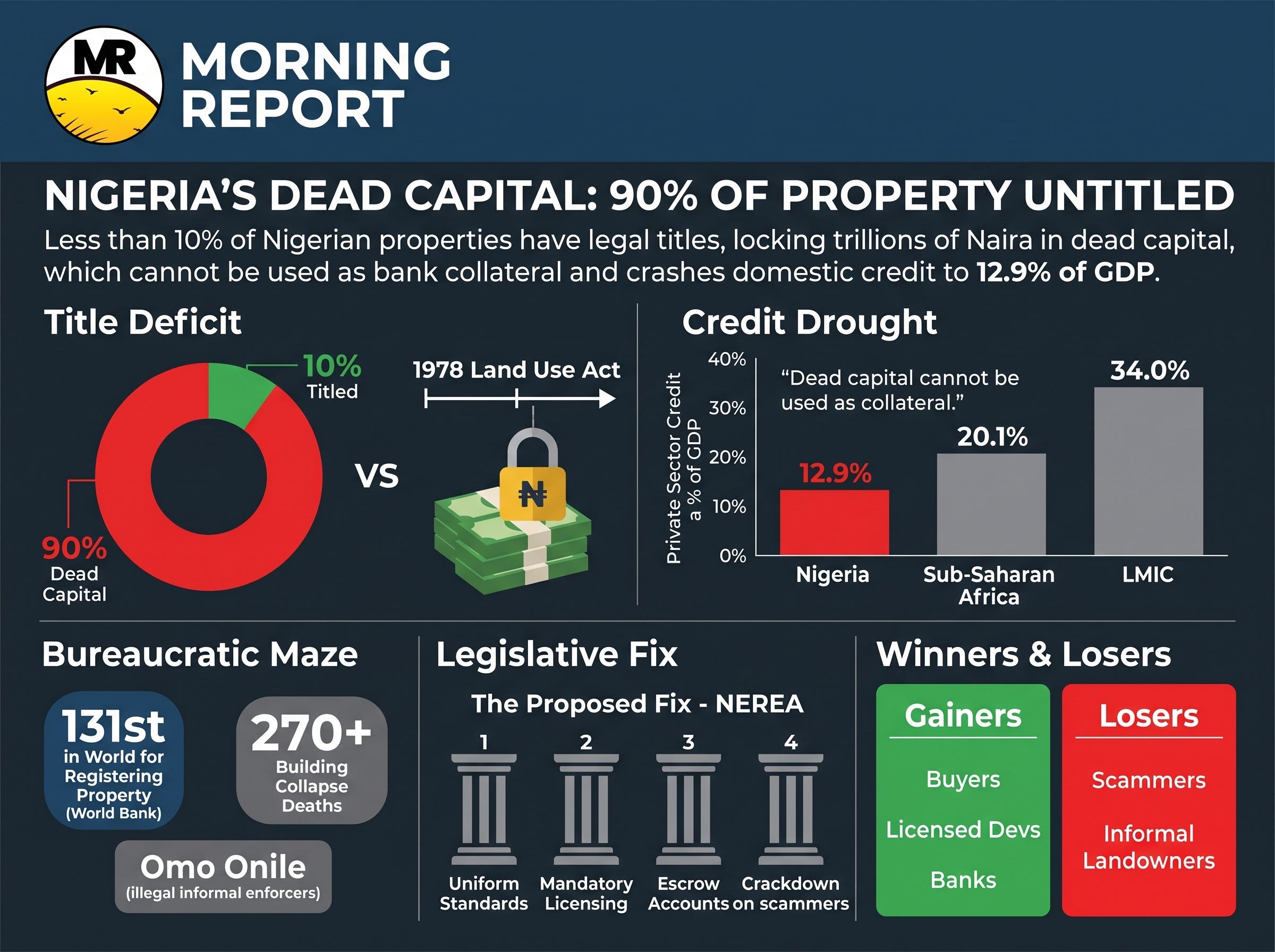
Nigeria is building. Lagos, Abuja, Port Harcourt and Kano are filling with concrete. Plazas rise. Estates spread. Billions of naira go into real estate every year. Then the paperwork fails. Fewer than 10 per cent of Nigerian properties have proper, legally verifiable land titles. That figure was disclosed by Armstrong Takang, Managing Director of the Ministry of Finance Incorporated. He spoke at a stakeholder conference organised by the House of Representatives on the proposed National Real Estate Regulatory Authority. The rest of the property market exists in a legal shadow. It is dead capital.
The Land Use Act 1978 is the root. It vested all land in each state in the governor, held in trust for the people. The intention was to ease public acquisition. The effect was to centralise control. Getting a Certificate of Occupancy requires ministerial approvals, planning clearances, survey maps and local government consent. The process is slow, expensive and prone to corruption. In its 2020 Ease of Doing Business rankings, the World Bank placed Nigeria 131st out of 190 countries for registering property. Lagos State digitised its registry. Other states did not follow. Most transactions remain informal. Buyers rely on agreements, family receipts and documents of uncertain provenance. Title fraud is a thriving industry. Land grabbers, known as Omo Onile, exploit the confusion.
The credit drought
Takang linked the title deficit to Nigeria’s low credit penetration. Domestic credit to the private sector stands at 12.9 per cent of GDP. The sub-Saharan African average is 20.1 per cent. Lower-middle-income countries average 34 per cent. In a working economy, real estate is the main collateral. A clean title lets a business borrow against its property. Without titles, banks cannot accept property as security. Millions of Nigerians sit on valuable assets and remain cash-poor. Their wealth is invisible to the financial system.
Hernando de Soto called this dead capital. Assets cannot be converted into money, traded easily or used as collateral. That is Nigeria’s property market.
The implications are enormous. A factory owner with a building but no title cannot expand. A homeowner cannot access equity. A developer cannot pre-sell legally. The economy loses investment, jobs and tax revenue. The banking sector loses a safe asset class. The government loses a database for planning and taxation.
Building safety
The regulatory void has killed people. Unregulated transactions bypass planning laws. Substandard construction follows. More than 270 deaths from building collapses have been recorded in recent years. The actual figure is higher because many incidents go unreported. The proposed National Real Estate Regulatory Authority aims to address this. The bill is before the House of Representatives. It would set uniform standards for transactions. It would license agents, brokers and developers. It would create escrow accounts to protect buyers’ funds. It would crack down on unlicensed operators who collect deposits and disappear.
The current regulatory landscape is fragmented. Federal housing agencies lack jurisdiction over state and municipal bodies. Duties overlap. Blind spots remain. The new authority would coordinate. It would not repeal the Land Use Act. States control land. The authority can only set standards and enforce them within its mandate.
The human cost
Consumer advocates say the fraud is relentless. Families save for years. They buy a plot. They discover it was sold to three other people. Developers vanish with deposits. Off-plan schemes collapse. Buyers have no recourse because their transactions were never registered.
The proposed escrow requirement would help. It would hold funds until construction milestones are met. It would punish developers who divert money. It would give buyers a legal remedy.
Winners and Losers
Winners: Licensed developers and agents, who gain a clear framework. Banks, if titles become reliable. Property buyers, who gain protection. The Federal Government, which gains a national property database. The economy, if credit expands.
Losers: Unlicensed operators and fraudsters, who face exclusion. Informal landowners, who must formalise. State governments, which cede some discretion. Taxpayers, if the new authority becomes another bureaucracy. The Land Use Act, which remains untouched.
Bottom Line
Fewer than one in ten properties has a title. That is not a housing problem. It is a national wealth problem. Trillions of naira sit in buildings that cannot be banked, sold cleanly or used as collateral. The proposed regulator is a start. It cannot fix the Land Use Act. It can clean up transactions and protect buyers. The National Assembly must pass the bill. States must digitise their registries. Until then, Nigeria’s biggest asset class will remain dead. And the economy will keep paying the price.