


Good morning,
Finally, D’Tigress have been paid! President Tinubu has disbursed $100,000 to each player following their AfroBasket championship victory, fulfilling a pledge made after the team retained the continental title. The payment is a significant financial boost for the players and a moment of recognition for women’s basketball, which remains underfunded relative to its achievements. It also follows a familiar pattern: state cash rewards tied to tournament outcomes, as seen with the Super Falcons in 2023. The cheque has cleared. The question is whether sustained investment in the sport will match the reward.
The same week that D’Tigress were honoured, Peter Obi’s convoy was blocked in Benue. Civil rights groups and opposition leaders have demanded heightened security protocols for political figures after the Labour Party presidential candidate’s convoy was stopped on a major highway. The incident is the latest in a series of actions targeting opposition politicians, and it has revived fears that the 2027 elections could be worse than 2023. The demand for protection is reasonable. The problem is that it is necessary at all.
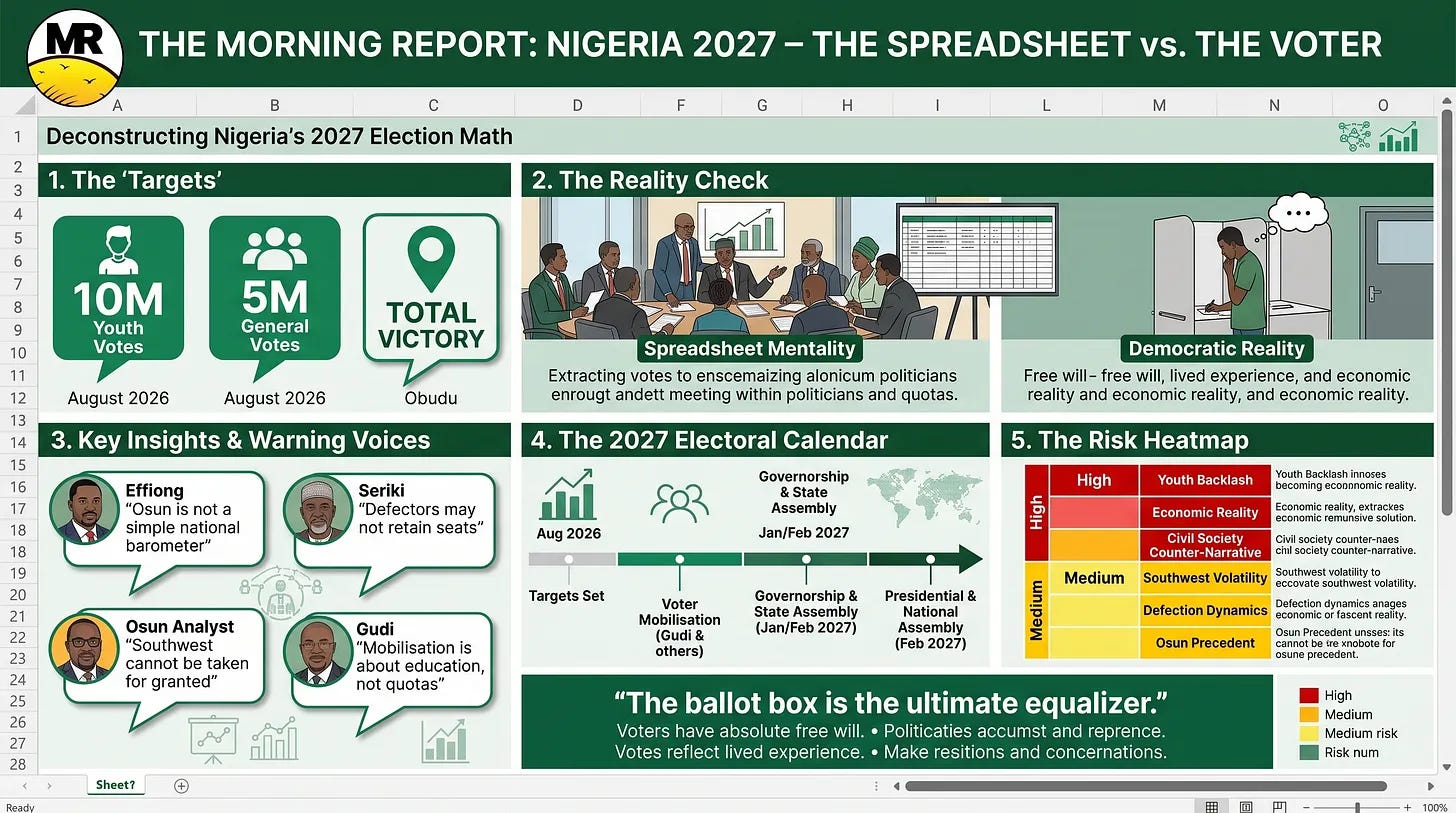
And then there is the pledge. A forum of chief executive officers from federal parastatals has promised to mobilise 10 million votes for President Tinubu’s economic reform agenda. The involvement of civil servants in political mobilisation raises uncomfortable questions about the neutrality of the public service. But beyond the ethics, there is a deeper issue: the arithmetic. Back on August 17, we published a piece titled The fallacy of the 10-million-vote target, arguing that treating voters as digits on a spreadsheet insults the intelligence of a demographic that has spent years navigating economic hardship. We are pleased to report that reality has caught up with our analysis. The parastatal CEOs have simply rebranded the same fantasy: a guaranteed harvest of votes that no one has earned. We saw the future. We just did not expect it to arrive wearing a government ID card.
In Abuja, motorists tried to “hold three cows” after a crash. A herd of cattle caused an accident, and a driver attempted to detain one of the animals as compensation. The image is funny. The problem is not. Cows roam freely on city roads, accidents pile up, and accountability is nowhere. The police say animal control is not their job. The FCT Minister has apologised. The cows remain.
And in Gombe, 22,000 cotton farmers have abandoned the crop for maize, rice and beans. The National Cotton Association says the collapse of ginneries and textile industries, a lack of support programmes, and poor-quality seeds have driven the exodus. Only 3,000 cotton farmers remain in a state that once had over 25,000. The winners are the food crop farmers. The losers are the cotton industry and the thousands who have walked away.
A cheque for champions. A blockade for an opposition leader. A vote target that insults the electorate. A cow held for ransom. A cotton industry in freefall. These are not separate stories. They are the same story: a country where celebration and intimidation sit side by side, where governance is confused with campaigning, where absurdity is routine, and where the ground is shifting beneath the economy. The question is whether we will build a country that works, or simply keep promising votes it does not have.
Warmly,
Lolade