


The concept of the “target” in political campaigns is a corporate import, a Key Performance Indicator slapped onto the messy, organic, and deeply personal reality of human democracy. The recent declaration by the youth leaders of the All Progressives Congress (APC) that they have set a target to mobilise 10 million youth votes for President Bola Tinubu’s 2027 re-election bid perfectly encapsulates this bizarre phenomenon. It paints a troubling picture of a political factory floor where votes are manufactured, packaged, and delivered on demand, rather than a democratic arena where votes are painstakingly earned through verifiable performance and good governance.
This grand ambition inherently strips the Nigerian youth of their civic agency. It reduces a dynamic, multifaceted, and highly intelligent demographic into a monolithic block of guaranteed digits on a campaign strategist’s spreadsheet. The total number of registered voters in the 2023 election was roughly 93.5 million, with the youth comprising a massive, undeniable chunk of that figure. To arbitrarily slice out 10 million as a guaranteed harvest assumes that elections are merely logistical exercises in herding bodies to the ballot box, completely ignoring that elections are, at their core, profound referendums on the socio-economic realities shaped by incumbent politicians.
Young Nigerians have spent the last few years navigating an incredibly complex economic landscape, dealing with the direct fallout of sweeping fiscal reforms, currency fluctuations, and a challenging job market. They are not passive observers of their nation’s trajectory; they bear the brunt of its growing pains. Therefore, the notion that a political youth league can simply leverage social media, grassroots mobilisation, and youth-focused programmes to cleanly win 10 million votes is practically insulting to the electorate's intelligence. It echoes the mobilisation campaigns of 2022, which also sought to secure the youth vote through similar mechanisms, but it fails to recognise how much the political consciousness of the Nigerian youth has evolved since then. A digital engagement strategy or a localised youth programme cannot override people's daily lived experiences. Voters ought to have free will, and their choices in the polling booth will be dictated by their personal assessments of their standard of living, not by the optimistic quotas set during party meetings in Abuja.
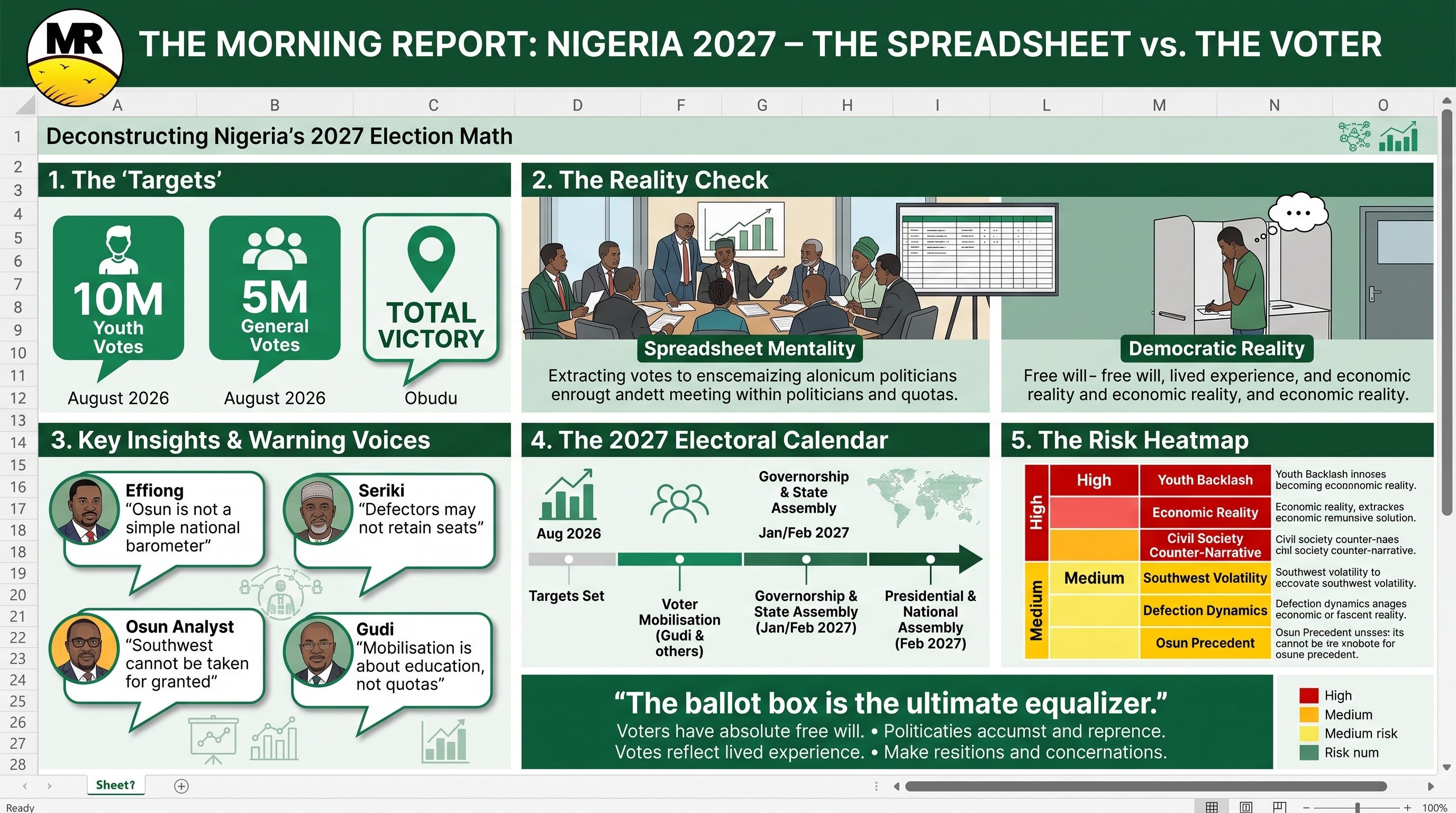
However, this spreadsheet mentality is not an isolated incident; it is a wider symptom of the ruling party’s current strategic posturing as it seeks to consolidate its support base ahead of 2027. Across the country, political structures are being activated with the same top-down numerical arrogance. Just days ago, on August 13, 2026, enthusiastic APC stakeholders officially launched a parallel movement to mobilise five million votes for President Tinubu ahead of the general elections. With canvassers confidently deployed across the 36 states and the Federal Capital Territory, the organisers proudly declared their intention to take the message of the Renewed Hope Agenda directly to the grassroots, framing the President as a detribalised leader entirely deserving of this pre-calculated mandate. The rhetoric is consistently one of absolute certainty and command over the electorate, leaving no room for the unpredictable nature of human choice.
This sentiment was echoed that same day during an interactive session held by the APC chapter in Obudu, Cross River State, where party loyalists gathered to reaffirm their structural unity. During that deeply partisan meeting, Hon. Agabi passionately stressed that the collective interest of the APC must remain far above individual ambitions, setting the tone for a rigid, unified, and uncompromising front. Taking up this mantle of mandated victory, the Obudu APC Chapter Women Leader and the Chapter Youth Leader emphasised the crucial roles of their respective demographics in mobilising support, explicitly demanding that their grassroots structures ensure the APC records a total victory in the 2027 elections. They speak of the electorate not as free-thinking citizens who must be persuaded through debate and policy, but as dormant resources waiting to be extracted by the party machinery.
Yet, this grand architecture of guaranteed vote banks and astronomical targets ignores the fundamental truth of the democratic process: voters possess absolute free will, and their ultimate loyalty is to their own survival, progress, and communities, not to a political party’s internal quotas. The assumption that political machinery and elite alliances can automatically dictate voter behaviour is cracking under the weight of political reality. Analysts observing the political climate ahead of the 2027 polls increasingly point to the fragility of these top-down assumptions. In a sharp August 14, 2026, analysis of the pivotal Osun State off-cycle governorship election by Al Jazeera, an event widely viewed as a critical early barometer for the 2027 presidential race, political commentator Effiong cautioned against treating such contests as simple reflections of national sentiment or party momentum. He pointed out that governorship elections often turn on localised issues like state governance and candidate appeal, rather than just the national crises that will inevitably define the 2027 landscape. This crucial nuance, that voters evaluate specific, localised conditions rather than just blindly following a party’s national directive, is completely lost on campaign strategists who confidently draw up 10-million vote quotas.
Furthermore, in the same analysis, political expert Seriki highlighted a critical blind spot in the ruling party’s strategy, noting that the impending electoral cycles will truly test whether lawmakers who have switched political platforms can actually retain their seats without the overarching political machinery of a governor behind them. The core issue, as Seriki succinctly identified, is whether political influence actually follows politicians when they defect, which will fundamentally test if voters are far less loyal to political machinery than these grand defection narratives and targets suggest.
When party leaders set these massive numerical targets, they implicitly assume that their traditional strongholds are politically captive and that the youth within them will fall into line. But the Nigerian electorate is not a captive audience. An anonymous political analyst from Osun State sharply articulated the danger of taking any demographic or region for granted in that same August 14 report. The analyst warned that if the Southwest, historically considered Tinubu’s most dependable region, delivers a mixed or losing result in local polls, his campaign strategists will have far less room to compensate for potential northern defections in 2027. This observation cuts through the APC Youth League’s 10-million vote target. It reveals that no region, and certainly no demographic as volatile, educated, and heavily scrutinised as the youth, can be securely locked into a spreadsheet. The electorate’s response is fluid, shaped by daily lived experience rather than the optimistic, self-serving projections of party youth leaders trying to prove their worth to the central campaign command.
As the 2027 elections slowly approach, it is vital to remember that the schedule and the ultimate power belong to the people and the independent bodies guiding the process, not the partisan groups assigning themselves homework. Following the Independent National Electoral Commission’s recent timeline announcements for the January and February 2027 polls, civil society is gearing up to remind the public of their innate agency. On August 11, 2026, voter mobilisation advocate Diepriye Gudi appeared on News Central TV to discuss the implications of the newly released INEC schedule for voter participation. Conversations like the one led by Gudi inherently prioritise organic, voluntary engagement by the electorate over manufactured, pressurised quotas pushed by political parties. Gudi’s focus on the actual timeline of democracy serves as a vital grounding counter-narrative to the APC’s numerical fantasies, reminding everyone that true mobilisation is about education and free choice, not meeting a self-imposed 10-million-person quota.
Ultimately, a self-assigned target of 10 million youth votes may serve as an impressive headline and a morale booster for party faithful during closed-door meetings in Abuja, but it is a profound democratic fallacy. It treats the highly consequential 2027 election as a mere logistical hurdle, completely sidestepping the reality that the upcoming polls will be a rigorous referendum on the incumbent administration’s tenure and policies. Nigeria's youth are not a natural resource to be mined by ambitious political canvassers; they are a critical, discerning body of citizens who will enter the voting booth with their own independent assessments of the past four years. To declare that millions of them have already been “targeted” and structurally secured is to fundamentally misunderstand the nature of free will in a functioning republic. The ballot box remains the ultimate equaliser, stripping away the hubris of campaign targets, the noise of social media strategies, and the arrogance of youth league spreadsheets, leaving only the unvarnished truth of the voter’s individual choice. When 2027 arrives, the Nigerian youth will cast their votes not because they were successfully herded to meet a politician’s arbitrary quota, but because they have exercised their unalienable right to shape the future of their nation on their own terms.
The winners: the APC, if the strategy succeeds; and the party machinery, which gains a powerful mobilisation tool. The losers: the Nigerian youth, reduced to digits on a spreadsheet; the opposition parties, facing a well-organised campaign; and the democratic process, which suffers when votes are treated as commodities rather than expressions of free will.
Bottom Line: A target of 10 million votes treats democracy as a logistical exercise. The Nigerian youth are not passive digits. The ballot box remains the ultimate equaliser. The question is whether the campaign will engage voters or just count them.