


Good morning,
They marched to the National Assembly on Wednesday morning, and they brought their wives and their children. Retired police officers, some of them grey-haired and leaning on canes, blocked the entrance to the complex to demand an exit from the Contributory Pension Scheme. Their placards said what their mouths have been saying for years: the scheme shortchanges them. It was designed for civil servants, not for men and women who risked their lives on the highways and in the forests. In 2021 they protested in Abuja over unpaid entitlements. In 2023 they tried again in Lagos. The grievances remain unresolved. The Federal Government recently cleared arrears dating back to 2007 through a ₦758 billion bond benefiting 957,045 retirees, but police retirees say they were excluded. They are still waiting. They are still owed.
At the same time, politics in Edo State moved from rhetoric to arson. The Nigeria Democratic Congress secretariat in Ikpoba-Okha was attacked on Tuesday night. Properties were destroyed. Parts of the building were set ablaze. Party members blame APC-linked thugs, though the identities of the attackers remain unverified and the police have announced no arrests. The attack did not come out of nowhere. Earlier, the APC chairman in Edo, Jarrett Tenebe, was captured on video warning that anyone blocking Tinubu’s 2.5 million votes would face “AK-47 fire.” The police did not act then. They have not acted now. Threats are made. Attacks follow. Arrests are rare. That is the pattern of Nigerian campaign violence in 2026, and the 2027 election is being fought before the ballots are even printed.
Meanwhile, the political class is busy fighting a different kind of war: the one over the past. The Minister of Aviation, Festus Keyamo, has accused Atiku Abubakar of leaving a “mess” in the defunct Nigeria Airways, saying the Tinubu administration is clearing it by releasing ₦36 billion to settle unpaid entitlements for workers who have waited 22 years, some of whom died while waiting. Atiku fired back through his campaign, describing the APC’s revised Presidential Campaign Council as “a crowded confession of Tinubu’s fear.” He said the length of the list, which includes FCT Minister Nyesom Wike and non-APC leaders, reveals a President counting politicians rather than answering for his record. “Tinubu can gather every governor, minister and political defector in Nigeria,” he said. “None of them can erase the hunger in people’s homes.” Both men are campaigning. Both men are talking about the past. The voters are thinking about the price of rice.
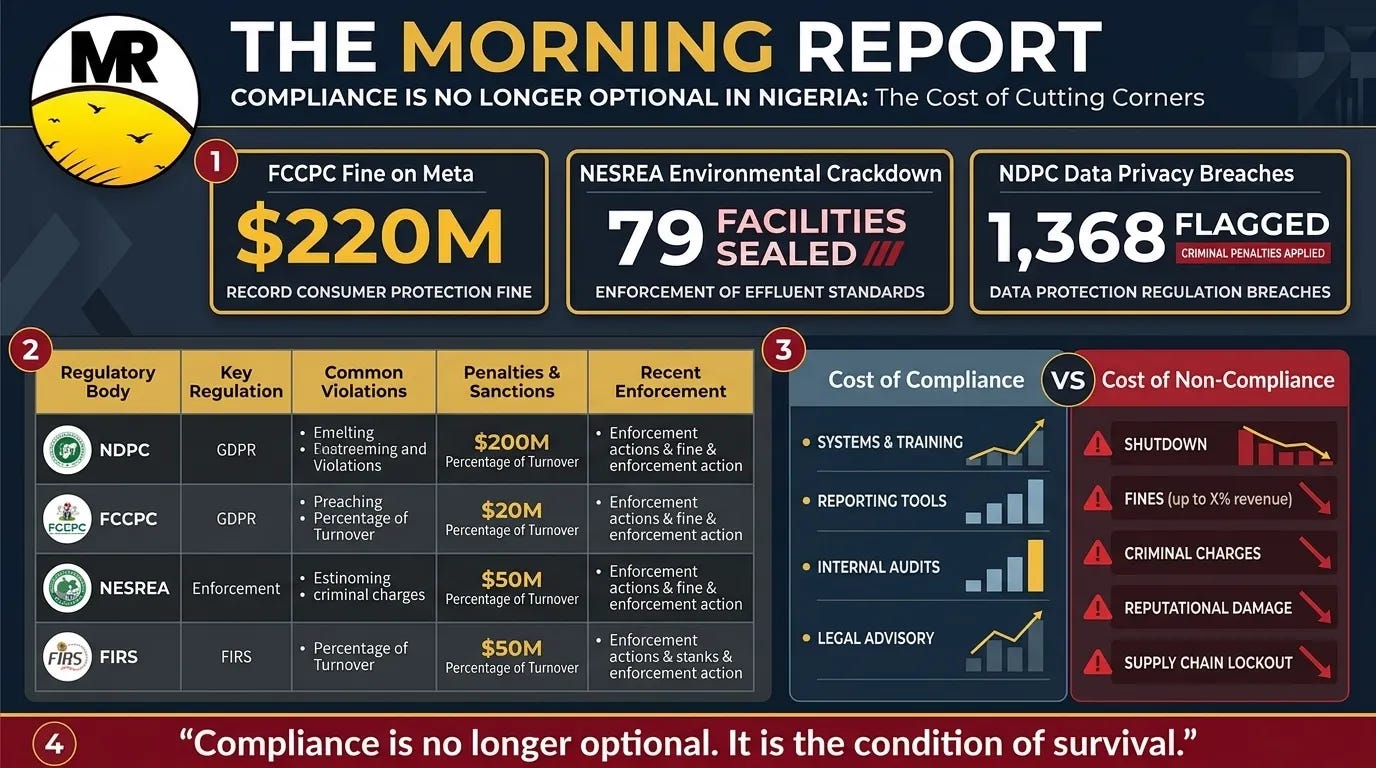
The cost of survival is rising, and the systems are responding in their own strange ways. Compliance with Nigeria Data Protection Act, FCCPC and NESREA regulations has become a condition of survival for Nigerian businesses, especially small and medium enterprises that struggle with multi-agency permits and high licensing fees. A tanker spilled 33,000 litres of groundnut oil near Ojota Bridge in Lagos, and residents rushed out with jerrycans and buckets to scoop it, ignoring warnings and ignoring the fact that oil mixed with road grime is not free food. A pastor in Warri linked Christ’s crucifixion to financial struggles among the disciples, sparking the familiar debate about prosperity gospel in Nigerian churches. And police arrested a woman alongside seven armed robbers. Deborah Saviour admitted she knew her boyfriend was a robber and accepted a stolen phone from him. Her first boyfriend was also a robber, and he is in prison. She moved on to another one.
A pension denied. A secretariat burned. A campaign that is already violent. A river of free oil scooped by people who cannot afford to buy it. A pastor who turned the cross into a cash flow problem. A woman who knew exactly what she was doing. These are not separate stories. They are the same story: a country where the systems meant to carry people keep falling short, and the people keep carrying themselves, and each other, until they cannot.
Warmly,
Lolade