


Compliance was once a box to tick. Businesses obtained certificates, appeased inspectors and filed documents away. That era is ending. Across the Ikeja Industrial Estate, the Port Harcourt refinery cluster and Abuja’s corporate towers, a quiet transformation is underway. Compliance has become a condition of survival.
Nigeria’s regulatory framework was once fragmented and weakly enforced. Corporate culture treated guidelines as negotiable. That landscape has changed. The Nigeria Data Protection Act now imposes strict mandates on businesses handling consumer data. The Federal Competition and Consumer Protection Commission has policed anti-competitive practices aggressively. The National Environmental Standards and Regulations Enforcement Agency has intensified inspections of plants, waste protocols and emissions. Nigerian regulators are no longer passive. They are active enforcers.
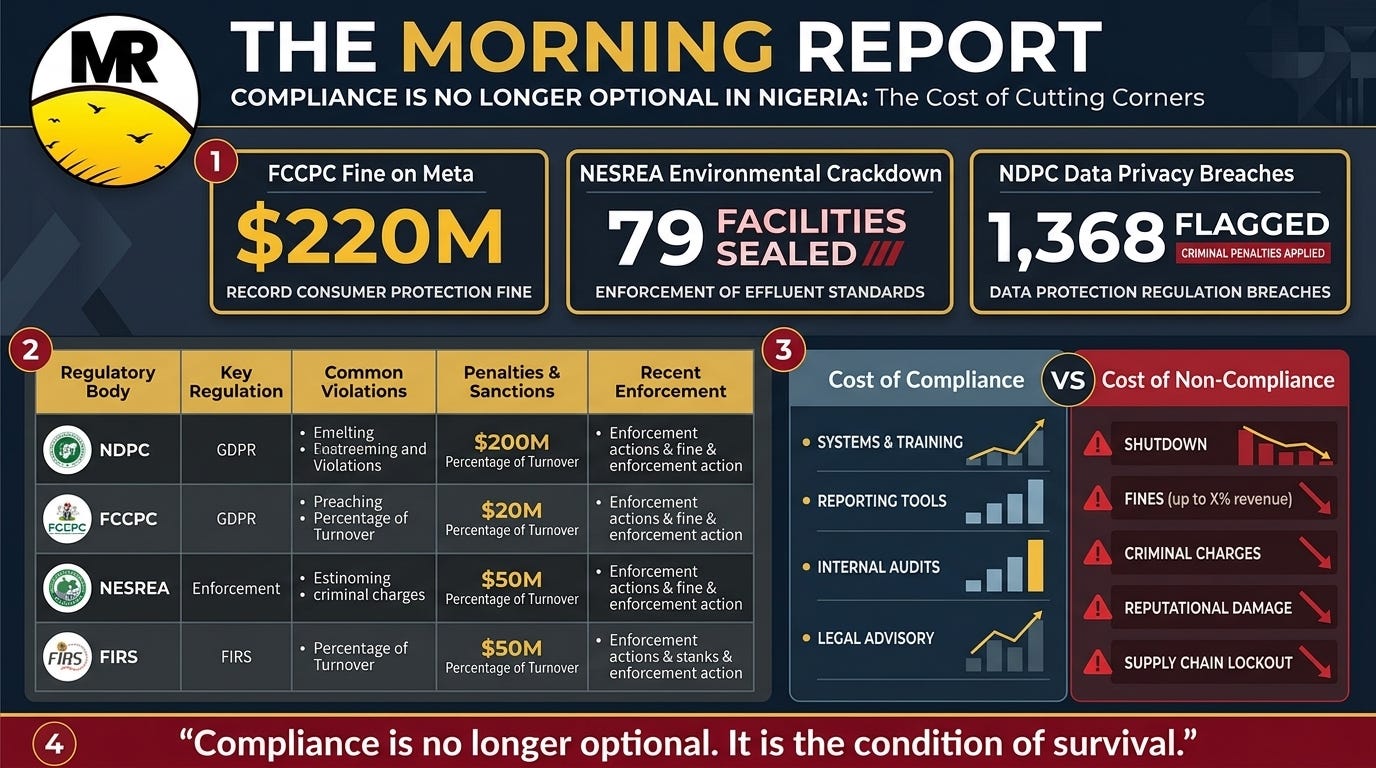
The new enforcement reality
Barrister Kemi Adeleke is Managing Partner at Adeleke & Associates Regulatory Law. She spoke at a corporate governance seminar in Lagos on 10 October 2026. She said the business environment has crossed an irreversible threshold. For years, indigenous firms assumed rules could be bypassed through informal negotiations. Recent enforcement actions by the FCCPC and NESREA have ended that era. “Boards of directors must realise that compliance is an integral pillar of corporate asset protection rather than a superficial legal formality,” she said.
The consequences of non-compliance are severe. Businesses face financial penalties, protracted litigation, shutdowns and reputational damage. Compliant organisations earn consumer trust. They enhance brand equity. They unlock commercial opportunities. Multinational corporations and global supply chains demand adherence to environmental, social and governance standards. Local vendors that cannot demonstrate compliance are locked out.
The export market imperative
Dr Oladipo Aina is Director of Policy and Trade at the Nigerian Association of Chambers of Commerce, Industry, Mines and Agriculture. He spoke on 11 October 2026. He said global buyers have zero tolerance for supply-chain non-compliance. International partners conduct rigorous ESG audits before procurement agreements. “Local companies attempting to cut corners on waste disposal, labour safety or data protection will find themselves completely shut out of profitable export markets, regardless of how competitive their pricing might be,” he said.
The EHS challenge
Environmental, health and safety compliance is the most urgent area. Many manufacturing firms operate without adequate waste disposal systems. They release untreated effluent into water bodies. They emit toxic substances. Unsafe factory floors expose workers to hazards. NESREA has responded with facility closures and sanctions.
Engr Tunde Bakare is Chief Technical Officer at a Lagos-based chemical processing firm. He spoke on 11 October 2026. He said many factory owners view safety equipment and waste treatment as dead expenses. “This mindset is dangerously myopic,” he said. A single industrial accident can trigger regulatory shutdowns, criminal investigations and civil lawsuits. “Integrating safety and environmental protocols into daily plant operations is the only way to safeguard human life and corporate continuity simultaneously.”
The SME burden
Compliance carries a financial cost. Small and medium-sized enterprises struggle with high operating costs, currency volatility and infrastructure deficits. Sophisticated compliance infrastructure appears prohibitively expensive. But the cost of non-compliance is higher. A sudden shutdown, a multi-million naira fine or a negligence lawsuit can destroy a growing business.
Mrs Amaka Obi is a small-scale agro-processing entrepreneur in Ogun State. She spoke on 12 October 2026. She said business owners want to operate within the law. But navigating multi-agency permits, high licensing fees and expensive compliance technology can suffocate a growing enterprise. She urged regulators to provide clearer guidelines and structured grace periods rather than immediate punitive fines.
The case for support
Dr Kemi Alabi is a senior researcher in public policy at the University of Lagos. She argued that regulatory bodies must balance enforcement with proactive guidance. Many small business owners commit infractions due to a lack of awareness or complex procedures. “Regulators should provide accessible compliance guidelines, regional training workshops and transitional support to help smaller enterprises build compliance capacity without stifling grassroots economic growth,” she said.
Winners: Compliant businesses, which gain consumer trust and preferred vendor status. Regulatory agencies, which strengthen enforcement. Consumers and workers, who gain protection. Legal and compliance consultants, who face surging demand. Losers: Non-compliant businesses, which face sanctions and disruptions. Under-resourced small firms, which struggle with capital expenditure. Industrial polluters, which face closures and reputational damage.
Bottom Line
Compliance is no longer optional. Regulators are watching. Consumers are demanding. Investors are requiring. The cost of compliance is high. The cost of non-compliance is existential. Nigerian businesses must adapt. Survival belongs to those who respect the law.