


Good morning,
Yewande Dada swept her frontage in Alimosho on a recent Saturday morning. She cleared the drains, as she does every month during Lagos’s mandatory environmental sanitation exercise. Then she watched as scavengers and rainfall scattered everything back into the gutters. Her waste had not been collected in three months, despite her regular payments. “I don’t know why we should continue with monthly sanitation when no one comes to pick up the refuse,” she said.
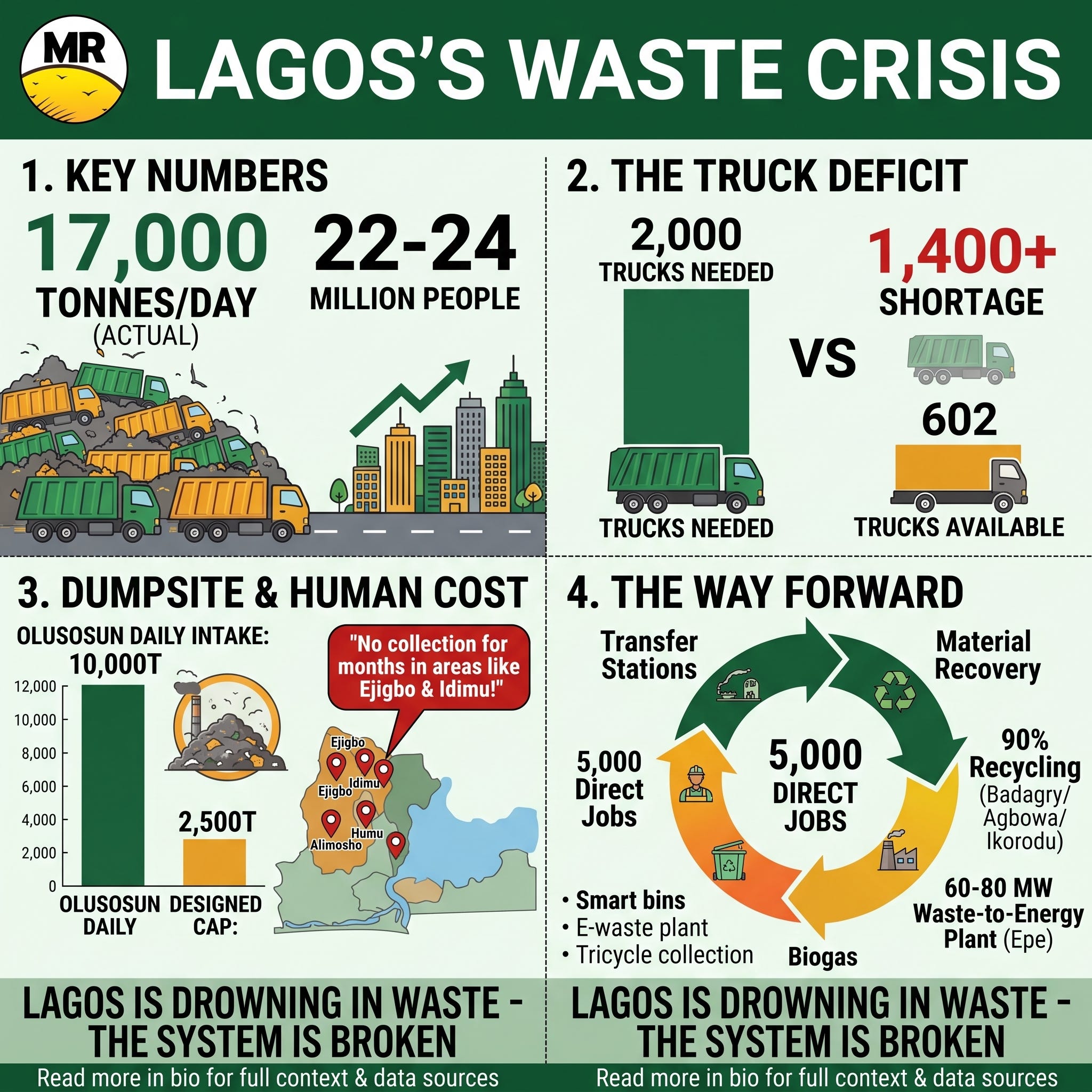
She is not alone. Lagos generates between 13,000 and 17,000 tonnes of waste every day, the equivalent of more than 1,000 fully loaded garbage trucks. The Lagos Waste Management Authority needs about 2,000 compacted vehicles for adequate coverage but has only a fraction. In Ejigbo and Idimu, residents have watched waste accumulate on road medians for four months. The PSP operators are struggling. Diesel costs have tripled since 2022, while the tariff they can charge residents has remained unchanged. Some residents pay as much as ₦48,000 every two months for waste evacuation, yet the service does not come. In June, Commissioner for Environment Tokunbo Wahab apologised. “Let me start by apologising to Lagosians. The past three, four months have been very bad,” he said.
For me, the apology is accepted until the problem is solved.
While Lagos drowns in waste, Geregu Power is cleaning up its balance sheet. The energy giant has fully settled its outstanding bond obligations, paying approximately ₦6 billion owed to investors on its ₦40.09 billion Series 1 Senior Unsecured Bond. Chairman Senator Abdul’aziz Abubakar Yari personally provided the funds following a recent default on a scheduled coupon and principal repayment. Investor confidence is restored. The question is whether the company can sustain its financial performance.
And Emzor Pharma is building for the future. The indigenous pharmaceutical company has raised ₦26.70 billion through a five-year fixed-rate bond to expand manufacturing capacity and complete Africa’s first full-scale antimalarial Active Pharmaceutical Ingredient manufacturing plant. The bond, which carries a 19 per cent interest rate, was oversubscribed. The project is expected to reduce Nigeria’s reliance on imported pharmaceutical ingredients. The plant is coming. The question is whether it will transform the industry.
The state police bill is taking shape. The Presidential Working Group on the National Policing Bill has begun reviewing public submissions as legal drafters start work on the proposed legislation. The bill is expected to provide the framework for a dual policing structure comprising a Federal Police Service and State Police Services. The National Assembly has passed the constitutional amendment bill for state police. The framework is moving. The question is whether it will strike the right balance between local control and national standards.
And Nigerian footballers in Europe delivered mixed results. Tolu Arokodare shone for Ajax, while Paul Onuachu endured a frustrating night for Trabzonspor, striking the woodwork in a 1-0 home defeat to Ferencváros. Chibuike Nwaiwu was shown a straight red card in added time. The results mirrored Nigerian football itself: flashes of individual excellence against a backdrop of collective underachievement.
Have a restful weekend,
Lolade