


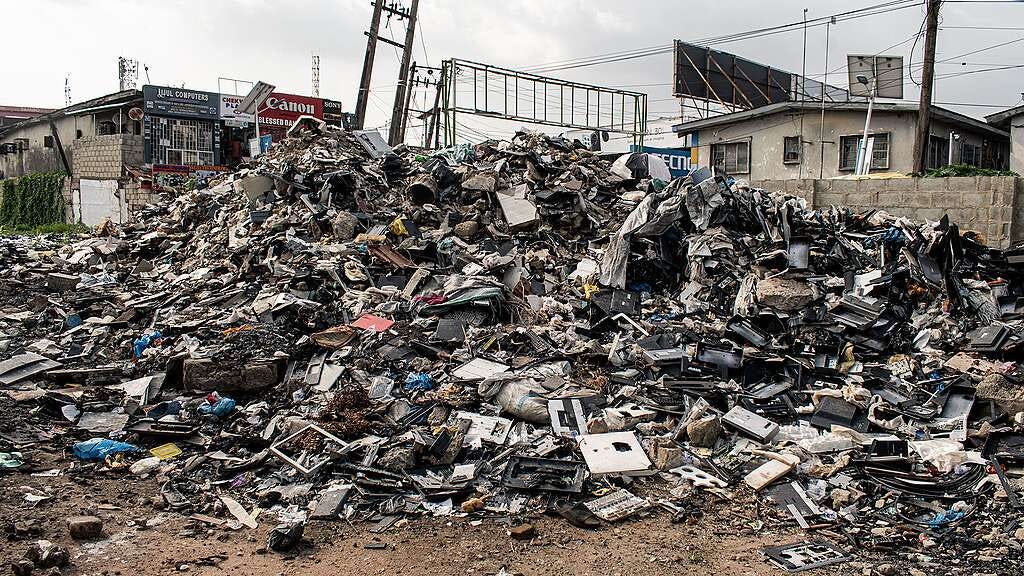
On a recent Saturday morning in Alimosho, Yewande Dada swept her frontage and cleared the drains, as she does every month during Lagos’s mandatory environmental sanitation exercise. Then she watched as scavengers and rainfall scattered everything back into the gutters. Her waste had not been collected in three months, despite her regular payments. “I don’t know why we should continue with monthly sanitation when no one comes to pick up the refuse,” she told reporters. “Without prompt evacuation of waste, the exercise will continue to lose its purpose”.
Dada’s frustration is shared by millions across Lagos. The city is drowning in its own refuse, and the stench of failure is everywhere.
The Scale of the Crisis
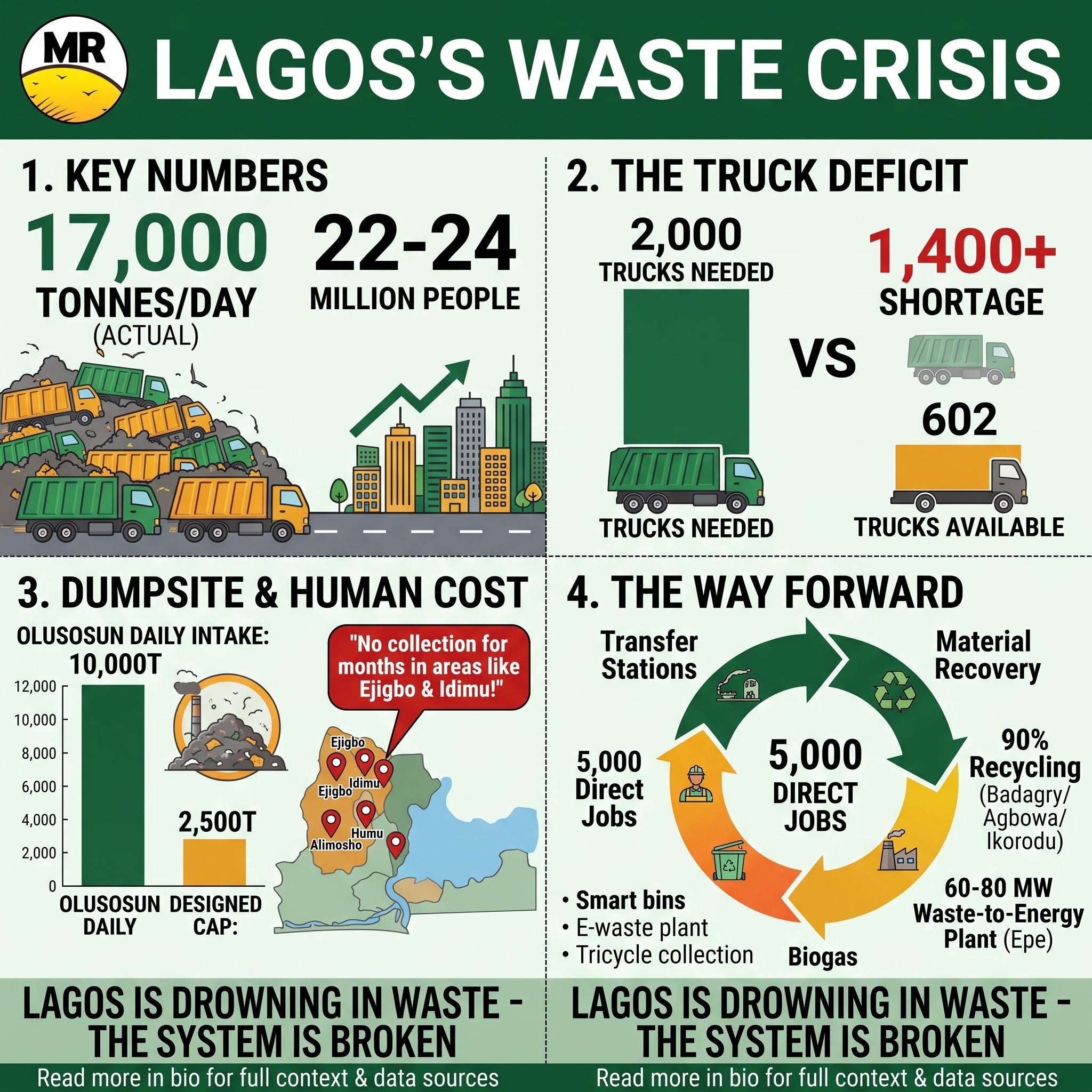
Lagos generates between 13,000 and 17,000 tonnes of waste every day. For context, that is the equivalent of more than 1,000 fully loaded garbage trucks, every single day. The state’s population, now estimated at between 22 million and 24 million, has overwhelmed the waste management infrastructure that was designed for a much smaller city. The Lagos Waste Management Authority (LAWMA) has admitted that it needs about 2,000 compacted vehicles for adequate coverage but currently has only a fraction of that number.
The result is a city where refuse heaps have become a permanent feature of the landscape. In Ejigbo and Idimu, residents have watched waste accumulate on road medians for four months. “The refuse has been here since May,” said Seun Ajayi, a resident. “August makes it four months since the refuse was dumped here. The PSP operators come around, but this particular heap has remained here”. At the Idimu Bus Stop, one heap has grown to the height of a vehicle.
The Broken System
The crisis is not the result of a single failure but a cascade of them. The Private Sector Participation (PSP) operators, who are supposed to collect waste from households, are themselves struggling. About 420 PSPs were licensed to operate, but many no longer have the required number of functional trucks. The cost of diesel has roughly tripled since 2022, while the tariff they can charge residents has remained unchanged. Some residents pay as much as ₦48,000 every two months for waste evacuation, yet the service does not come.
“Even if we have 2,000 or 3,000 trucks, poor access to disposal sites and deteriorating roads leading to landfill locations slow everything down,” said Adesola Olugbenga, President of the Association of Waste Managers of Nigeria. The major dumpsite at Olusosun is approaching the end of its operational life. During the rainy season, access roads and disposal platforms flood, grinding operations to a halt.
The Government’s Response
The government has acknowledged the scale of the failure. In June, Tokunbo Wahab, the Commissioner for Environment, publicly apologised to residents on Arise TV. “Let me start by apologising to Lagosians. The past three, four months have been very bad with respect to waste collection,” he said. “I won’t play the ostrich by not admitting we had a challenge. Are we fixing it? Yes”.
Governor Babajide Sanwo-Olu ordered round-the-clock waste evacuation and revived the monthly environmental sanitation exercise after a 10-year break. The government announced the deployment of additional compactor trucks and the creation of a “Waste Police” unit for enforcement. LAWMA rehabilitated a secondary access road to the Olusosun dumpsite and constructed new disposal platforms. “Over the next few days there won’t be refuse on our roads,” LAWMA Managing Director Muyiwa Gbadegesin assured residents in July.
Yet, weeks later, the refuse remained. “I am disappointed that one week after nothing seems to be happening,” said Akeem Salami of Ago Palace Way. In Orile, Agboju, Mile 2 and Ikotun, huge refuse still dot the roads. The government’s promises have not matched the reality on the ground.
The Human Cost
For the residents of Lagos, the crisis is not abstract. It is the smell of decomposing waste that fills their nostrils every day. It is the flies and disease-carrying pests that thrive in the refuse. It is the fear that the waste will wash into drainage channels and worsen the flooding that plagues the city during heavy rains.
Local government councils have been accused of abdicating their responsibility. “The local government councils have abdicated the responsibility for refuse management and flood control to the state government as though they have no responsibility for the welfare of people at the grassroots,” said Nelson Ekujumi, a resident of Ogba. Bolu Olorunfemi of Agege asked: “What are the local governments doing? In functional societies, refuse disposal should be the responsibility of local governments, which are closer to the people than the state government”.
A Way Forward
Lagos cannot continue with the decades-old practice of simply collecting waste and dumping it at landfill sites. The state is shifting towards a circular waste economy, where waste is treated as a resource. Plans include transfer loading stations, material recovery facilities, and waste-to-energy plants.
But these are long-term solutions. In the meantime, the stench remains. The city that claims to be Nigeria’s commercial capital is being buried under its own filth. As one resident put it, “The authorities need to do something about this. It is not enough to evacuate refuse once in a while. There should be regular evacuation because people generate waste every day”.
For now, the residents of Lagos continue to pay for a service they are not receiving, sweep streets that are immediately refilled, and hold their breath against a stench that refuses to leave.
Bottom Line: Lagos is drowning in waste. The system is broken. The government is promising fixes. The residents are waiting. The question is whether the city will be cleaned up before it is completely buried.