


The Presidential Implementation Committee on Technology Transfer has signed a Memorandum of Understanding with Valmont Industries, the world’s largest manufacturer of pivot irrigation systems, to establish an irrigation equipment production plant in Nigeria in partnership with the National Agency for Science and Engineering Infrastructure (NASENI). The agreement includes a 40,000-hectare pilot programme in Adamawa State, implemented with NIRSAL and the National Agricultural Development Fund .
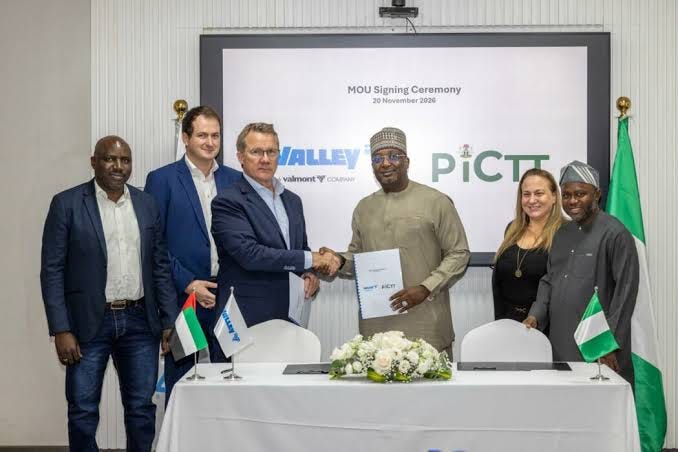
The mechanics of the deal deserve scrutiny. Valmont, through its Valley Irrigation brand, accounts for more than 40% of centre-pivot systems worldwide, with over 250,000 pivots deployed across more than 120 countries . The MoU commits Valmont to technology transfer and capacity building. It does not disclose the investment value, production capacity or expected completion date for the factory . A pilot on 40,000 hectares is meaningful, but Nigeria’s irrigation gap is vast: only 5.8% of agricultural land had been irrigated under command-area development as of September 2026 .
This echoes the 2020 and 2023 agricultural mechanisation partnerships that produced memoranda and pilot programmes without a manufacturing base. It also mirrors the broader pattern of Nigerian industrial policy announcing local production before the factory exists.
The winners are Valmont, which gains a foothold in Africa’s largest market, and NASENI, which gets a technology transfer mandate. The losers are the farmers who will wait for the factory while the pilot runs, and the taxpayers who will fund the pilot without knowing what the equipment will cost once it is made locally.
Bottom Line: An MoU with a factory promise is a start. The completion date is the policy.