


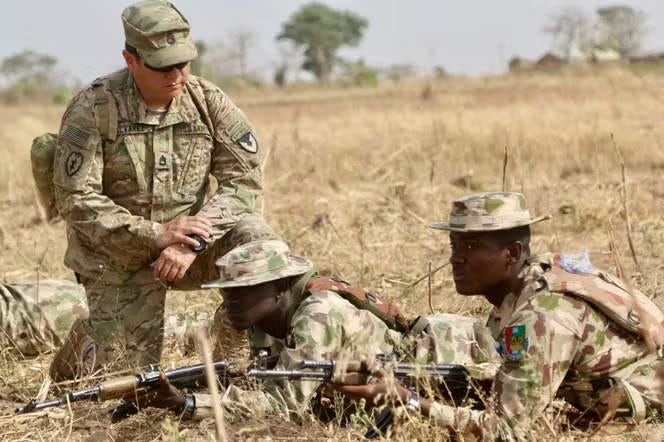
The United States has withdrawn most of its forces deployed for a joint counterterrorism operation in Nigeria’s Lake Chad Basin. Commander of US Air Forces in Europe-Air Forces Africa, General Dagvin R.M. Anderson, disclosed this during a press briefing on the outcome of the African Chiefs of Defence Conference 2026.
The United States deployed about 200 military personnel to Nigeria in February to support intelligence, surveillance and counterterrorism operations in the Lake Chad Basin. The deployment came amid growing security cooperation between Washington and Abuja in the fight against ISIS and other terrorist groups operating in the region. The troop deployment followed the redesignation of Nigeria as a Country of Particular Concern by US President Donald Trump, who had vowed to intensify US support against terrorist groups operating in the country.
On 25 December 2025, the US carried out air strikes on two terrorist enclaves in the Bauni Forest in Tangaza Local Government Area of Sokoto State. The partnership culminated in the killing of Abu-Bilal Al-Minuki, the second-in-command of ISIS, at his hideout in Borno State.
Anderson explained that the military operation had ended and most US personnel involved had left for Washington DC. “And so that operation in the Lake Chad Basin of Nigeria not only helped the countries in that immediate region; it also helps countries globally as that disrupts the ISIS network. And so, and then we have withdrawn much of our forces that were just there for that operation, but are continuing the partnership that Nigeria has asked for to help continue with the intelligence sharing and the understanding that’s necessary to be able to prosecute these difficult tasks,” he said.
The US general described Nigeria as a capable partner with a strong military and said the cooperation between both countries had yielded significant results against ISIS. According to him, US intelligence support, combined with Nigerian military efforts, led to a successful operation against the second-in-command of the ISIS global network.
The withdrawal of US troops from Nigeria raises important questions for Abuja. The Nigerian military has demonstrated its capacity to conduct operations with US intelligence support, but the question is whether it can sustain the momentum without US personnel on the ground. The withdrawal also comes at a time when insecurity is spreading from the North-east to other parts of the country, and when the Lake Chad Basin remains a fertile ground for insurgent activity.
This mirrors the 2015 withdrawal of US troops from West Africa after the Ebola crisis, when Washington reduced its military footprint in the region. The result then was a gap in intelligence and surveillance capabilities that took years to fill. The current withdrawal may have a similar effect, particularly if the intelligence-sharing partnership does not remain robust.
From a Nigerian vantage point, the withdrawal is a reminder that US military support is contingent and temporary. Nigeria must build its own intelligence and surveillance capabilities. The partnership with the US will continue, but it will be on US terms.
The winners: the US, which has completed its operation and reduced its footprint. The losers: Nigeria, which loses US military personnel on the ground, and the Lake Chad Basin region, which faces the risk of insurgent resurgence.
Bottom Line: US troops are leaving Nigeria. The intelligence partnership remains. The question is whether that is enough.