


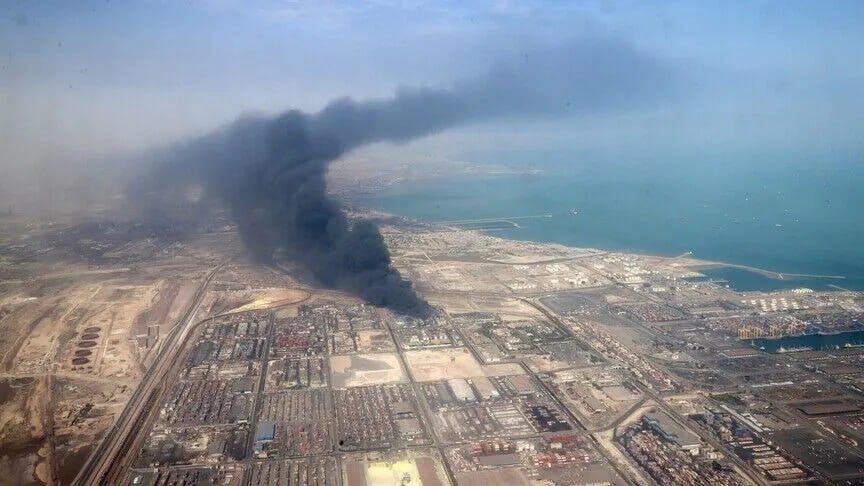
The war between the United States and Iran entered its seventh consecutive night on Friday, with both sides targeting civilian infrastructure and escalating a conflict that has already claimed dozens of lives. US strikes on Iran hit desalination pumps in the coastal village of Bunji in Hormozgan province, cutting water supply to about 10,000 people across 20 villages. The attack on the desalination plant, which had a production capacity of 3,150 cubic metres per day, completely destroyed the pumping station and a power transformer. Iranian officials described the strikes as “a series of crimes and terrorist attacks”.
The US strikes also targeted the central city of Yazd and the southern cities of Lar, Ahvaz, Sirik, Bushehr, Bandar Abbas and Darab, with explosions also reported on Qeshm Island. In Hormozgan province, air strikes hit two bridges and one tunnel, killing three people and injuring eight others. Iran’s Health Ministry said US attacks since July 6 have killed at least 50 people and wounded more than 500 across the country.
Iran responded with what it described as a “corresponding response” at Gulf States hosting American military bases, including Kuwait, Jordan and Bahrain. Kuwait’s Ministry of Electricity, Water and Renewable Energy disclosed that an Iranian attack caused a fire on a component of a power and water desalination plant in the country. The ministry said all operational and emergency plans were activated immediately upon the incident, but several power generation units were shut down. Kuwait National Airport has also suspended operations, with flights rescheduled and airways closed. Kuwait described the attack as a “heinous Iranian aggression targeting vital facilities and essential infrastructure, endangering the lives and safety of civilians”.
The Nigerian stake is direct. Nigeria is an oil-exporting country that benefits from higher crude prices, but it also faces higher import costs and increased inflation. The attacks on Kuwaiti infrastructure are particularly significant, as Kuwait is a major oil exporter and a key player in OPEC. Any disruption to Kuwait’s oil production could push global crude prices higher, with direct consequences for Nigeria’s economy.
This echoes the 2019 Strait of Hormuz crisis, when tanker attacks pushed oil prices higher and raised global tensions. The mechanism then was different, but the result was the same: oil markets spiked, and Nigeria found itself caught between higher revenue and higher costs.
The winners: oil-exporting countries, including Nigeria, which earn more from crude sales in the short term. The losers: Nigerian consumers, who pay more for fuel, transport and food; the Nigerian economy, which suffers from higher inflation; and the Nigerian government, which faces renewed pressure on the naira and the fiscal deficit.
Bottom Line: US and Iranian strikes are hitting water infrastructure in Iran and Kuwait. The war is escalating. Nigerian consumers will pay the price at the pump again.