


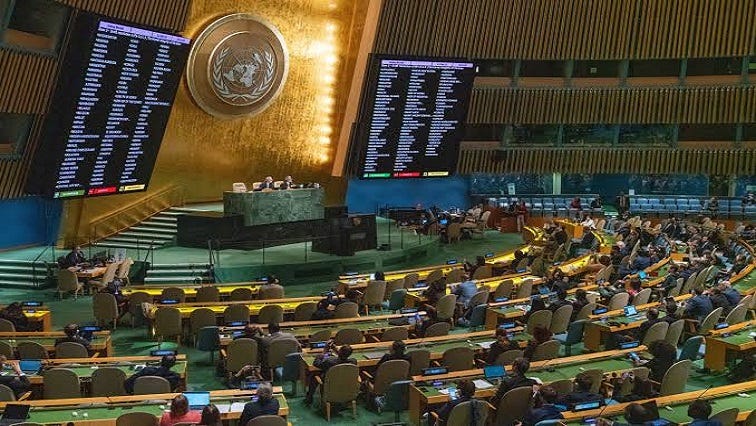
The President of the General Assembly, Khalilur Rahman, has said Africa’s exclusion from permanent membership of the Security Council is a continuing injustice. He spoke at the closing of the General Debate of the 81st session of the UN General Assembly in New York. He demanded justice for the continent. From a Nigerian vantage point, the statement echoes Abuja’s own demand. President Bola Tinubu made the same call at this UNGA. Nigeria wants two permanent seats with veto powers for Africa.
The Security Council was formed in 1945. It has five permanent members: the United States, Russia, China, France and the United Kingdom. Each holds veto power. Africa has no permanent seat. The Ezulwini Consensus, adopted in 2005, demanded two permanent seats with veto and five non-permanent seats for Africa. Successive Nigerian presidents have repeated the demand. Nothing has changed. The five permanent members resist dilution of their power.
Rahman said world leaders spoke clearly about reforming the United Nations. He said the UN80 initiative would continue. But he added a caveat. “Administrative reform cannot substitute for deeper political reform,” he said. “Reform is not an exercise in rearranging structures or reducing budgets.” He said reform is about whether the organisation delivers better, faster and more fairly. He said Africa’s exclusion is a continuing injustice. “No reform agenda, including UN80, is complete without addressing this long-standing inequity,” he said.
He also discussed the appointment of the next Secretary-General. He called it one of the Assembly’s most consequential responsibilities. The Charter states that the Assembly appoints the Secretary-General on the Security Council’s recommendation. He said the process must be transparent, inclusive and merit-based. “The selection process must strengthen, not diminish, the legitimacy, independence and moral authority of the office,” he said.
More than 193 delegations took the rostrum during the debate. That included 113 heads of State and Government, one Crown Prince, 11 Vice-Presidents, seven Deputy Prime Ministers and 48 ministers. Rahman summarised the themes. Peace came before all others. But peace was spoken of as an urgent defence, not a distant aspiration. Other themes included the Sustainable Development Goals, debt burdens, climate change, human rights and gender equality. Artificial intelligence was mentioned by 128 delegations. Four years ago, only five mentioned it. Rahman said AI governance must be human-centred and attentive to developing countries.
Winners: Africa, which gains a platform. Rahman, who shows leadership. The Global South, which gains visibility. Reform advocates, who gain momentum. Losers: The five permanent members, who face pressure. Countries opposing reform, who look obstructionist. The status quo, which is challenged. Nigeria, if the demand remains rhetorical.
Bottom Line: Africa’s exclusion from the Security Council is an injustice. Rahman said it plainly. Tinubu said the same. The veto is the obstacle. Reform requires consent from those who benefit from the current system. Unlikely. But the demand must be made.