


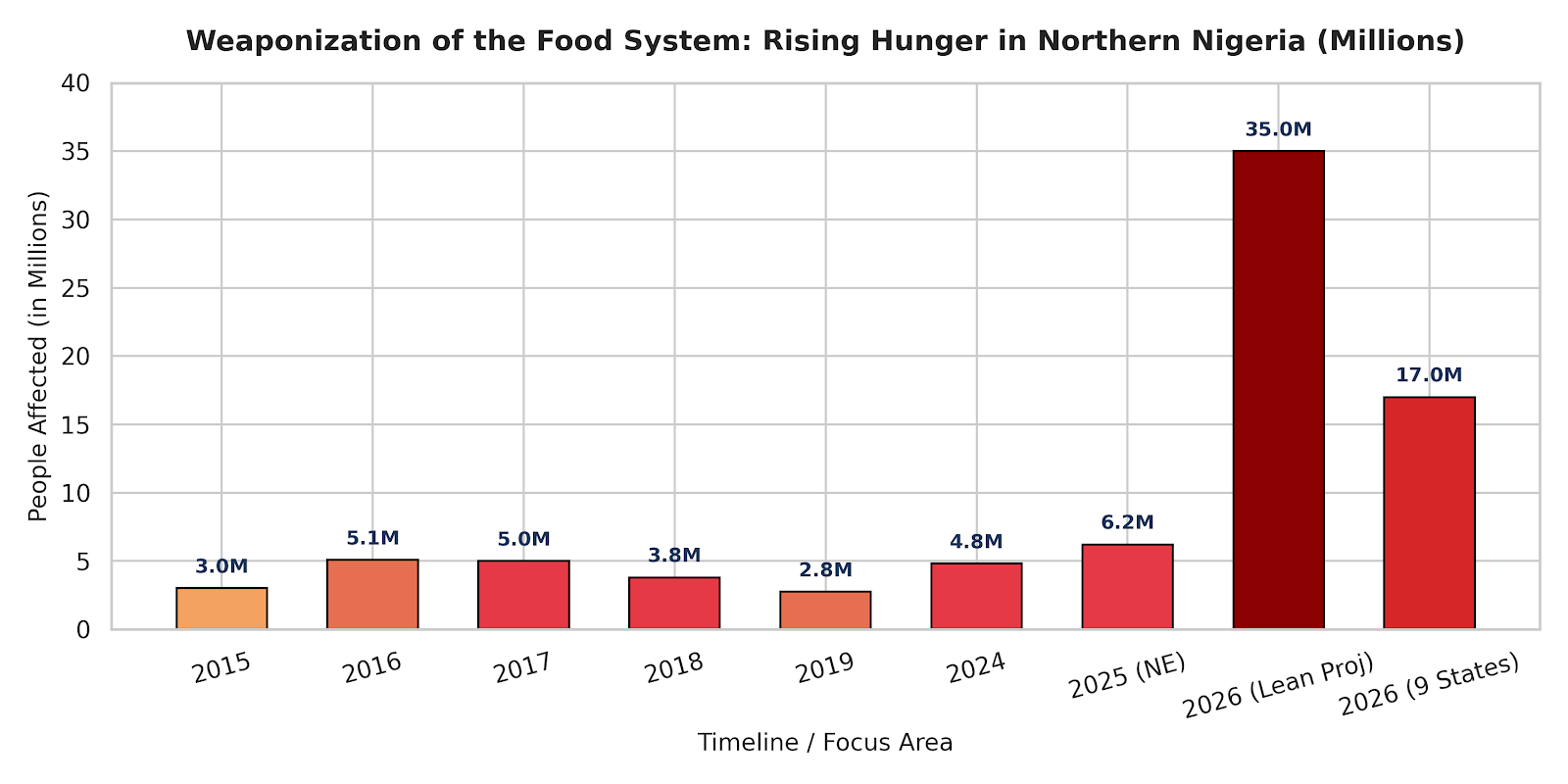
The United Nations World Food Programme has warned that northern Nigeria is facing a food security crisis that is deteriorating faster than previously expected, with conflict and reduced aid pushing hunger levels to their highest in nearly a decade. The agency said that recently completed analysis shows that over 17 million people across nine conflict-affected states, particularly in the North-east, are experiencing crisis, emergency or catastrophic hunger, an increase of nearly 2 million people from the previous forecast.
In Borno State, where insurgent attacks are becoming more frequent and food aid has been cut, over 3 million people are facing severe food insecurity. Of these, more than 750,000 are in emergency hunger levels, and over 10,000 are facing catastrophic hunger. While the catastrophic hunger figure represents a small fraction of Borno’s food-insecure population, the UN agency noted that it signals a grim warning that conflict, displacement and reduced humanitarian aid are pushing the crisis toward more dangerous territory.
WFP West and Central Africa Regional Director Kinday Samba said: “What worries us most is the spread of this crisis. For years, insurgent attacks and violence were largely confined to parts of north-east Nigeria. Now they are spreading to a wider area, forcing people off their farmland, causing displacement, and restricting humanitarian access, which means famine could be imminent.”
The report also noted that persistent access constraints and severe funding shortages have worsened the humanitarian and food security situation, making it increasingly difficult for WFP to reach vulnerable populations. The number of inaccessible locations has doubled, with 15 additional areas now considered partially inaccessible by WFP field staff.
Funding shortfalls have reduced the scale of humanitarian assistance. Despite the food-insecure population in the three north-eastern states rising to 6.2 million, WFP can only reach 740,000 of them, leaving 5.5 million people, particularly children, without life-saving food and nutrition support. “This is a significant drop from the 1.3 million people WFP was able to support at the height of the 2025 lean season,” the agency stated.
The suspension of food assistance in some camps due to funding shortfalls has triggered a deeply alarming escalation in exploitation and gender-based harm particularly impacting women and children. Communities have reported cases of individuals joining armed groups in search of food or income. WFP requires $89 million over the next six months to continue food and nutrition assistance and essential logistics support across northern Nigeria.
This crisis echoes the 2016-2017 famine warning in Borno State, when the insurgency first displaced millions and humanitarian agencies struggled to reach affected populations. The difference now is that the crisis is spreading beyond Borno into neighbouring states, and the funding is even thinner.
The winners: none. The losers: over 17 million Nigerians who do not know where their next meal is coming from, and the Nigerian state, which cannot protect its citizens from hunger or insecurity.
Bottom Line: Over 17 million Nigerians are facing hunger. The UN needs $89 million. Without it, the crisis will get worse.