


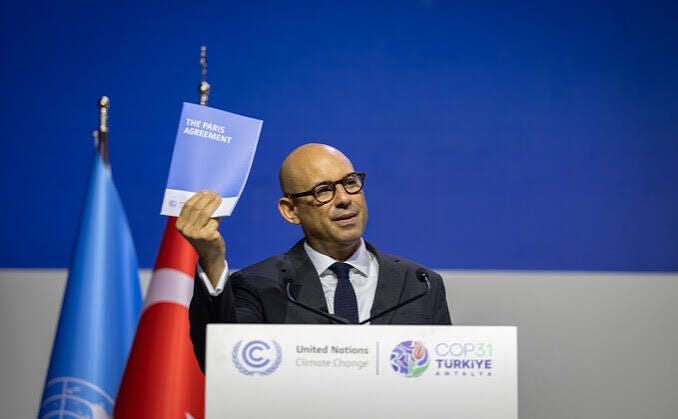
Simon Stiell, executive secretary of UN Climate Change, has told ministers at COP31 that climate finance must be redesigned to lift developing countries out of a cycle of debt and disaster. He spoke at the opening of a high-level ministerial dialogue on climate finance in Antalya, Turkey. Stiell argued that meeting a headline financial target will not solve the problem. “Meeting a financial target does not always meet countries’ needs,” he said. “To do that, we need to look at how finance is delivered”.
The mechanics matter. Countries agreed at COP29 that developed nations would lead in providing $300 billion a year by 2035, as part of a wider effort to raise $1.3 trillion annually from all sources. Stiell said the roadmap for reaching those sums must become reality. But he argued that the terms of the money matter as much as the amount. “Many developing countries are trapped in a downward loop of debt, disaster, and devastating capital costs,” he said. “The threat of floods, fires, storms and droughts hangs over them, pushing up the price of borrowing even before disaster strikes”.
The data supports his warning. International climate finance for developing countries reached about $137 billion in 2024. Almost 70% of it came in the form of loans. Countries in sub-Saharan Africa paid more than twice as much in external debt service between 2021 and 2023 as they received in climate finance. Interest payments consumed more than 10% of government revenue in 27 African countries in 2024. Nigeria sits within that group. The country borrows to recover from floods and to build resilience against future ones, while debt service consumes revenue that could fund adaptation.
This mirrors the 2015 Paris Agreement, where developed countries promised $100 billion a year by 2020. That target was missed. The difference now is that the debt burden is heavier and the climate shocks are more frequent. Stiell called for grant-based and highly concessional finance, particularly for Least Developed Countries, Small Island Developing States and other vulnerable economies. The winners are vulnerable countries if the terms improve; development banks that design concessional instruments; and climate negotiators who can claim a shift from quantity to quality. The losers are creditor nations that prefer loans; private financiers who profit from high borrowing costs; and developing countries if the redesign stalls in committees.
Winners: Vulnerable countries if terms improve; development banks designing concessional instruments; climate negotiators.
Losers: Creditor nations preferring loans; private financiers profiting from high costs; developing countries if redesign stalls.
Bottom Line: Stiell is right that the terms matter as much as the total. Nigeria must demand grants and concessional finance, not just celebrate loan pledges that deepen its debt.