


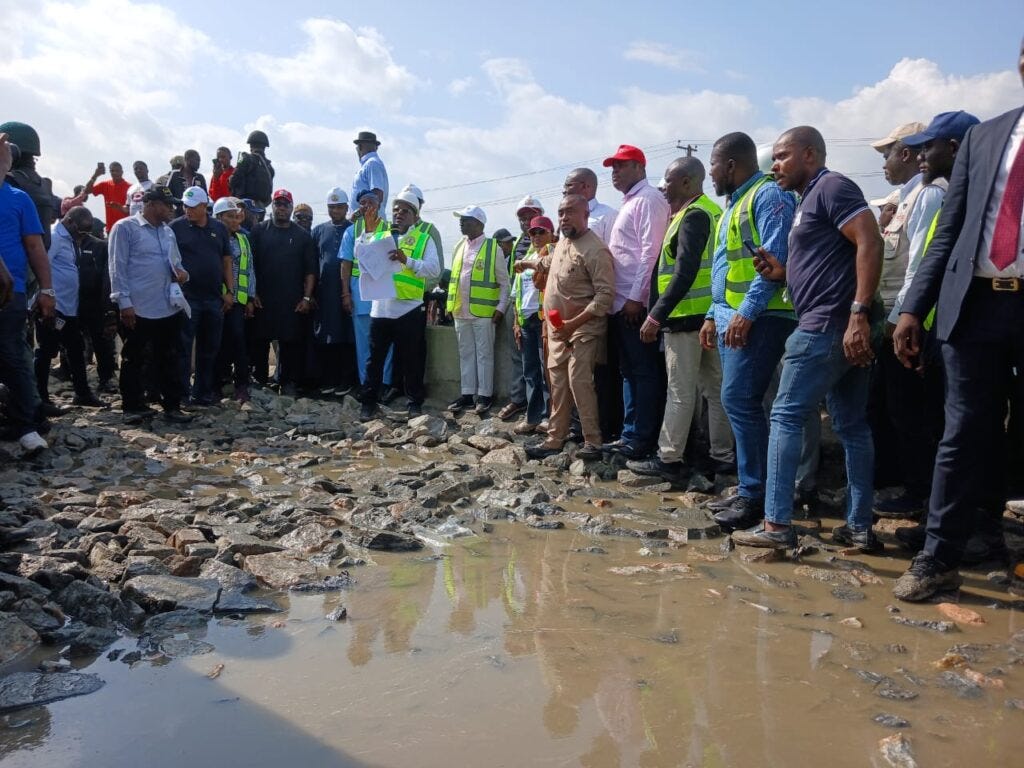
The Minister of Works, David Umahi, has apologised to commuters and residents of Edo and Delta states for the deplorable condition of the Benin-Sapele Road, which has caused untold hardship. The minister also ordered the arrest of the contractor and concessionaire, as well as others found removing asphalt from federal roads without authorisation.
Umahi offered the apology and issued the directive on Tuesday in Benin during an inspection tour of some major roads in Edo. The minister thanked Edo youths for remaining calm despite the hardship caused by the road's condition, noting that their restraint helped prevent a possible breakdown of law and order. He expressed disappointment with the concessionaire handling the road, accusing the company of lacking the technical competence required to execute the project.
Umahi said he had personally observed the removal of asphalt from the road during an earlier inspection with the state Governor, Monday Okpebholo, and directed the contractor to stop the practice. According to him, the Ministry of Works does not permit contractors to remove asphalt from federal roads without authorisation, describing such acts as “destruction of public infrastructure.” He therefore directed all ministry controllers to arrest any contractor or concessionaire found removing asphalt from federal roads without approval.
The minister criticised the concessionaire’s handling of the project, alleging that its lack of technical capacity had subjected commuters and residents to untold hardship. He said the Federal Government had a responsibility to ensure that concessionaires possessed the necessary technical competence before being awarded road projects. Umahi maintained that the concessionaire had no reputation for competence and integrity before taking over construction of the Benin-Agbor Road.
The minister further said President Bola Tinubu had taken note of the suffering of road users and directed the Ministry of Works to do everything necessary to restore the road and ease the people's suffering. He explained that although concession agreements were governed by law, the government could invoke overriding public interest where necessary to protect citizens and critical infrastructure.
The minister reiterated his apology to commuters, residents of Edo and Delta, and other road users affected by the poor condition of the road. He assured them of the immediate rehabilitation of the road to bring relief to the people, in line with Tinubu’s directive. Umahi added that the government would prioritise people's welfare and safety.
The Federal Government is also considering a review of the concession agreement for the Benin-Asaba Expressway following widespread complaints over the deteriorating condition of the highway. Umahi expressed dissatisfaction with the Benin-Asaba Expressway Concession Company's (BAECC) handling of the project, accusing the concessionaire of lacking the technical competence to execute it, particularly by removing existing asphalt without first constructing drainage infrastructure.
“I am disappointed. The President has directed me to redesign all roads from Kogi to Warri and around Edo State. They are to be done with concrete pavement,” he said. According to him, the affected roads require total reconstruction rather than continued reliance on palliative measures.
Responding, Governor Okpebholo appealed to residents and youths in the affected areas to remain patient and exercise restraint over the road's deplorable condition. He said Edo’s strategic location made it a gateway to several regions, warning that unrest in the state could have consequences for the entire country. The governor recalled the poor state of the Benin-Ekpoma road, saying President Tinubu had promised to reconstruct it after their meeting and had fulfilled the promise.
The concessionaire's Chief Executive Officer, Mr Samuel Daramola, blamed the slow pace of work on heavy rains, saying the company had resorted to palliative works to allow traffic to move. He said the company started with palliative works because of the numerous potholes on the road, to make access easier for commuters. However, the project consultant's representative, Mr Toyin Akinlapa, said the concessionaire was advised to construct the drainage system before removing the existing asphalt. “We told them to first do the drains, but they ignored us, and that affected the road. The company had some challenges in their technical team,” he said.
The winners: the Federal Government, which is taking responsibility for the road; and commuters, who may finally see action on the dilapidated highway. The losers: the concessionaire, which faces arrest and loss of the contract; and the Nigerian public, who have endured years of suffering on the road.
Bottom Line: The government has apologised and ordered an arrest. The question is whether the action will translate into a road that Nigerians can use without fear.