


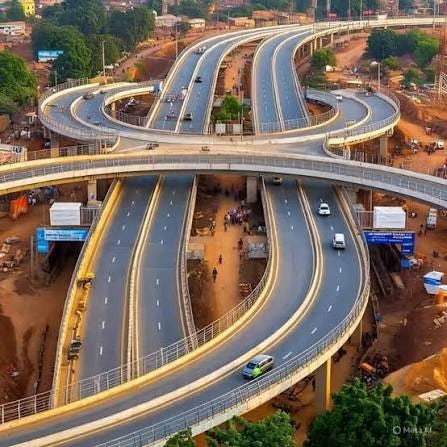
President Bola Tinubu has issued a strikingly blunt directive to Nigeria’s state governors regarding their fiscal priorities. During a recent meeting at the State House on 30 July 2026, the President specifically instructed governors to abandon the construction of politically popular but economically sterile urban infrastructure projects. He singled out the widespread practice of building massive flyovers in locations completely devoid of significant traffic. Instead, he argued, these massively increased state revenues must be aggressively redirected into foundational human capital development. He specified that governors must rapidly increase funding for primary healthcare, basic foundational education, and rural poverty alleviation. He maintained that these direct investments in human capital are the absolute bedrock of any sustainable economic recovery.
This presidential rebuke occurs against the backdrop of an unprecedented surge in state-level financial resources. Tinubu pointedly reminded the delegation, which included former Oyo State Governor Rashidi Ladoja, that current governors are collecting exponentially higher allocations than any previous administration. Following the highly controversial removal of the petrol subsidy in 2023, the monthly federal disbursements to states have ballooned. The President noted that states are essentially receiving four to five times their historical revenues, completely eliminating the need to borrow money merely to pay civil service salaries and pensions. Consequently, Tinubu argued that there is absolutely no fiscal excuse for states failing to deliver tangible improvements in the daily lives of their poorest citizens.
This demand for human capital investment strongly aligns with the federal government’s massive new social intervention push. Earlier in July, Tinubu formally launched a sweeping $3 billion social protection and human capital development package. This package, heavily supported by the World Bank, includes the $1.5 billion Human Capital Opportunities for Prosperity and Equity (HOPE) initiative. The HOPE programme specifically targets severe deficits in foundational literacy, basic numeracy, and primary healthcare delivery at the ward level. It fundamentally aims to upgrade roughly 65,000 public primary schools and significantly boost quarterly visits to primary healthcare centres nationwide. The President’s message to the governors is clear: the federal government is pivoting heavily toward human capital, and the states must actively mirror this financial commitment.
The President’s frustration highlights a chronic, structural dysfunction within Nigerian state governance. For decades, governors have heavily favoured highly visible “legacy projects” like massive concrete flyovers, vast state secretariat complexes, and sprawling international airports. These gigantic concrete structures are incredibly easy to commission on national television during election cycles. However, a massive flyover in a sleepy provincial capital provides absolutely zero economic value if the surrounding rural communities lack basic clinics or functional primary schools. These vanity projects routinely consume billions of naira that could otherwise stock rural pharmacies, train specialised teachers, or provide clean water to agrarian communities. The President essentially accused the governors of prioritising political optics over actual human survival.
Tinubu also explicitly linked this failure to invest in rural infrastructure to the nation’s severe internal security crisis. He argued that instead of building empty flyovers, governors should be constructing basic arterial road networks into remote, deeply impoverished areas. He noted that extreme poverty and total state absence create the perfect breeding ground for banditry and insurgency. Furthermore, he argued that without basic road infrastructure, federal security agencies simply cannot physically penetrate these remote areas to protect citizens or combat kidnapping syndicates. He directly connected the lack of rural development to the escalating kidnappings plaguing regions like the Sahel and Northern Nigeria.
Ultimately, the President is demanding a complete philosophical shift in how state governors define “development.” He is insisting that true economic progress is not measured in the tonnage of concrete poured in the state capital. It is measured in the reduction of learning poverty, the expansion of maternal healthcare access, and the creation of sustainable rural livelihoods. The massive windfall from the subsidy removal has finally given the states the financial capacity to execute this shift. However, as the President clearly recognises, financial capacity is entirely useless without the political will to spend it on the people who desperately need it most.
Winners: Vulnerable rural communities, primary school teachers, and local healthcare workers who stand to benefit directly if state governors actually heed this directive and reallocate funding toward human capital.
Losers: State governors who rely on commissioning massive vanity infrastructure to secure re-election, and the large construction syndicates that traditionally secure these lucrative, politically motivated public works contracts.
Bottom Line: A state government that builds massive concrete flyovers over populations dying in unequipped primary clinics is fundamentally failing its basic social contract.