


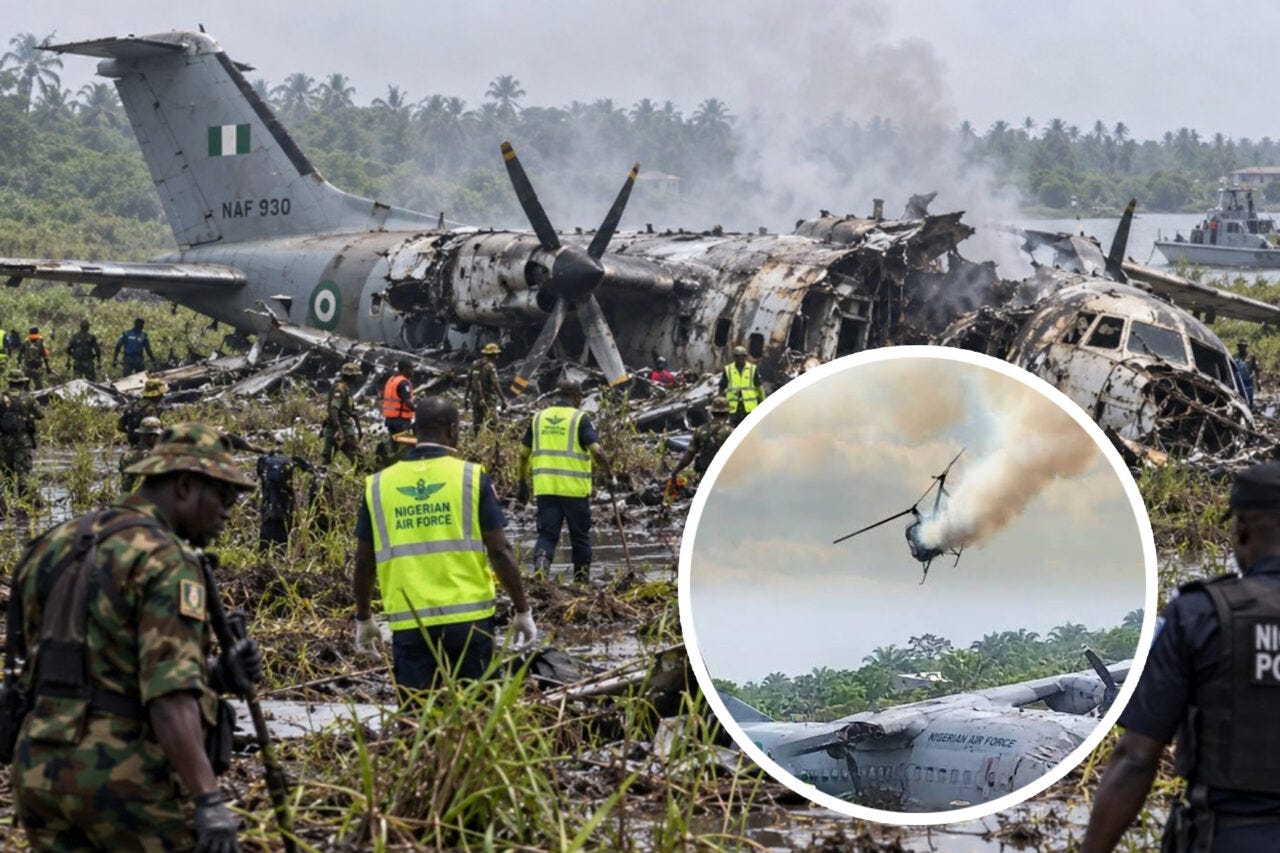
A Nigerian Air Force ATR-42 aircraft crashed near a naval base in the Igbokoda area of Ondo State on Monday, killing all 32 people on board. The aircraft, with tail number NGR 931, was on a routine mission from Benin, Edo State, to Lagos. It carried 25 passengers and seven crew members.
President Bola Tinubu declared a three-day national mourning for the personnel and directed that flags be flown at half-mast throughout the country. “This is a painful moment for our Armed Forces and for the entire nation,” Tinubu said in a condolence message to the Chief of Air Staff, Air Marshal Sunday Aneke. “Our Air Force personnel put their lives on the line every day to secure Nigeria. Their sacrifice will never be forgotten.”
Tinubu directed the Nigerian Air Force to immediately commence a thorough investigation into the cause of the crash to prevent future occurrences. He commended the Air Force for activating an immediate search and rescue operation. The Air Force will release the officers’ names after contacting their families.
The Nigerian Civil Aviation Authority and the Nigerian Safety Investigation Bureau offered technical assistance. The Nigerian Navy’s Forward Operating Base in the state joined the rescue effort. Governor Lucky Aiyedatiwa of Ondo State directed the State Emergency Management Agency, the Ministry of Health and security agencies to mobilise support. He ordered the crash site cordoned off to allow responders to operate without hindrance.
Aviation Minister Festus Keyamo noted that control and regulation of military aircraft are “completely outside the authority of the Ministry of Aviation and the civil aviation authority.” The ATR-42 is a twin-engine turboprop used for regional transport. It is certified for civil and military operations.
This mirrors the pattern of military air accidents in Nigeria, which have claimed senior officers and personnel in recent years. In 2021, a Beechcraft King Air 350 crashed near Kaduna, killing the Chief of Army Staff, Lt Gen Ibrahim Attahiru, and ten others. In 2019, a Nigerian Air Force helicopter crashed in Damasak, Borno State. The accidents raise recurring questions about maintenance, airworthiness and operational tempo. The investigation will determine whether this was mechanical failure, human error or something else.
The human stakes are about the 32 families who lost loved ones. The officers were on a routine mission. They were not in combat. They died in transit. The mourning period is a national acknowledgment of their service. The investigation is the accountability mechanism. The families deserve both.
Winners and Losers
Winners: The Nigerian Air Force, which responded rapidly and coordinated with civil and naval authorities. The Ondo State Government, which mobilised support and secured the crash site.
Losers: The 32 people on board and their families. The Nigerian Air Force, which faces another crash and the investigation that follows. The aviation sector, which loses confidence with each accident. Nigerian taxpayers, who fund investigations that rarely produce accountability.
Bottom Line: A three-day mourning is a gesture. An investigation is a process. Thirty-two lives are gone. The families deserve answers that outlast the flags at half-mast.