


A quiet epidemiological disaster is unfolding across the African continent, threatening to overturn four decades of public health strategy and expose over 126 million urban residents to a disease historically confined to rural hinterlands. The culprit is Anopheles stephensi, an invasive, city-dwelling mosquito species native to South Asia and the Persian Gulf. Unlike native African vectors such as Anopheles gambiae, which breed primarily in clean, temporary rain pools in rural villages, An. stephensi thrives in human-made urban environments. It breeds prolifically in overhead concrete water tanks, plastic jerrycans, open drains, and discarded tyres. Following warnings issued on 5 August 2026 by international public health authorities, the rapid movement of this vector across East Africa, the Horn of Africa, and into West African transport corridors represents an existential threat to municipal healthcare systems that are fundamentally unequipped to handle urban malaria surges.
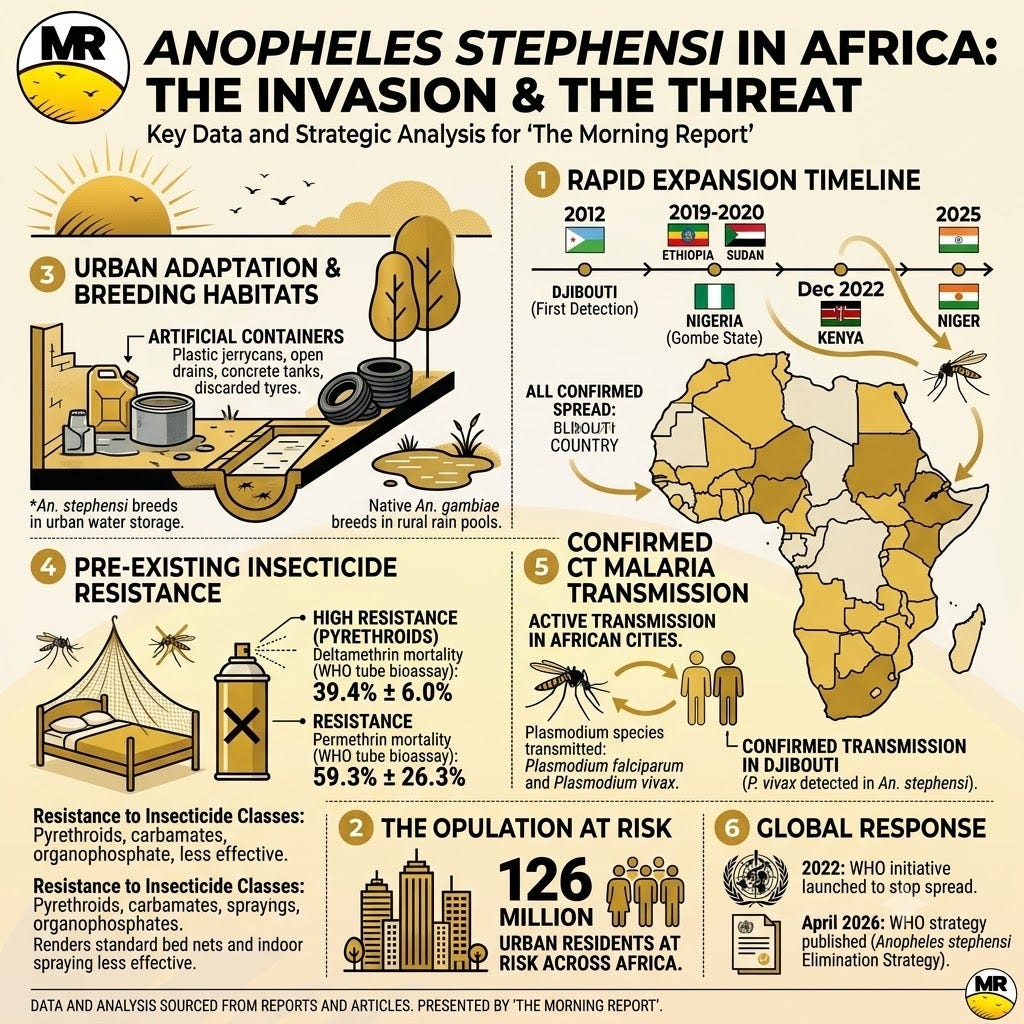
The structural danger posed by this species lies not merely in its geographic flexibility, but in its formidable biological resilience. Speaking on 31 July 2026 following a landmark genomic tracking study, Dr Tristan Dennis, a lead vector researcher at the Liverpool School of Tropical Medicine, pointed out that the insect did not adapt to insecticides after entering the continent. Instead, genomic analysis reveals that the species arrived at African maritime ports from South Asia already pre-equipped with high levels of resistance to pyrethroids and carbamates, the primary chemical classes used in bed nets and indoor spraying programmes. Dennis emphasised that Djibouti acted as an initial invasion bridgehead, from which maritime shipping and long-haul trucking routes rapidly seeded secondary fronts across Ethiopia, Yemen, Sudan, and West Africa. The mosquito arrived carrying a complete genetic toolkit for survival against standard vector control tools.
This physiological resistance renders traditional African malaria control frameworks almost entirely obsolete in urban zones. Addressing a public health forum in Addis Ababa on 2 August 2026, Professor Delenasaw Yewhalaw, a renowned medical entomologist at Jimma University, explained that African national malaria elimination programmes have spent billions of dollars over two decades perfecting rural interventions. He noted that hanging long-lasting insecticidal nets over beds offers minimal protection against An. stephensi, which bites outdoors during early evening hours and feeds readily on both human and animal hosts. Yewhalaw warned that because millions of urban households lack reliable municipal pipe-borne water, residents are forced to store water in open drums and unsealed plastic tanks. In doing so, urban populations are inadvertently cultivating massive, hyper-local breeding grounds inside their own living compounds.
The consequences for clinical care are already becoming visible in East African municipalities, where unexpected spikes in urban transmission are straining municipal clinics. Dr Ngashi Ngongo, a senior vector control specialist with the Africa Centres for Disease Control and Prevention, addressed the operational fallout during an emergency briefing on 3 August 2026. He highlighted that An. stephensi efficiently transmits both Plasmodium falciparum, the deadliest malaria parasite, and Plasmodium vivax, which can lie dormant in the human liver and cause recurring relapses. Ngongo observed that city healthcare workers, historically accustomed to treating urban fever cases as typhoid, dengue, or general viral infections, are failing to diagnose malaria early. This diagnostic delay leads to severe complications, severe anaemia in children, and elevated fatality rates in densely populated informal settlements.
The prospective expansion into West Africa’s massive coastal megacities presents a nightmare scenario for regional planners. Dr Olusola Adeyemi, an urban epidemiology consultant based in Lagos, evaluated the local risk profile during a health policy roundtable on 4 August 2026. He stated bluntly that a city like Lagos or Accra, characterised by intense population density, millions of unsealed water storage containers, and thousands of kilometres of clogged greywater channels, represents an ideal biological paradise for An. stephensi. Adeyemi stressed that if the vector establishes a permanent footing in West Africa’s commercial hubs, the resulting economic toll from worker absenteeism, emergency clinical hospitalisations, and diverted municipal resources will run into hundreds of millions of dollars annually.
Countering this invasive vector requires a total pivot from traditional bed-net distribution to aggressive, capital-intensive urban engineering and biosecurity. Speaking on 1 August 2026, Professor Endalamaw Gadisa, Director General of the Armauer Hansen Research Institute, stressed that containment demands systematic Larval Source Management, including treating urban standing water with biological larvicides, deploying genetic surveillance at major seaports, and enforcing strict municipal water storage regulations. However, Gadisa warned that executing these measures requires functional local government administration, constant inter-agency coordination, and sustained municipal funding, three commodities that remain severely lacking across much of sub-Saharan Africa.
Ultimately, the spread of An. stephensi exposes the broader fragility of African urban infrastructure. Decades of unmanaged urbanisation, characterised by sprawling informal housing and crumbling water networks, have created the exact ecological conditions for an invasive parasite vector to flourish. Managing fiscal deficits and foreign exchange volatility has routinely taken precedence over basic urban sanitation and vector surveillance. Until African governments recognise that municipal infrastructure, clean pipe-borne water, and closed drainage systems are fundamental prerequisites for public health defence, millions of city dwellers will remain completely vulnerable to an aggressive, insecticide-resistant swarming vector.
Winners: Pharmaceutical manufacturers producing novel, non-pyrethroid larvicides and specialised diagnostic combination tests designed to detect multi-species parasite strains.
Losers: Urban city dwellers and municipal health authorities, who face exploding clinical healthcare costs and seasonal disease surges across heavily populated cities historically unequipped for malaria transmission.
Bottom Line: Traditional bed nets cannot stop an urban mosquito that breeds in water storage jerrycans and bites outdoors; containing An. stephensi requires piped water, functioning drains, and municipal biosecurity that African cities have consistently failed to deliver.