


The 32nd Nigerian Economic Summit met in Abuja under a theme of jobs, productivity and shared prosperity. Senator Abubakar Atiku Bagudu, Minister of Budget and Economic Planning, addressed the hall. He was clear. There will be no return to the petroleum subsidy. He said the government will stay the course. He acknowledged the need to “calibrate and do better”. He cited two consecutive quarters of growth. He cited moderating inflation and borrowing costs. He cited federation allocations rising, with some subnational tiers recording more than fivefold increases. He cited over $6 billion mobilised from the World Bank and other partners. The narrative was structural transformation and a $1 trillion economy.
Outside the security perimeter, the conversation is different. On the streets of Lagos, Kano, Port Harcourt and Enugu, the subsidy removal of May 2023 remains the most volatile fact of daily life. Global energy shocks and currency depreciation made it worse. Petroleum pricing is no longer a line item. It is the engine of transport, food and service costs. It is also the sharpest political wire in the country.
The data
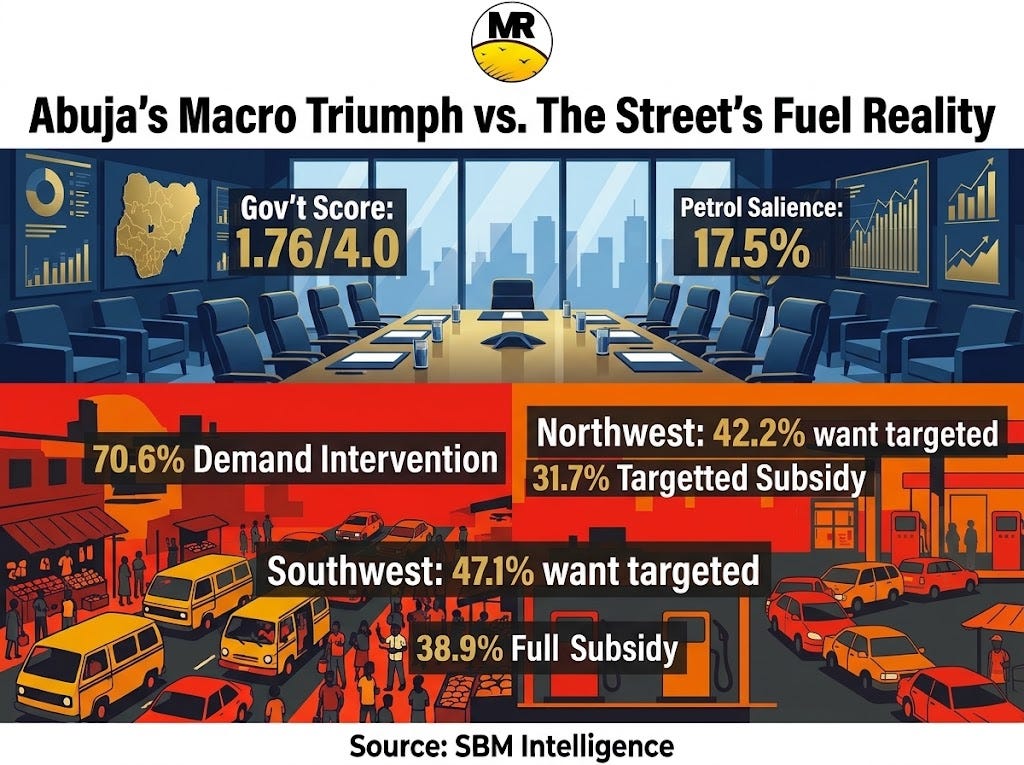
The SBM Intelligence Voter Sentiment Tracker, Wave 2, quantifies the gap. Petroleum costs rank second among voters’ primary anxieties nationwide. It captures 17.5% of responses, just behind insecurity. More telling is the competence score. Petrol pricing is the single poorest-scoring issue for the administration, with a mean rating of 1.76 on a four-point scale. One means very poor. Across almost every zone, petrol matches or outranks every other economic grievance. Fuel is not a statistic. It is the cost of breathing.
On policy, the rejection of the status quo is overwhelming. 70.6% of Nigerians want some form of government intervention. 38.9% want full reinstatement of the subsidy. 31.7% want a limited, structured or targeted intervention. Only 18.1% support complete removal with no mitigation.
The geography sharpens the picture. Petrol salience is highest where transport dependency and commercial distribution are heaviest. In the South-South, 29.2% rank petrol as their primary or secondary economic worry. In the Southwest, the figure is 30.5%.
There is an opening the government has not taken. In the Southwest and Northwest, the zones that have moved most decisively toward the incumbent, support for a targeted subsidy rather than a blanket market price stands at 47.1% and 42.2% respectively. The electorate is not closed to reform. It is asking for an institutional cushion against volatility. That is a policy question, not a philosophical one.
The street
Inside the bus parks, fiscal consolidation has a price. Musiliu Olayiwola drives a danfo in Lagos. He has fifteen years on the road. He did not engage with the summit’s language. He engaged with his fuel receipts. “When they sit in Abuja talking about macroeconomic stability and GDP growth, do they look at what we buy petrol for every morning?” he asked. Every pump increase raises spare parts and food. Passengers fight over fares because they have no money either. “We are working from morning till night just to buy fuel and pay levies,” he said. His demand was specific. If subsidy is not returning, fix the refineries so Nigerians can buy their own fuel cheaply. “We cannot continue surviving on promises while the price of fuel controls our breathing.”
Online, the reaction was immediate. Chidera Ezenwa, a Lagos-based writer and civic commentator, framed the psychological exhaustion. “You cannot preach the gospel of a $1 trillion macro economy to a citizen who spends ₦70,000 out of a ₦100,000 monthly salary just on transportation and basic food,” she wrote. Balance sheets capture oil revenues and higher tax yields. Households liquidate assets to eat twice a day. “Staying the course without an effective social safety net is not economic discipline; it’s economic exhaustion.”
In Kano, the cost travels by truck. Alhaji Balarabe Koki is a grain merchant and distributor. He explained what fuel does to food before it reaches a stall. “People think fuel subsidy only affects car owners,” he said. Moving maize, beans or millet from rural farms to urban markets requires heavy trucks. When diesel and petrol prices triple, transport doubles the price of food. He acknowledged the minister’s fivefold allocation increase. He asked where it shows in the markets. “Our people are hungry, and no amount of statistical growth can substitute for a plate of food.”
The political calculus
The 2027 election is approaching. The uncompromising subsidy stance is a gamble. SBM’s data shows the incumbent has engineered a 55-point net favourability rebound. It rose from -58.5 in May 2026 to +2.7. That is survivable. It is not comfortable.
The vulnerability is twofold. Petrol pricing is the single issue where the administration scores lowest across every demographic and geographic segment. And the coalition underpinning the recovery is concentrated in rural and small-town areas. Those are the places where fuel and transport costs hit agrarian and trading communities hardest. Rural economies rely on affordable fuel for haulage, irrigation and local transport. An unyielding refusal to calibrate petroleum pricing risks fracturing the very base that currently sustains the reelection prospects.
Opposition parties have noticed. Their rhetoric has shifted toward relief and subsidy recalibration. The ruling party insists that a return to the old regime would bankrupt the federation. The opposition points to the 70.6% mandate for some form of support. Both claims have merit. Only one will win votes.
The urban-rural cleavage is stark. Urban respondents score the government poorly across almost all governance metrics. They lean heavily toward opposition platforms. Rural respondents gave the incumbent his recent gains. Community solidarity and agricultural initiatives provided a mild cushion. That cushion is thin. It depends on fuel prices staying within reach. If they do not, the gains reverse.
The historical anchor
This is not Nigeria’s first subsidy standoff. In 2012, the Jonathan administration attempted partial removal. The Occupy Nigeria protests forced a compromise. In 2016, the Buhari administration raised prices and survived the backlash. In 2023, Tinubu removed the subsidy entirely and floated the naira. Each time, the government argued that the fiscal cost was unsustainable. Each time, the public argued that the social cost was unbearable. Each time, the government won the policy argument and lost the political one, or the reverse.
The difference now is the scale. The old regime cost an estimated $10 billion to $15 billion annually. The CPPE puts a restored universal subsidy at roughly ₦19 trillion a year. That is not affordable. But the public is not asking for the old regime. 31.7% want a targeted structure. 47.1% of the Southwest and 42.2% of the Northwest want calibration. That is the middle ground. The government has the data. It has not acted on it.
The $6 billion question
Bagudu’s assurance of over $6 billion in multilateral support is a step. Social safety nets, agricultural productivity and mass transit are the right priorities. The problem is speed and visibility. A citizen calculating a daily transport budget does not see a World Bank facility. He sees the pump. He sees the price. He sees the queue.
The palliative rollout has been criticised as slow and poorly targeted. Cash transfers reach a fraction of the poor. CNG conversion is expanding but concentrated. Refinery output is rising but prices have not fallen. The gap between announcement and experience is where trust erodes.
Winners: The Federal Government, which holds the fiscal line. The treasury, which retains revenue. Multilateral partners, who see reform discipline. Domestic refiners, who benefit from import parity pricing. Investors, who gain predictability. The opposition, which gains a campaign issue from the government’s refusal to calibrate. Losers: Households, who spend a growing share of income on transport and food. Danfo drivers, whose margins vanish at the pump. Grain merchants, whose logistics costs double. Rural voters, whose support is contingent on affordability. The poor, who have no cushion. The government, if the rural base fractures. The economy, if consumption collapses.
Bottom Line
Bagudu said there will be no return to subsidy. He is right on the fiscal logic. He is wrong on the politics. 70.6% of Nigerians want some form of intervention. A targeted structure is available and popular in the zones that matter most. The government can hold the line or calibrate it. It cannot do neither and expect the rural coalition to hold. The pump is the policy. The policy is the election. And the election is coming.