


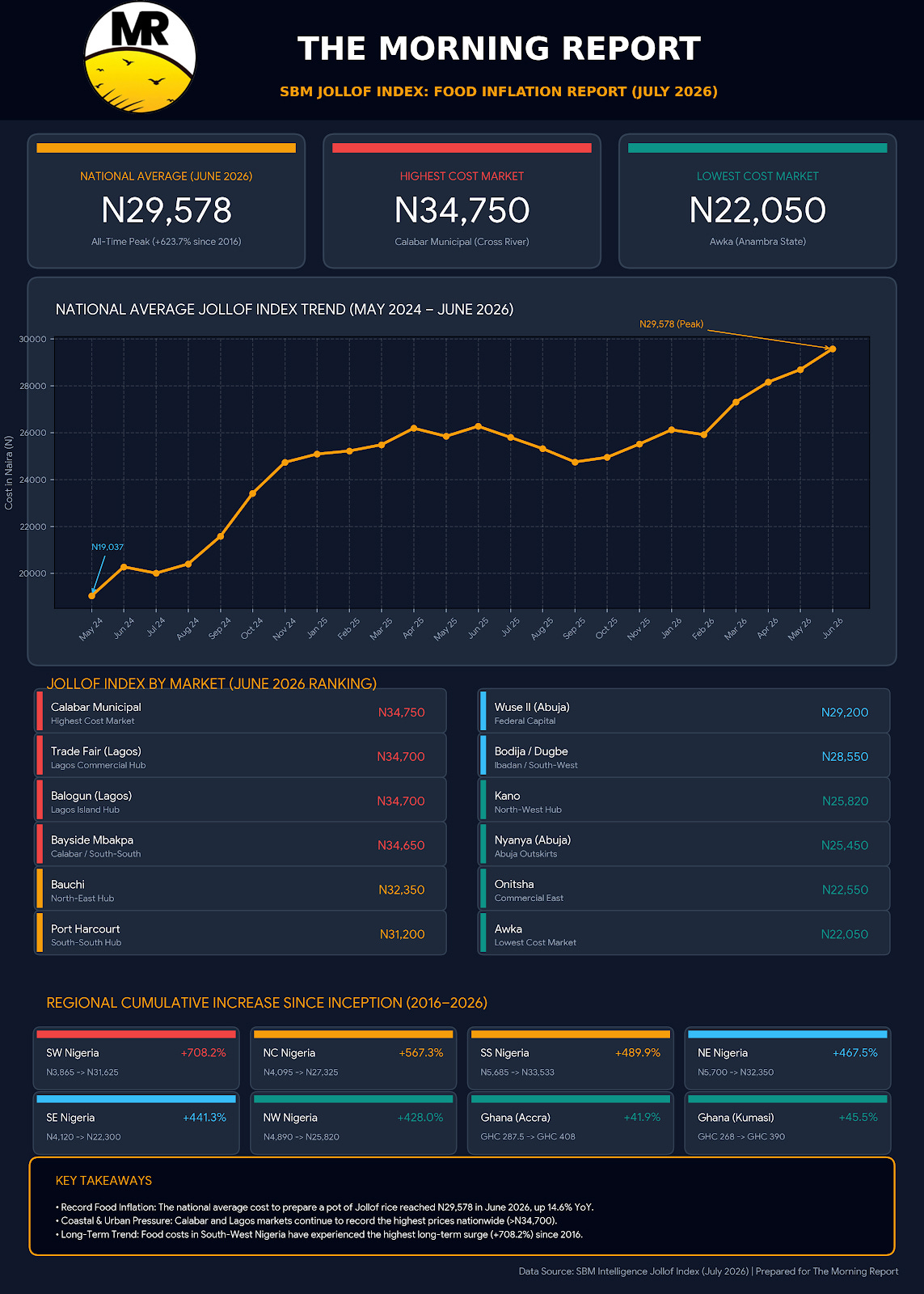
The quintessential Nigerian meal has officially become an extreme luxury item. A recent data analytics report from SBM Intelligence tracking domestic food costs reveals a terrifying economic reality. The national average cost of cooking a standard pot of jollof rice reached ₦29,578 in June 2026. This represents a 14.6% increase from July 2025. Over a ten-year period, the price explosion appears truly catastrophic. The index climbed from just ₦4,087 in July 2016 to the current mark. This represents a staggering 624% increase over a single decade.
We must humanise this brutal metric to understand the deep social fracture it represents. The new national minimum wage currently stands at ₦70,000. This means a minimum wage earner must spend over 40% of their monthly salary to cook one family meal. A single pot of rice, tomatoes, and basic protein now consumes nearly half a month of labour. This mathematical reality destroys any lingering illusion of a growing Nigerian middle class. People are working full time merely to afford basic calories.
The report collected monthly price data on twelve key ingredients across thirteen regional markets. It tracked items like rice, vegetable oil, beef, pepper, onions, and seasoning cubes. Protein continues to account for the largest share of the cooking cost. Meat has become increasingly unaffordable for the average urban household. The widening gap between different regional markets exposes a deeply fragmented internal economy.
Calabar Municipal is currently the most expensive market in the country for this meal. Preparing the dish there costs an astronomical ₦34,750. In stark contrast, Awka in the Southeast remains the cheapest market at ₦22,050. The difference of over ₦12,000 between two Nigerian cities highlights massive supply chain inefficiencies. The Southeast benefits from much shorter supply chains and a very strong local farming culture. They rely significantly less on long-distance haulage.
Meanwhile, Lagos experienced the sharpest price acceleration nationwide over the past year. Markets like Trade Fair and Balogun saw costs jump by nearly 50%. Lagos functions as the primary import gateway for the entire country. It absorbs the direct shocks of currency depreciation and soaring international shipping costs. When the Naira weakens at the ports, the Lagos consumer feels it instantly at the local market. The city essentially imports global inflation.
The root causes of this crisis extend far beyond simple monetary policy. High fuel prices and a total collapse in transport logistics are the primary drivers. The conflict in the Middle East pushed global crude prices sharply upward. This directly inflated the cost of the diesel required to move food across the country. A truck moving grains from northern farms to Abuja now pays exorbitant freight fees. Logistics operators immediately pass these compounded transport costs down to the final consumer.
Economic experts warn that the government is fundamentally misdiagnosing the problem. Muda Yusuf directs the Centre for the Promotion of Private Enterprise. He issued a blunt policy brief on 16 July 2026 regarding the escalating situation. He warned that this renewed acceleration in food prices severely undermines Nigeria’s fragile macroeconomic stability. He noted that current inflation reflects persistent supply-side constraints. He explicitly listed rural insecurity, high transport costs, and supply chain disruptions as the main culprits. He argued that the central bank cannot resolve these physical challenges using monetary policy.
The survival tactics on the streets are increasingly desperate and depressing. Consumers are entirely abandoning bulk purchases in favour of micro retail. They are substituting beef for cheaper smoked fish and drastically reducing their portion sizes. A Lagos food vendor described the daily household calculus during a market survey on 22 July 2026. She noted that families cannot simply remove the rice from a jollof dish. However, she explained that cooks make the rice go further by adding extra water. She said they intentionally use fewer expensive ingredients to stretch the meal. This is not economic resilience, but rather a slow surrender to malnutrition.
Despite these grim street-level realities, Abuja maintains a stubbornly optimistic narrative. The Ministry of Agriculture insists that its structural interventions are actively working. Abubakar Kyari serves as the Minister of Agriculture and Food Security. He addressed an agricultural gathering in Zaria on 17 July 2026. He boldly claimed that the government plans to increase national grain output to 25 million tonnes. He insisted the administration remains fully committed to reducing food inflation through local production rather than expensive imports. He then made a highly controversial assertion. He claimed that government interventions have already caused prices of essential food commodities to drop by 50% nationwide.
State-backed lenders echo this official government optimism. Ayodeji Sotinrin is the Managing Director of the Bank of Agriculture. He also spoke at the Zaria agricultural summit on 17 July 2026. He defended the government’s strategy of providing subsidised fertilisers and seeds to smallholder farmers. He explained that the intervention offers essential inputs through a single-digit financing facility. He argued that this partnership between the government and local farmers will guarantee long-term food sovereignty. He predicted that this initiative would eventually meet domestic demand and create massive agricultural export opportunities.
There is a massive disconnect between the government’s future projections and the citizens’ present hunger. Promising 25 million tonnes of future grain does not help a family starving today. Handing out subsidised fertiliser is completely useless if armed militias prevent farmers from harvesting their crops. The state is attempting to fix a severe security and logistics crisis using basic agricultural financing tools. It is a fundamental mismatch of policy and reality.
This situation strongly echoes the painful structural adjustment programmes of the 1980s. During the Babangida era, the state rapidly withdrew agricultural subsidies and price controls. The government promised that exposing farmers to the free market would trigger massive agricultural growth. Instead, it triggered immediate hyperinflation and widespread urban poverty. Today, the government has similarly removed fuel subsidies while promising future agricultural abundance. The citizens are once again absorbing the immediate price shocks while waiting for a promised harvest.
Climate change is also acting as a vicious threat multiplier across the agricultural belt. Heavy rainfall and severe flooding have recently devastated vegetable harvests. Bauchi witnessed extreme tomato inflation, with prices rising over 200% due to weather disruptions. The torrential rains destroy the already fragile rural road networks. Trucks get trapped in mud for days, causing perishable goods to rot before reaching urban centres. This artificial scarcity drives market prices even higher.
The data reveals that food inflation is hardening fast in real dollar terms as well. The cost of cooking the meal rose from roughly $14 in 2023 to nearly $22 in 2026. This proves that the problem is not just domestic currency devaluation. The actual physical cost of producing and moving food has fundamentally increased. Every single ingredient in the basket became much more expensive to move, store, and sell.
The government cannot secure the farms, and it cannot fix the rural roads. Therefore, the urban middleman capitalises massively on the resulting chaos. Aggregators buy whatever small harvest makes it out of the conflict zones. They hoard these goods in secure urban warehouses and dictate punishing prices to desperate consumers. This dynamic transfers wealth directly from the hungry citizen to the connected commodity trader.
A country that cannot feed its citizens cheaply is a country constantly teetering on the edge of unrest. Food inflation is the single most dangerous economic metric for any developing economy. When a basic cultural staple becomes mathematically unaffordable, the social contract breaks completely. The state must stop measuring success by the amount of seeds it distributes to farmers. It must start measuring success by the final price of food on a local plate.
Winners: Urban commodity aggregators and logistics operators who exploit supply chain bottlenecks to charge massive premiums on basic food items.
Losers: Minimum wage earners and small households who lose their purchasing power, forced to dedicate nearly half their income to a single meal.
Bottom Line: Until the government physically secures rural farming communities and fixes logistics, any agricultural financing policy will simply subsidise inflation rather than reduce it.