


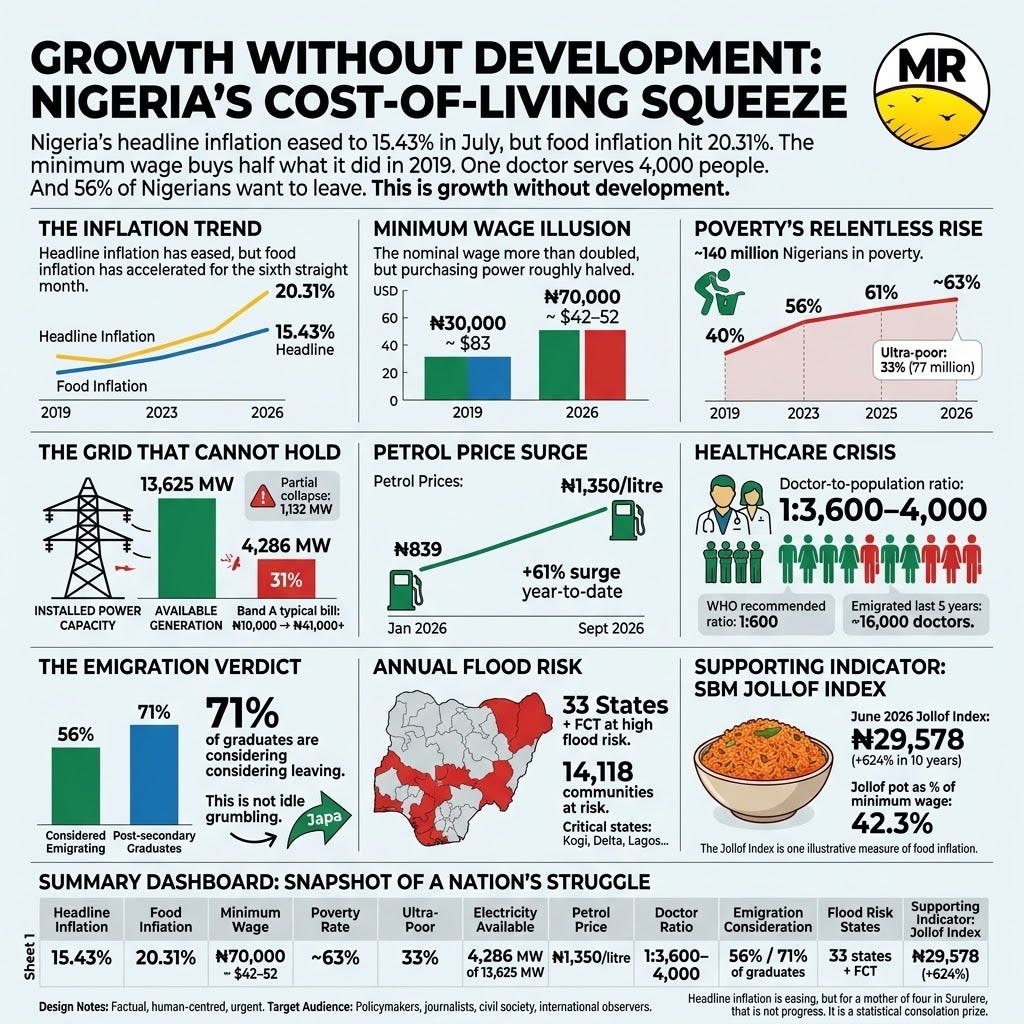
In Surulere, Lagos, the morning trip to the market has become an exercise in quiet desperation. Mrs Funmi Adeleke, a mother of four, stands before stalls of yam, gari and vegetables with a shrinking wad of banknotes. Official economic announcements feel entirely detached from her physical reality. The National Bureau of Statistics reported that headline inflation eased slightly to 15.43% in July 2026. Behind that top-line moderation lies a harsher truth. Food inflation accelerated for the sixth consecutive month, climbing to 20.31%. For Adeleke and millions of caregivers across Nigeria’s urban centres, a fractional dip in general inflation offers zero relief when the cost of feeding a household keeps rising. It is not progress. It is a statistical consolation prize.
Speaking on 10 September 2026, Adeleke said her weekly food budget now buys less than half of what it secured two years ago. Every market visit yields smaller quantities of basic staples. She has cut back on protein and fresh produce for her growing children. Local traders adjust prices upwards every few days to reflect rising transport costs. Official figures claiming inflation is slowing, she said, sound like an insult to families struggling to put a single decent meal on the table.
The arithmetic of a payslip
The erosion of living standards is laid bare by the decay of national income thresholds. Nigeria’s statutory minimum wage sits at ₦70,000 a month. With the naira trading near ₦1,400 to the United States dollar, that floor equates to about $42. When the previous minimum wage of ₦30,000 was enacted in 2019, it was worth roughly $83 at the rates of the day. The nominal figure has more than doubled. Its real purchasing power has roughly halved. This brutal arithmetic explains why ordinary Nigerians speak about their economy not with abstract optimism, but with deep, pervasive anxiety.
This hardship sits on a longer continuum. Nigeria has weathered severe cost-of-living crises before. The 1986 Structural Adjustment Programme enforced aggressive naira devaluations and sharp subsidy cuts. It triggered widespread domestic austerity. The 2016 recession, precipitated by a global oil price crash and an unsustainable currency peg that depleted reserves, exposed the fragility of a monoculture economy. Each shock produced a distinct wave of outward migration. Economic historians argue the current crisis differs in structural depth and social breadth.
Dr Bamidele Opeyemi, a senior fellow in public policy and economic history at the University of Lagos, offered a diagnosis on 11 September 2026. Previous downturns featured cyclical recovery windows driven by oil market rebounds. The contemporary crisis, he said, represents a deep, systemic compression of household wealth. Despite high-level policy shifts and revenue reforms, growth has failed to translate into structural poverty reduction. Analysts call it growth without development. The economy expands on paper while impoverishing its citizens in practice.
The poverty numbers
The human dimension of that failure is in the data. World Bank projections put the share of Nigerians living in poverty at about 63% heading into 2026. That is up from roughly 56% in 2023. In absolute terms, between 129 million and 141 million citizens live below national poverty lines. For a country with vast agricultural land, major oil deposits and a young workforce, the expansion of poverty across urban and rural centres points to a profound breakdown in the distribution of national wealth.
The invisible tax of power
Compounding the food crisis is a fractured energy infrastructure. It acts as an invisible tax on every aspect of daily life. Nigeria has about 13,625 megawatts of installed generation capacity. In April 2026, average available generation hovered at a meagre 4,286 megawatts. The national fleet operated at roughly 31% of its design potential. Grid fragility remains constant. The national grid suffered a total collapse on 23 January 2026. It partially collapsed again on 22 August, when nationwide generation plunged to 1,132 megawatts from over 4,000 earlier that day.
To offset the shortfall, authorities reclassified selected urban neighbourhoods into premium Band A supply corridors. The promise was minimum daily hours of power in exchange for steep tariff hikes. For many consumers, the burden has proven overwhelming. Households reclassified into Band A report monthly bills leaping from ₦10,000 to over ₦41,000. Residents in gated estates receive quotes between ₦50,000 and ₦70,000. Many still get as little as four to six hours of supply on bad days.
Engr Chidi Nwachukwu, a light manufacturer and workshop manager in Ikeja, described the operational strain on 12 September 2026. Energy costs now devour more than 40% of his total overhead. When the grid fails, his business switches immediately to fossil-fuel generators. Petrol prices hovered between ₦1,100 and ₦1,400 per litre through late 2026. Running a small generator for four hours an evening inflicts a crushing penalty that must be passed to already impoverished consumers. Small enterprises across the country are shutting down because the combined cost of grid tariffs and generator fuel exceeds their monthly turnover.
Flooding as a budget line
Add to that the recurring environmental tax of seasonal flooding. It has become an expected annual budget line for millions of vulnerable families. Emergency management authorities issue seasonal alerts with grim regularity. They warn communities along the riverine basins of Benue, Kogi, Anambra, Delta, Bayelsa and Rivers states. In affected towns, residents no longer treat flood warnings as extraordinary news. They treat them as an inevitable seasonal disaster that displaces households, destroys yields and forces families to rebuild from scratch each year, without adequate social insurance.
The health system’s silent crisis
The public healthcare architecture is crumbling under resource constraints and accelerating brain drain. Data from the Nigerian Medical Association shows only about 55,000 doctors in active practice for a population exceeding 220 million. That is roughly one doctor for every 3,600 to 4,000 citizens. It is far below World Health Organization benchmarks. Over the last five years, about 16,000 Nigerian doctors have emigrated to Europe, North America and the Middle East. Outside Lagos, Abuja and a handful of federal teaching hospitals, specialised care has become so scarce it is almost theoretical.
Dr Amina Bello, a senior registrar and NMA committee member based in Ibadan, warned on 13 September 2026 that the public health system is on the verge of operational paralysis. Remaining professionals face extreme burnout. They work gruelling eighty-hour weeks for depreciated wages while equipment deteriorates without replacement. When skilled specialists leave en masse, patients with complex but manageable conditions lose access to life-saving interventions. A silent mortality crisis spreads across rural and semi-urban communities.
The japa verdict
The cumulative impact of unyielding inflation, failing infrastructure, environmental hazards, and declining public services has produced a societal shift. Nigerians call it the japa wave. Afrobarometer found that 56% of Nigerians have actively considered emigrating. That is a twenty-point surge from 2017. The proportion who reported thinking about leaving “a lot” has tripled to 33%. Among Nigerians with post-secondary qualifications, the desire to emigrate escalates to 71%.
This is not idle social media chatter or transient youth culture. It represents the productive core of a nation. Engineers, doctors, educators, technology developers and finance professionals are running the numbers on their own domestic future. The balance sheet no longer balances. In previous cycles, the emigrants were often those with nothing to lose. Now they have the most to offer.
Toluwalase Akinyemi, a 28-year-old software systems analyst finalising his visa documentation in Lagos, spoke on 14 September 2026. Leaving, he said, is no longer driven by luxury or ambition. It is driven by a basic requirement for predictability and security. Young professionals are tired of spending income on private security, private road repairs, private boreholes and private generators while savings lose value by the month. When an educated worker cannot see a viable path to homeownership, reliable healthcare or raising a family in dignity, departure becomes the only logical calculation left.
Winners: Private hospitals, private schools, generator sellers, solar installers and immigration consultants. Landlords in London, Toronto and Manchester, who receive Nigerian rent. Diaspora families, who remit billions and sustain relatives who stay. The World Bank and IMF, whose reform prescriptions are being implemented even as poverty deepens. The educated migrant, who gains predictability abroad.
Losers: Households paying twice for electricity, once to the discos and once to the generator. Patients in understaffed public hospitals. Students whose teachers have left. Farmers whose roads turn a ninety-minute journey into four hours. The 129 million to 141 million Nigerians living below the poverty line. Small manufacturers like Nwachukwu, whose margins vanish into fuel and tariffs. Nigeria itself, which trains the professionals it cannot keep.
Bottom Line: Nigeria is not one country. The distance between life in Surulere and life in a Zamfara farming hamlet is a matter of kind, not degree. When 71% of the educated workforce contemplates exit, that is a sovereign verdict on the national social contract. Statistical recalibrations will not reverse it. Only food, power, health and currency stability will.