


The federal government’s relentless rhetoric regarding a $1 trillion economy by 2030 is currently colliding with a massive wall of stubborn mathematical reality. The Tinubu administration has staked its economic legacy on this astronomical target, pitching it as the ultimate vindication of its deeply painful fiscal reforms. Following the explosive removal of the petrol subsidy and the aggressive unification of the foreign exchange market, government officials argue that the hardest structural work is finally over. However, the underlying arithmetic tells a significantly less optimistic story. To reach this monumental threshold by the end of the decade, Nigeria does not merely need steady improvement; it requires a prolonged, miraculous economic explosion reminiscent of China’s late-20th-century industrial boom. At the current trajectory, the rhetoric is vastly outperforming the reality.
Official government communications continue to project immense confidence, framing the current economic hardship as a necessary transitional phase. Addressing a major policy gathering on 30 July 2026, the Minister of Finance and Coordinating Minister of the Economy, Taiwo Oyedele, vehemently defended the administration’s timeline. He insisted that a $1 trillion economy by 2030 is a measurable target, not a mere political slogan. Oyedele argued that Nigeria has successfully completed the gruelling foundational phase of macroeconomic stabilisation. He maintained that the government’s immediate task is now converting that baseline stability into aggressive investment, and translating that investment into higher productivity and decent jobs. While his assessment of the recent stabilisation efforts is accurate, his timeline for exponential growth severely underestimates the deep structural rot inhibiting the real sector.
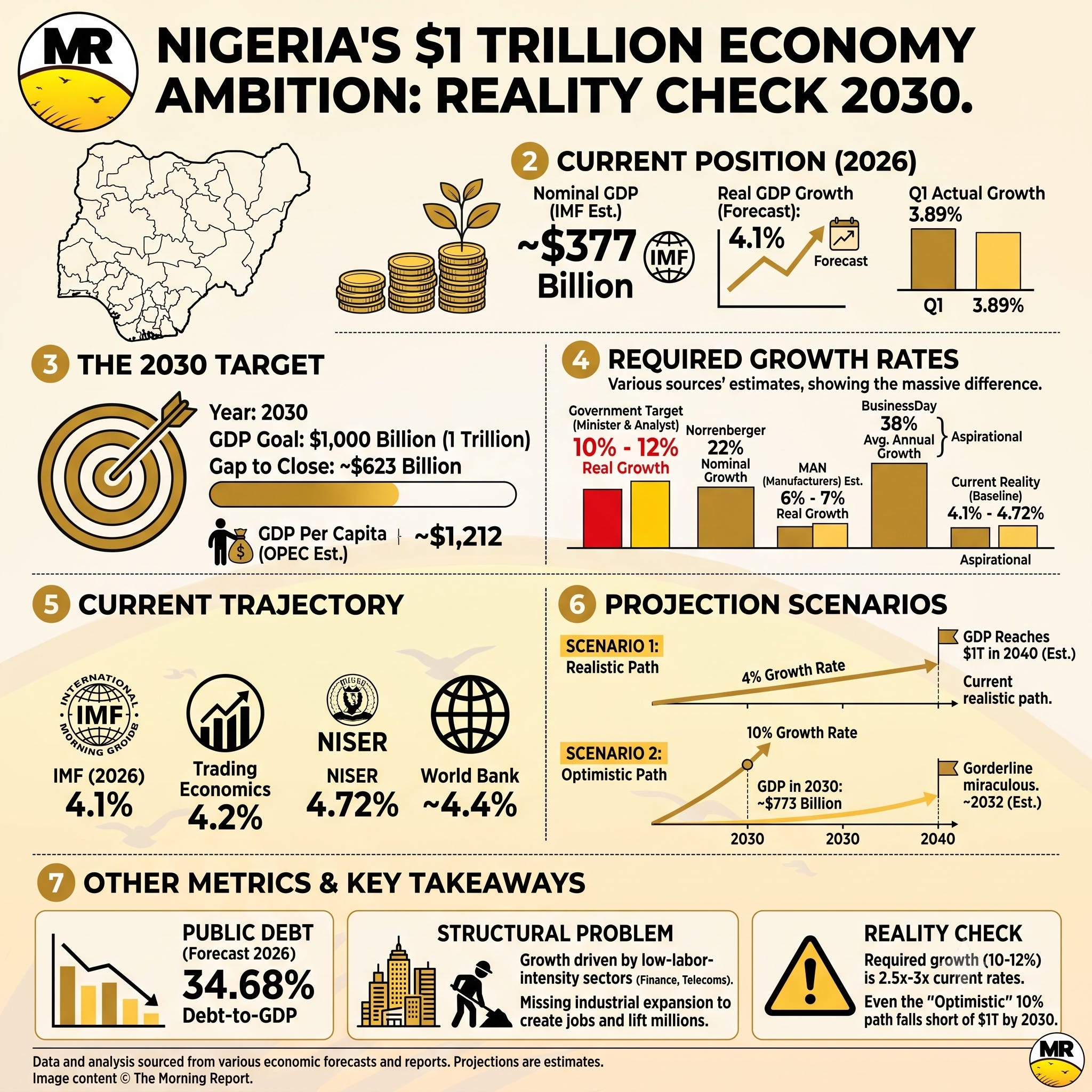
The quantitative gap between the government’s timeline and the required growth rate is staggering. Idris Oyekan, a senior analyst at Quantum Zenith, addressed this mathematical disconnect during a financial review on 28 July 2026. He stated unequivocally that Nigeria would need to sustain an annual economic growth rate of between 10 percent and 12 percent over the coming decade to achieve the $1 trillion ambition. This figure is wildly misaligned with the current reality. The International Monetary Fund’s baseline projection for Nigeria in 2026 hovers around a modest 4.4 percent. While this represents a marked improvement from the sluggish performance of the early 2020s, it is completely insufficient to cross the trillion-dollar finish line within the administration’s stated timeframe.
Detailed economic modelling further exposes the fragility of the 2030 target. Oluwatobi Ojabello, a lead economic analyst, published a comprehensive breakdown of the country’s growth scenarios in BusinessDay on 28 July 2026. His projections reveal a highly sobering timeline. If Nigeria remains on its current, realistic path of 4 percent annual real GDP growth—assuming standard currency depreciation and inflation deflators—the economy will only cross the $1 trillion threshold around 2040. Ojabello noted that even under a highly optimistic, bordering on miraculous, scenario of 10 percent annual growth with a broadly stable naira, the economy would still only reach approximately $773 billion by 2030. Under these perfect conditions, the target would only be hit around 2032. The raw numbers clearly indicate that the 2030 deadline is practically dead on arrival.
Beyond the raw percentages, the fundamental nature of Nigeria’s current growth is fundamentally flawed. The economy is currently expanding, but it is not creating the type of massive industrial base required to elevate millions out of poverty. Muda Yusuf, the Chief Executive of the Centre for the Promotion of Private Enterprise, highlighted this structural defect during an industry review on 28 July 2026. He issued a stark warning that Nigeria’s hard-won macroeconomic stabilisation has yet to translate into significant, broad-based improvements in productivity and competitiveness. He noted that while sectors like telecommunications and finance are driving headline GDP figures, they are not labour-intensive. An economy cannot reach $1 trillion on the back of bank profits and telecom data subscriptions while its manufacturing sector suffocates under catastrophic power deficits and predatory taxation.
Furthermore, the capital required to trigger a 10 percent growth rate will not enter an environment characterized by institutional unpredictability. Vice-President Kashim Shettima directly addressed this foundational weakness during a corporate governance summit in late July 2026. He accurately argued that Nigeria cannot possibly build a $1 trillion economy on a foundation of weak corporate governance. He warned that serious foreign and domestic investors will absolutely not commit long-term, productive capital to an environment where contracts are routinely violated, regulatory institutions are weak, and corporate abuses go unpunished. Shettima’s warning strikes at the heart of the crisis: Nigeria does not just need portfolio capital chasing high-yield treasury bills; it desperately needs patient capital that builds factories, mechanised farms, and export-oriented logistics hubs.
Ultimately, the ambition itself is not inherently flawed, but the roadmap is dangerously incomplete. The federal government’s current strategy treats the $1 trillion target as an inevitable reward for enduring the pain of subsidy removal. In reality, stable monetary policy is merely the baseline requirement for participation in the global economy, not a guarantee of wealth. A $1 trillion Nigerian economy requires reliable, grid-scale electricity, a seamless national transport infrastructure, and an industrial policy that violently punishes rent-seeking behaviour. Until the government pivots from merely managing its fiscal deficits to actively engineering an industrial revolution, the $1 trillion target will remain a glittering political mirage.
Winners: Financial institutions and tech-driven service sectors that continue to post impressive profit margins despite the broader macroeconomic constraints.
Losers: The Nigerian manufacturing sector and the rapidly expanding labour force, who remain stranded in a low-productivity, low-employment economy that is growing far too slowly to absorb them.
Bottom Line: A stable currency and a balanced budget are merely the starting blocks; crossing the $1 trillion finish line requires an industrial and manufacturing explosion that the current Nigerian ecosystem is fundamentally unequipped to support.