


Adamu Isah is 19. He carries bite marks on his arm. The marks came from a cellmate gasping for air in the last minutes of his life. Isah was arrested by the Nigeria Security and Civil Defence Corps (NSCDC) over alleged illegal mining around the M.I. Wushishi and Lukoto area of Minna. He spent days in detention. On 17 September, 37 of his fellow detainees died. He survived. His account, given to reporters on Thursday, raises fresh questions about what happened inside the cell.
Custodial deaths are a recurring problem in Nigeria. The National Human Rights Commission has documented thousands over the past decade. Detention facilities are routinely overcrowded and poorly ventilated. The NSCDC is a civil defence corps, not a prison service. Its cells were not designed for mass arrests. The Minna incident is the latest example. It follows a pattern that has produced protests, panels and promises before. Prosecutions rarely follow.
Isah said he and others were arrested as they reported for work at the mining pits. They were taken to a cell near the PDP Secretariat in the Bloodson Hospital area of Minna. About 20 detainees were initially held. Some were released on bail. About 17 remained.
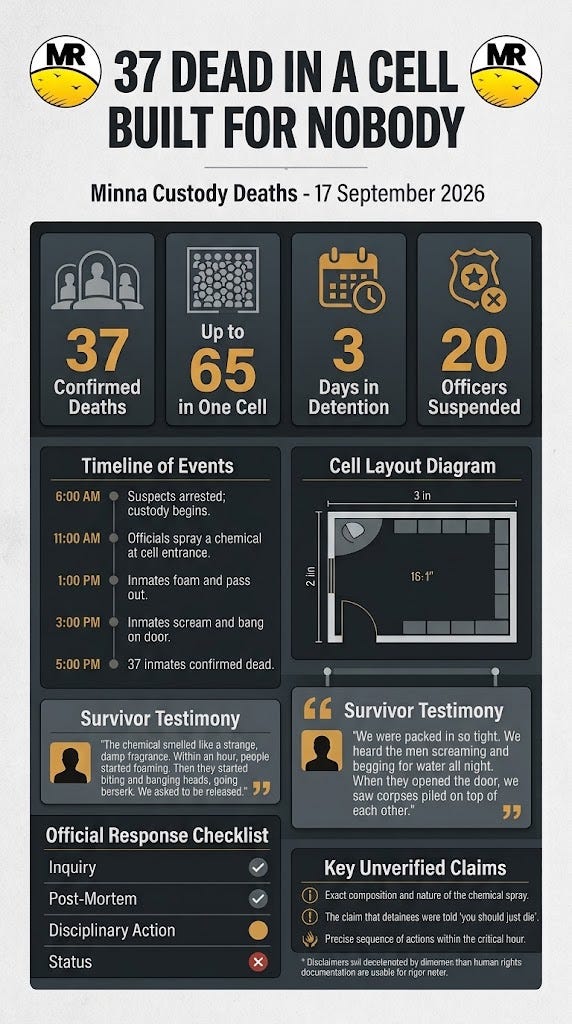
On the third day, he said, officials sprayed a chemical around the entrance of their cell. “It smelled like a fragrance or perfume, but it felt damp or moist, so we knew it wasn’t a normal spray,” he said. Within an hour, an inmate began foaming at the mouth and passed out. “Following that, people started dying.” Some became violently agitated. “Some went berserk, exhibiting signs of madness. Some started biting people. Some were banging their heads against the wall.”
He said detainees screamed for help. “We called out to them to open up, but they replied that we should all just die.” About 17 managed to exit. Eleven were rushed to hospital. “Even now, my health is not fully restored,” he said.
Fifteen-year-old Zuwayra Aliyu was held in the women’s cell. She said it had no window, just a small hole near the ceiling with a mesh. From there, the women heard the men. “They were shouting that the heat was killing them. They were screaming and begging for water.” The cries turned into banging. The next morning, an officer said the men had died. “When they opened the door for us, we saw corpses piled on top of each other.”
Khadija Mohammed, 16, said up to 65 men were packed into one room. From about 8 pm, they banged on the door and asked for water. “If they had allowed us, we would have helped them because we had water and food.” Some survivors squeezed into a toilet to reach air through a small opening. “They lifted the children so they could catch a little bit of air to breathe.”
There is no publicly established forensic evidence that a chemical caused the deaths. The NSCDC initially attributed the deaths to a suspected disease outbreak. It later said this had not been conclusively established. Bodies were deposited at the General Hospital in Minna for examination.
Fatima Sa’adu lost her 14-year-old son, Fahad. He supported the family with money from selling water. “He was the one helping me. He provided my food and drink.” She took food to him in custody but was prevented from giving it. She later saw him brought out. “As he was brought out, he hugged me tightly, crying, ‘Mother, mother!’” He died several minutes later.
Isiaku Usman is still searching for his nephew’s body. Kabiru Usman’s name appeared on the list of the dead. The family cannot locate his remains. He has visited the mortuary twice. He wants the authorities to help so the family can bury him.
The aftermath has been swift. President Bola Tinubu directed a comprehensive investigation. Interior Minister Olubunmi Tunji-Ojo inaugurated a 10-member independent committee on 22 September. It has two weeks to complete its work. Its mandate includes identifying the deceased, examining their arrest and detention, determining the cause of death and recommending compensation. The Nigerian Bar Association’s Minna branch set up its own 13-member committee. Twenty NSCDC officers were suspended, including the state commandant, Suberu Aniviye. A new commandant, Abdulhamid Kabara, has been deployed.
Some miners have returned to the pits. One artisanal miner said mining is a hand-to-mouth occupation. “It has been two days since we entered this bush. We haven’t even sold five naira worth of gold yet.” For these miners, the issue is not only legality. It is unemployment and the absence of alternatives. Residents near M.I. Wushishi complain that mining is expanding into residential areas. “They have dug all our backyard and are gradually coming into our compound,” a resident, Mal Awwal, said.
Winners: The investigation panels, which gain mandates. Officials who can claim responsiveness. The NSCDC national leadership, which distances itself from the local command. Losers: The 37 dead and their families. Fatima Sa’adu, who lost her 14-year-old son. Isiaku Usman, whose nephew’s body is still missing. The survivors who watched men die behind a locked door. The rule of law, which was already thin. Every Nigerian who now knows that arrest can be a death sentence.
Bottom Line: Survivors say a chemical was sprayed, 65 men were packed into one cell, and pleas for water went unanswered. The autopsies will confirm what happened. The investigation must answer why. Until detention conditions change nationwide, Minna will not be the last cell of death.