


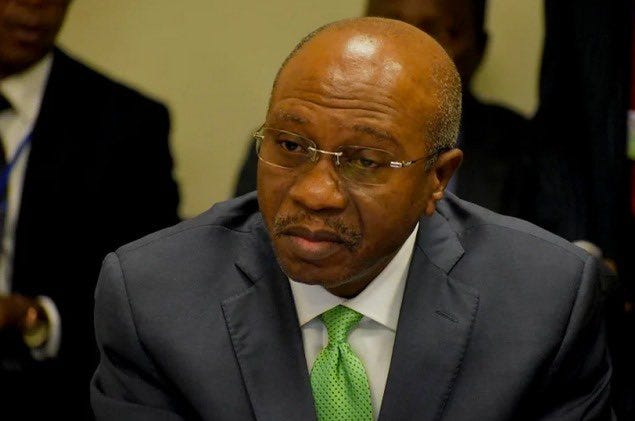
The Supreme Court has affirmed the final forfeiture of seven landed properties, $2,045,000 and share certificates linked to former Central Bank Governor Godwin Emefiele. The apex court set aside the Court of Appeal’s judgment and upheld the Federal High Court’s decision. The properties were reasonably suspected to have been acquired with proceeds of unlawful activities. This is a significant victory for the Economic and Financial Crimes Commission (EFCC), which has pursued the case for years.
The final forfeiture order was originally granted on 1 November 2024 by Justice D.I. Dipeolu of the Federal High Court in Lagos. The EFCC, through its then counsel Rotimi Oyedepo (SAN), filed the application under Section 17 of the Advance Fee Fraud and Other Fraud Related Offences Act, 2006. The application was supported by an affidavit from investigating officer David Jayeoba. Emefiele challenged the decision at the Court of Appeal, which reversed the trial court’s judgment. The EFCC appealed to the Supreme Court, and a five-member panel led by Justice Ibrahim Mohammed Saulawa unanimously set aside the appellate court’s decision.
The forfeited assets include a duplex on Hakeem Odumosu Street, Lekki; an undeveloped plot on Oyinkan Abayomi Drive, Ikoyi; a bungalow on the same street; a four-bedroom duplex on Probyn Road, Ikoyi; an industrial complex in Agbor, Delta State; eight apartments on Adekunle Lawal Road, Ikoyi; and a duplex on Bank Road, Ikoyi. The court also ordered the forfeiture of $2,045,000 and share certificates of Queensdorf Global Fund Limited. The total value of the assets is substantial, though the EFCC has not given a precise figure.
This is the first time in recent memory that a former CBN governor has faced such a comprehensive forfeiture order. The last time a senior official of Emefiele’s rank lost assets to the state was during the Abacha regime, when the government recovered billions from the dictator’s family. The difference is that Emefiele’s forfeiture is judicial, not political. The courts have spoken, and the EFCC has won. But the victory is limited. Emefiele has not been convicted of any crime. The forfeiture is civil, not criminal. The assets are gone, but Emefiele remains free.
The winners from this ruling are the EFCC, which has secured a major legal victory; the federal government, which gains assets worth millions; and Nigerians who see some measure of accountability. The losers are Emefiele, who has lost properties and cash; the Court of Appeal, whose judgment was overturned; and the broader cause of anti-corruption, which still lacks a conviction. The forfeiture is a step forward. But it is a step, not a leap. The EFCC has won the battle. The war against corruption continues.
Winners: The EFCC, the Federal Government, Nigerians who believe in accountability.
Losers: Godwin Emefiele, the Court of Appeal (which was overruled), the broader cause of anti-corruption (which still lacks a conviction).
Bottom Line: The Supreme Court’s affirmation of Emefiele’s forfeiture is a rare judicial victory in Nigeria’s anti-corruption war, but without a conviction, it remains a partial success.