


Standard Chartered expects the Central Bank of Nigeria to reduce interest rates by only 150 basis points in 2026, saying persistent inflationary pressures will likely force the apex bank to adopt a slower, more cautious monetary easing cycle than previously anticipated.
The revised outlook was disclosed by Razia Khan, Chief Economist for Africa and the Middle East at Standard Chartered, in an investment note. The bank now expects the Monetary Policy Rate (MPR) to end 2026 at 25%, while also raising its average inflation forecast for the year to 15.5% from an earlier projection of 12%.
“We now see inflation averaging 15.5% in 2026 compared with 12% previously and 14.7% next year from a prior forecast of 13.8%. We now see scope for 150 basis points of policy easing in 2026 — previously under review — taking the monetary policy rate to 25% at year-end,” Khan said.
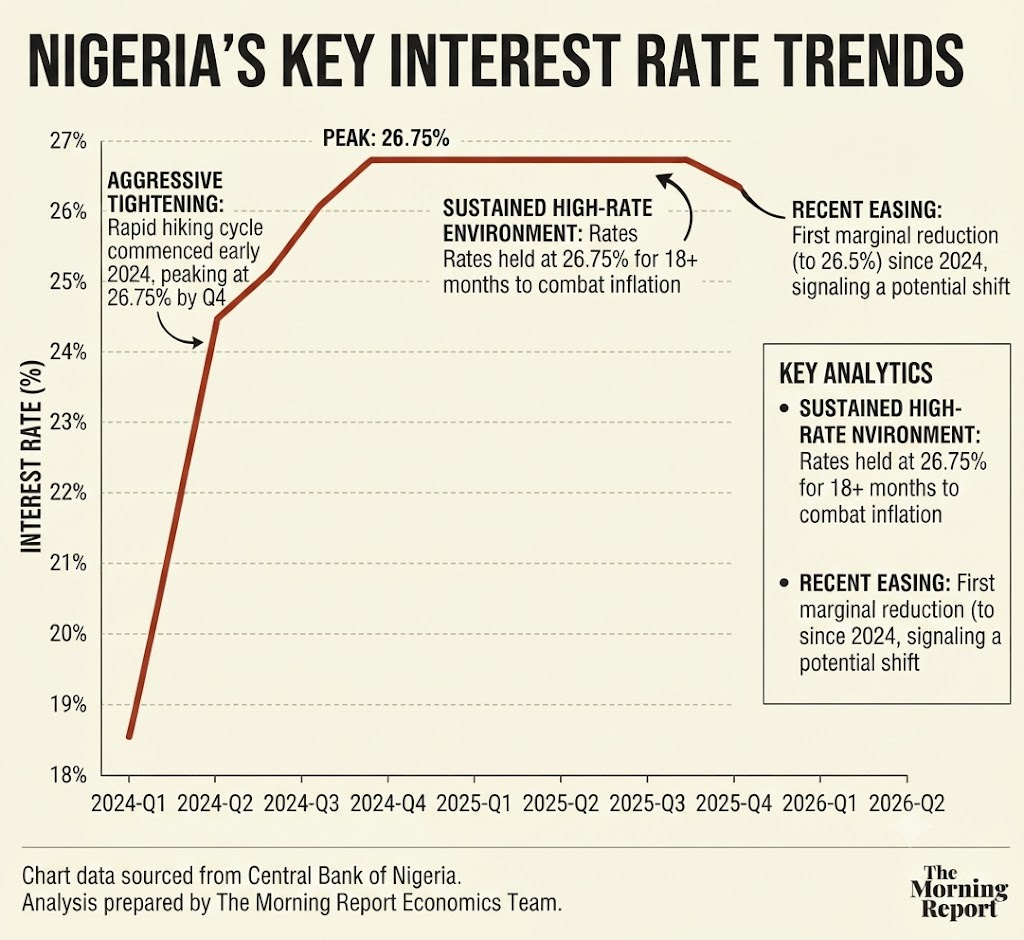
Despite its cautious outlook for next year, the investment bank expects inflation to ease more meaningfully thereafter, paving the way for a more aggressive monetary easing cycle. Khan projects that the CBN could reduce interest rates by 700 basis points after the January 2027 elections, followed by an additional 350 basis points in 2028, as inflation moderates and macroeconomic conditions improve.
The CBN has maintained a cautious monetary policy stance in recent months as it seeks to balance inflation control with economic growth. At the conclusion of its 305th Monetary Policy Committee meeting on May 20, the committee left the Monetary Policy Rate unchanged at 26.5%, maintaining its wait-and-see approach after delivering a 50-basis-point rate cut in February. The committee said its decision reflected the need to maintain tight monetary conditions amid renewed inflationary pressures, including consecutive increases in headline inflation in March and April.
Standard Chartered’s latest outlook comes as investors await the release of Nigeria’s June Consumer Price Index by the National Bureau of Statistics on Wednesday, a key data point expected to shape expectations ahead of the CBN’s next MPC meeting on July 21. Headline inflation rose to 15.93% in May 2026, up from 15.69% in April, indicating that price pressures remain elevated despite a slowdown in monthly inflation. Economists expect June inflation to edge above 16%.
A higher-than-expected inflation reading could reinforce the CBN’s cautious monetary policy stance, strengthening expectations that interest rates will remain elevated for longer despite growing calls from businesses for lower borrowing costs.
This mirrors the 2014-2015 monetary policy tightening cycle, when the CBN kept rates high to defend the naira amid falling oil prices. The mechanism then was different, but the result was the same: high interest rates that squeezed businesses but failed to fully control inflation.
The winners: savers, who benefit from high interest rates, and the CBN, which maintains its credibility. The losers: businesses, which face high borrowing costs, and the Nigerian economy, which suffers from restricted credit.
Bottom Line: Interest rates will stay high until 2027. Businesses will keep struggling. The CBN will keep watching. That is not a policy. That is a holding pattern.