


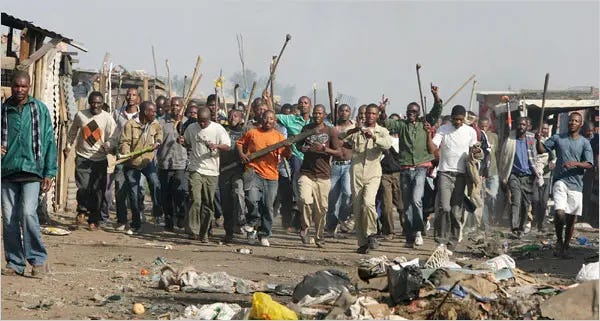
Groups of anti-immigrant protesters in South Africa went door-to-door on Thursday, pulling people from their homes and handing them to the police. In the Johannesburg township of Alexandra, a Reuters reporter saw them break down doors and enter houses where they believed undocumented foreigners were hiding. Protesters wielding sticks and flags also marched through Soweto with plans to search for illegal migrants. There were also protests in Durban.
The action comes after months of often violent anti-immigrant demonstrations and an unofficial 30 June deadline by protesters for all undocumented foreigners to leave. “Our mandate is clear, we need them to go. We don’t need them here in South Africa because they are here illegally,” said Musa Mabiko, a community leader in Alexandra. But he added that the anti-migrant protest march there had got out of hand and needed to stop immediately after chaotic scenes that included a crowd of men carrying sticks. One local suggested the “march” seemed more like vandalism than a protest.
Soweto township community leader Portia Zulu said South Africans feel overwhelmed as the borders are not well-controlled and there is “a high influx of undocumented foreigners”. “The pie is now too small to share because South Africans are unemployed, the rate of crime has gone too high. So we want the government to be serious about deporting undocumented foreigners,” she said.
The leader of the anti-migrant movement March and March, Jacinta Ngobese-Zuma, has again denied claims the organisation is xenophobic. Last week she said it would stage protests every Thursday until the government shows it is taking the group’s demands seriously.
South Africa hosts more than three million foreigners, just over five percent of its population, but unemployment exceeds 30 percent, fuelling anger toward migrant workers.
The Nigerian stake is urgent. Thousands of Nigerians live and work in South Africa, and they face the same risks. Nigeria, one of several countries that have repatriated some of its citizens, said this week that the situation for foreigners in South Africa is deteriorating. Thousands of people from African nations, including Ghana, Nigeria, Malawi, Zimbabwe and Mozambique, have fled the country in recent weeks.
This mirrors the 2019 attacks on foreign-owned businesses in South Africa, which led to a diplomatic crisis between Abuja and Pretoria. The mechanism then was different, but the result was the same: African migrants targeted, businesses looted, and governments scrambling to respond.
From a Nigerian vantage point, the violence is a reminder that Nigerian citizens abroad are vulnerable. The government’s evacuation efforts have been reactive rather than preventive. The question is whether Nigeria will step up its diplomatic engagement with South Africa, issue travel advisories or push for an African Union response to the recurring violence.
The winners: none. The losers: the foreign nationals who are being targeted, the Nigerian citizens living in South Africa who face the same risks and the African Union, which has failed to address the recurring violence.
Bottom Line: Mobs are dragging foreigners from their homes in South Africa. Nigeria is watching. The question is whether it will act before its citizens become the next targets.