


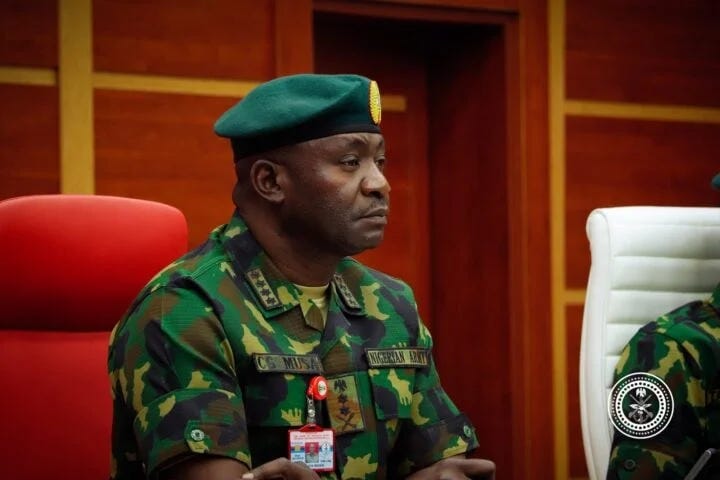
Reactions have followed Defence Minister Christopher Musa’s disclosure that the minimum monthly salary for Nigerian soldiers has increased to ₦100,000, with serving and retired military personnel describing the amount as inadequate amid rising living costs. Some veterans questioned whether the new pay was being implemented, while serving personnel urged President Bola Tinubu to fulfil his March 2026 promise of a broader salary review, warning that poor welfare was hurting morale, recruitment and retention.
Musa said soldiers’ pay had risen from ₦49,000 to ₦100,000 but admitted the military remained underfunded. “The military is underfunded, and we need to do more. We appreciate what the President has done, but we need to do more,” Musa said. He also called for the death penalty for kidnappers to strengthen deterrence against rising insecurity.
Meanwhile, President Tinubu convened a closed-door security meeting with military chiefs, intelligence heads and senior security advisers at the Presidential Villa to review the country’s security situation following recent military operations against terrorists and bandits in the North-West and North-East.
The pay increase, while significant, barely keeps pace with inflation. In 2023, the minimum wage for soldiers was ₦49,000. The new ₦100,000 represents a 104 percent increase, but inflation has eroded purchasing power across the economy. A soldier in 2026 earning ₦100,000 faces the same cost pressures as every other Nigerian: food prices, transport costs and housing expenses that have all risen faster than wages.
Colonel Kolawole Adebayo (retd), a former infantry officer, said the pay raise is welcome but insufficient. “₦100,000 in 2026 is not what ₦100,000 was in 2023. The government must understand that soldiers are not just fighting terrorists. They are fighting to feed their families,” Adebayo said. Sergeant Musa Abubakar (rtd), a veteran of the North-east counterinsurgency campaign, echoed the sentiment: “I have seen young soldiers struggle to pay school fees for their children. The government talks about morale, but morale starts with the ability to provide for your family.”
On the other hand, some analysts argue that the military’s budget constraints make further increases difficult. “The defence budget is already stretched thin between procurement, operations and personnel costs,” said Dr Oluwole Ogunlade, a security analyst. “The government has to balance pay increases with equipment and operational funding.” Another observer, retired Brigadier General Tunde Ogunbiyi, said the military’s problems go beyond pay. “The military needs better equipment, better intelligence and better welfare for families. A pay raise alone will not solve the recruitment and retention crisis.”
Neutral observers note that the military’s underfunding is a long-standing problem. “The military has been underfunded for decades,” said Professor Chidi Nwosu, a defence policy expert. “The government has increased spending in recent years, but the gap between requirements and resources remains wide.” Another analyst, Funmi Ogunyemi, added: “The soldiers are right to demand more. But the government is also right that resources are limited. The question is whether the political will exists to prioritise defence spending.”
This echoes the 2012 military pay crisis, when soldiers protested over poor welfare and inadequate allowances. The mechanism then was different, but the result was the same: a military that feels undervalued and a government struggling to meet its obligations.
The winners: soldiers who have received a pay increase. The losers: the military, which remains underfunded; the government, which faces pressure to do more; and the Nigerian public, which depends on the military for security.
Bottom Line: Soldiers are now earning ₦100,000. They say it is not enough. The Defence Minister agrees. That is not a solution. That is an admission.