


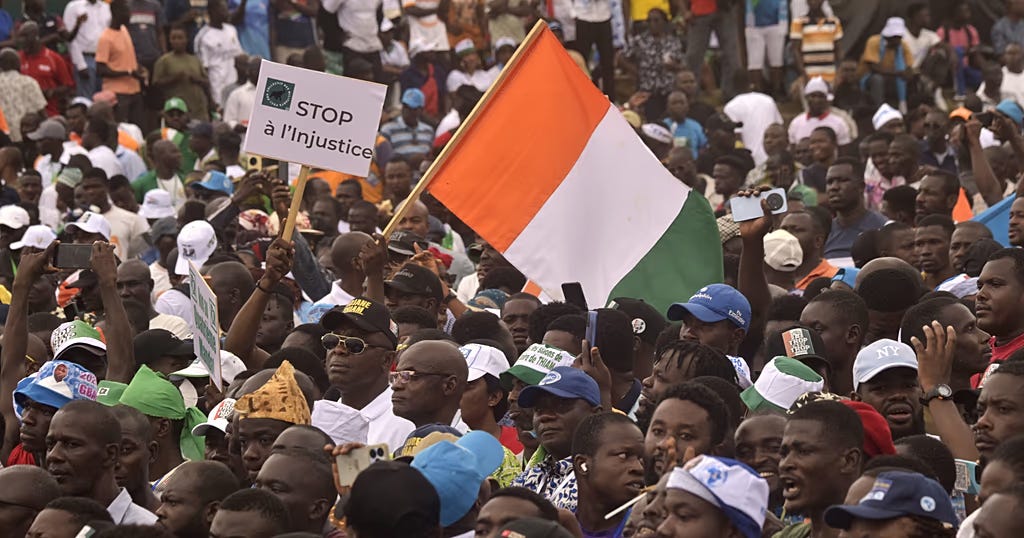
Ivorian judicial authorities have summoned six senior officials of the opposition Democratic Party of Côte d’Ivoire. Summonses were issued on 15 October and run to 23 October. They came from the dean of investigating judges at the Abidjan court of first instance. Several refer to the court’s antiterrorism section. The report did not state the charges.
Côte d’Ivoire’s October 2025 election was contested. Laurent Gbagbo’s PPA-CI boycotted it. The PDCI-RDA, the party of the late Henri Konan Bédié, has walked a difficult line between opposition and engagement. Political detentions have recurred since the 2011 post-election crisis. In 2022, several PPA-CI members were held. In 2026, PPA-CI executive Blaise Lasm was partially cleared after nearly a year in detention, though lesser charges remain.
The officials summoned include vice-presidents Georges Philippe Ezalé, Alain Kokou Tré and Mandjia Biya Roger. The report linked the summonses to an inquiry into unrest around the October 2025 election. Five officials of the African Peoples’ Party – Côte d’Ivoire were summoned earlier.
The PDCI-RDA issued a statement. It rejected any association with a criminal or terrorist organisation. It called the summonses a serious political signal. It asked regional bodies, notably the Economic Community of West African States, to monitor the proceedings. The report included no response from the court, prosecutors or government.
The antiterrorism reference is the most serious element. Terrorism charges in Côte d’Ivoire carry heavy penalties and limited bail. Using the antiterrorism section for election-related unrest widens the legal exposure of opposition figures. It also invites international scrutiny.
The timing matters. The summonses were issued on 15 October, days after Lasm’s partial clearance. The pattern suggests a widening inquiry rather than a narrowing one. Opposition parties will read it as pressure ahead of future contests.
Winners: The government, if the inquiry narrows opposition activity. The court, which asserts jurisdiction. No one else. Losers: The six summoned officials, who face legal jeopardy. The PDCI-RDA, which faces disruption. Opposition politics in Côte d’Ivoire, which is constrained. ECOWAS, which faces another test. Ivorian voters, who see political competition moving from ballots to courtrooms.
Bottom Line: Six senior opposition officials have been summoned. Several face the antiterrorism section. The charges are unstated. The party denies any link to terrorism. The court has not commented. Côte d’Ivoire’s opposition is being tested in courtrooms. ECOWAS is being asked to watch. The process must be transparent. If it is not, the political signal will be read as intended.