


The generators hum. In Lagos, Abuja, Kano and Port Harcourt, that is the sound of daily life. Not the steady drone of the national grid. The industrial roar of petrol and diesel machines. In late 2026, the grid hit a fresh low. Generation output fell to between 2,800 and 2,900 megawatts. That is a fraction of what Africa’s most populous nation requires. Then a ghost emerged from the ports. Over 300 containers of electrical equipment sat abandoned at Lagos for nearly two decades. Transformers. Cables. Switchgear. All procured for grid expansion. All left to rot.
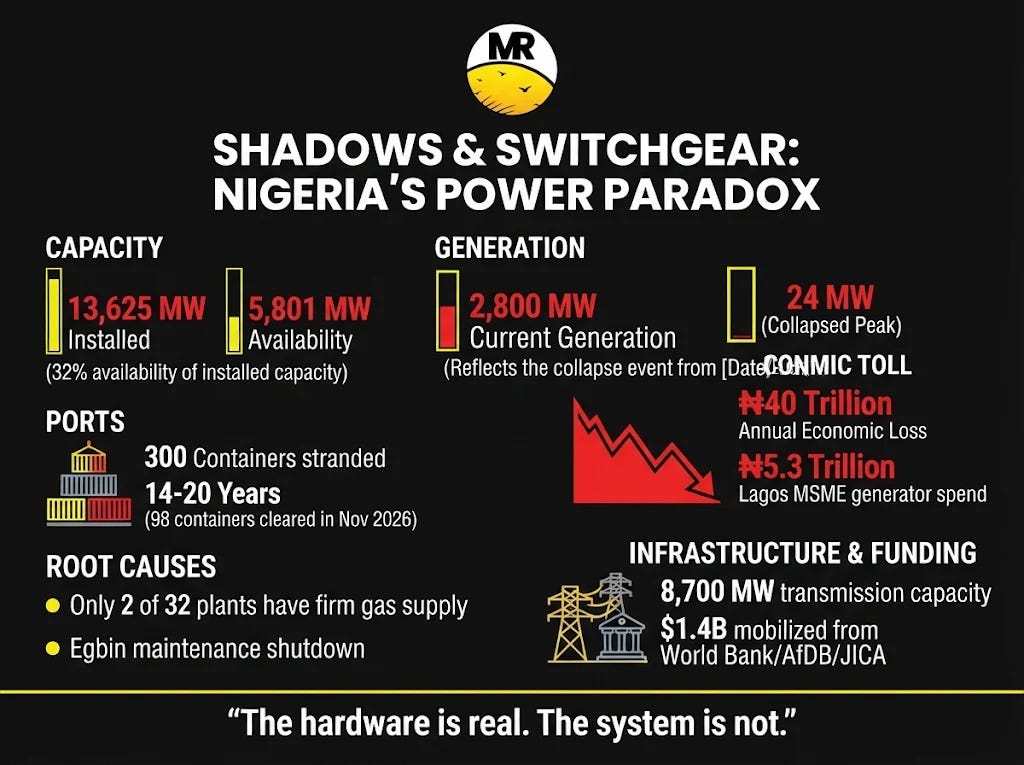
Nigeria has struggled with electricity since independence. The Nigerian Electricity Supply Company served the colonial period. The Niger Dam Authority followed. In 1972, the National Electric Power Authority was created. It held a monopoly for three decades. NEPA became a byword for failure. In 2005, the Electric Power Sector Reform Act unbundled the monopoly. Generation, transmission and distribution were separated. Privatisation followed in 2013. The grid did not improve. Installed capacity is about 13,625 megawatts. Average available generation has hovered around 4,286 megawatts. Transmission capacity sits near 5,000 megawatts. The system cannot move what it can produce. It cannot produce what the economy needs. Every administration promises to fix it. Each leaves the problem to the next. That is how equipment procured in 2006 was still sitting at Apapa in 2026.
The port time capsule
The Nigeria Customs Service announced the clearance of an initial batch of 98 containers. They came from the long-abandoned stockpile at Apapa’s ENL Terminal. The equipment was procured over twenty years ago. Successive power sector initiatives ordered it. It was meant to reinforce transmission networks. It was meant to upgrade overloaded substations. It was meant to expand distribution. Instead, it became a monument to bureaucratic inertia. Port demurrage fees accumulated. Inter-agency red tape multiplied. Institutions passed responsibility to one another.
President Bola Tinubu issued a direct directive that broke the gridlock. The Ministry of Power and Customs collaborated. The Power Minister, Joseph Olasunkanmi Tegbe, said the cleared equipment is undergoing rigorous technical testing. They must confirm structural integrity and operational viability before deployment. State governments and distribution companies in Kaduna, Osun, Nasarawa and Cross River are slated to receive components. The aim is to ease pressure on overwhelmed transformers and stabilise local feeders.
Industry insiders call the unfreezing pragmatic. The public is less forgiving. How does critical national infrastructure sit rotting by the docks for two decades? Nigerians spent trillions of naira on generator maintenance and fuel in that time. The equipment arrived outdated. It is being cleared now.
The grid’s immediate failures
The port revelation coincided with a turbulent period for the national grid. Widespread load shedding and sudden collapses plunged regions into darkness. Tegbe offered explanations. Severe maintenance shutdowns at the Egbin Power Station. Critical gas supply shortages choking thermal plants. Vandalism targeting high-tension transmission lines.
He assured citizens that technical teams were working around the clock. Idled generating units would be restored within 48 to 72 hours. The ministry was engaging gas producers to resolve feedstock deficits. Breached transmission corridors were being repaired.
The long-term plans were outlined. East and West Super Grids. Complete modernisation of the 64-year-old National Control Centre in Osogbo. The transmission capacity figure is telling. It hovers around 5,000 megawatts. Generation potential exceeds 13,000 megawatts. The grid cannot carry what the plants could produce. The bottleneck is not one problem. It is several, stacked on each other.
Opposition figures have intensified pressure. Peter Obi, the NDC presidential candidate, urged the administration to move past rhetoric. Generation at 2,800 to 2,900 megawatts is unacceptable for an economy targeting a $1 trillion GDP, he said. He is right. A trillion-dollar economy cannot run on generators.
Voices from the ground
Chinedu Okafor runs a tailoring business in Ikeja. He was blunt. “It is an absolute insult to our collective intelligence for the government to announce they just discovered transformers sitting at the port for 20 years,” he said. “Meanwhile, my tailoring business in Ikeja runs on generator fuel that costs more than my monthly shop rent. Twenty years of darkness while equipment rots by the sea? This is not just inefficiency. It is economic sabotage against ordinary Nigerians.”
Dr Zainab Aliyu is an energy policy researcher in Abuja. She rejected the theatrical framing. “Let us not be distracted by theatrical port clearances,” she said. “Finding 300 containers after two decades exposes a profound institutional rot where no single agency takes ownership of national assets. Generating less than 3,000 megawatts in 2026 is a national emergency. Patchwork repairs and 48-hour ministerial promises cannot fix a grid built on quicksand. We need a complete structural decentralisation of power generation and true private accountability.”
Emeka Nnadi runs a tech startup in Port Harcourt. His servers run on diesel. “Every dry season or rainy season, the story is the same: gas shortages, line vandalism, maintenance at Egbin,” he said. “Why is our entire national grid dependent on fragile pipelines that get vandalised every month without fail? My startup spends a fortune on diesel just to keep servers running. The government is celebrating clearing old containers, but those transformers were outdated when they arrived in 2006. We are patching a leaking titanic with duct tape.”
Funke Adebayo is a civil rights activist in Ibadan. She described numbness. “Nigerians have graduated from anger to absolute numbness when it comes to electricity,” she said. “Power Minister Tegbe can give all the technical grammar he wants about 72-hour turnarounds, but the reality on our streets is pitch black. We have paid trillions in electricity tariffs for darkness. Until those responsible for abandoning public infrastructure for 20 years are held criminally accountable, announcements mean nothing.”
Dr Oladipo Adeleke is a senior macro-energy analyst at the Lagos Economic Study Group. He offered a measured view. “The current power crisis is a complex legacy issue intersecting with immediate operational shocks,” he said. “On one hand, releasing 300 stranded containers is a commendable administrative cleanup initiated by the current political will. It eliminates bureaucratic waste and supplies much-needed hardware to ailing substations. On the other hand, the underlying grid vulnerability, driven by gas supply pricing disputes and pipeline security, proves that hardware alone cannot solve the sector’s liquidity and infrastructure deficit. The system requires holistic commercial viability, not just emergency engineering interventions.”
Ibrahim Danlami processes agricultural produce in Kano. He is more hopeful. “For the first time in a long time, we are seeing decisive political courage,” he said. “Finding and clearing containers that were abandoned by past administrations for 20 years takes real executive push. Minister Tegbe and President Tinubu are confronting decades of institutional inertia head-on. If these transformers are successfully tested and deployed to states like Kaduna and Osun, our processing plants will finally have the stable voltage needed to boost local production. Change does not happen overnight, but clearing the port backlog proves we are finally moving in the right direction.”
Winners: The Ministry of Power, which gained a visible win. The Customs Service, which cleared a backlog. States receiving the equipment, which gain infrastructure. Contractors and technicians, who gain work. The presidency, which claims decisive action. Consumers in the recipient states, if supply improves. Losers: The 20 years of administrations that left the equipment at the port. Nigerians who paid for generators and fuel during that period. The treasury, which absorbed demurrage and storage costs. DisCos that cannot move enough power. Businesses that cannot plan around unreliable supply. The economy, which loses productivity every time the grid fails. Consumers who pay tariffs for darkness.
Bottom Line
Clearing the ports is a start. It is not a solution. Transformers sitting in a warehouse, whether for twenty years or twenty days, generate no watts. They must be tested, installed, connected to functional substations, fed by reliable gas and protected from vandalism. Nigeria’s problem is not one missing piece of hardware. It is a system that cannot carry the power it produces, cannot produce the power it needs, and cannot keep the equipment it buys. The port containers are a symptom. The grid is the disease. Until the country bridges the gap between policy documents and functioning infrastructure, the generators will keep humming. And the shadow of those twenty years will fall over every announcement of progress.