


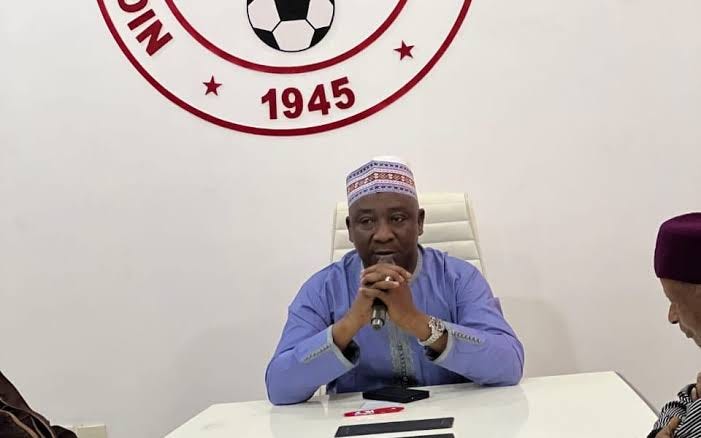
The Senate has expressed its disappointment and dismay over the dismal performances of Nigeria’s football teams, from the Super Eagles’ failure to feature in the 2026 FIFA World Cup to the Super Falcons’ non-qualification for the 2027 FIFA Women’s World Cup in Brazil. Senator Abdul Ningi, Chairman of the Senate Committee on Sports, held an emergency meeting with the Chairman of the National Sports Commission, Shehu Dikko, and the President of the Nigeria Football Federation, Ibrahim Musa Gusau.
Speaking to journalists at the end of the meeting, Ningi said the meeting was called at the prompting of the Senate President, Senator Godswill Akpabio. “I have the authority of the Senate President on this very important meeting who recently asked me that Senator Ningi, what is happening in sports, what is happening in football?” he said.
Ningi stressed the need for NSC and NFF to close ranks for better performances by Nigerian teams at the world stage. “I called them to close ranks, that is, the Nigerian Football Federation and the National Sports Commission because as it is today, they are wide apart,” he said.
The senator also questioned the effectiveness of the government’s investment in sports. “Recall, in a very long time, the government never compensated sportsmen and women, but the president, in his magnanimity, dished out a hundred thousand (dollars) each to players and officials. I thought the president had done all that he could in motivating them. As the chairman of the Senate committee, I’ve seen that the president has almost quadrupled the sports ministry’s budget. Then what other motivation does a player or officials need?” he said.
He lamented: “We were all pained when we couldn’t be in the World Cup in the United States and further pained by the failure of Super Falcons to make it to Brazil next year.”
The Senate’s intervention is a recognition that the crisis in Nigerian football has reached a tipping point. The Super Eagles missed the World Cup. The Super Falcons missed the World Cup for the first time in 30 years. The NFF and NSC have been at odds, and the government’s investment has not translated into results. The Senate’s demand for answers is a sign that the political class is losing patience. The question is whether the NFF and NSC will heed the warning or continue their infighting.
This echoes the 2010 Senate intervention in Nigerian football, which also demanded answers after a poor World Cup performance. The mechanism then was different, but the result was the same: a crisis in Nigerian football.
The winners: the Senate, which is asserting its oversight role; and the Nigerian public, who are demanding accountability. The losers: the NFF and NSC, which face scrutiny; and Nigerian football, which continues to decline.
Bottom Line: The Senate is demanding answers from the NFF and NSC. The football crisis is deepening. The question is whether the intervention will lead to reform or just more talk.