


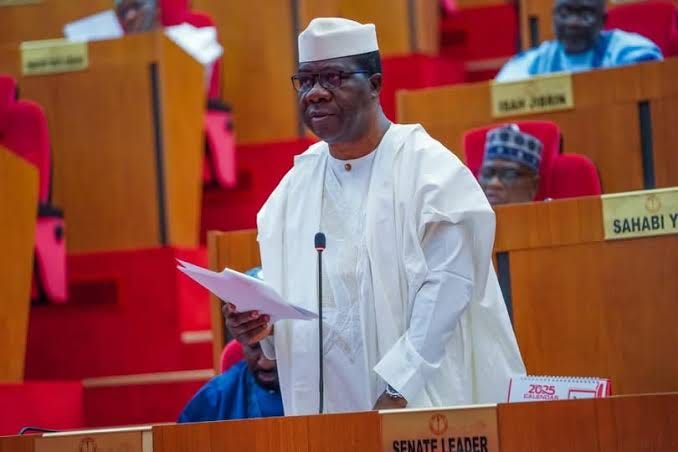
The National Assembly has proposed 74 additional seats for women in the Senate and House of Representatives. The Senate Leader, Opeyemi Bamidele, disclosed the plan at the 2026 Law Week of the International Federation of Women Lawyers in Ekiti. The proposal would add 37 seats to each chamber. Every state and the FCT would get one additional seat in each. Three additional seats would be reserved for women in each state House of Assembly.
Women’s representation in Nigeria’s legislature is among the lowest in Africa. In the 10th Senate, four of 109 senators are women, about 3.7 per cent. In the House, 17 of 360 members are women, about 4.7 per cent. Across the 36 state assemblies, women hold between 45 and 54 of roughly 990 seats, about 4.4 to 4.5 per cent. Rwanda’s Chamber of Deputies is 63.75 per cent female. South Africa’s parliament is roughly 43 to 45 per cent female. Nigeria’s gap is structural, reinforced by party gatekeeping and the cost of nomination forms.
Bamidele said the proposal emerged from the constitutional review process. It would not displace existing seats. The arrangement would run for 16 years, four electoral cycles, before a review. He described it as a sunset clause designed to allow a more inclusive political culture to develop. The amendment requires approval from two-thirds of state assemblies. Bamidele said the committee is engaging state legislatures. He framed the proposal as a democratic imperative, not a partisan one. “A democracy that systematically excludes over half of its population from the decision-making tables that determine their futures is, at best, a flawed democracy,” he said.
The proposal is ambitious. Special seats for women are rare in presidential systems. The sunset clause is a compromise. Opponents may argue that reserved seats undermine merit. Supporters say the current system already distorts merit through patronage and money. The state assemblies will decide.
Winners: Women aspirants, who gain a pathway. The National Assembly, which shows initiative. FIDA, which gained a platform. Civil society, which has pushed for inclusion. Losers: Critics who see reserved seats as tokenism. Male aspirants who face competition for fewer open seats. States that reject the amendment. The political process, if the seats become patronage tools.
Bottom Line: Seventy-four seats for women is a significant intervention. The sunset clause limits it. The state assemblies must approve. Without them, it is a proposal. With them, it is a reset.