


The House of Representatives has approved President Bola Tinubu’s request to raise approximately $7.7 billion in external loans to help finance Nigeria’s 2026 budget deficit, adding another major borrowing commitment to the country’s public debt obligations.
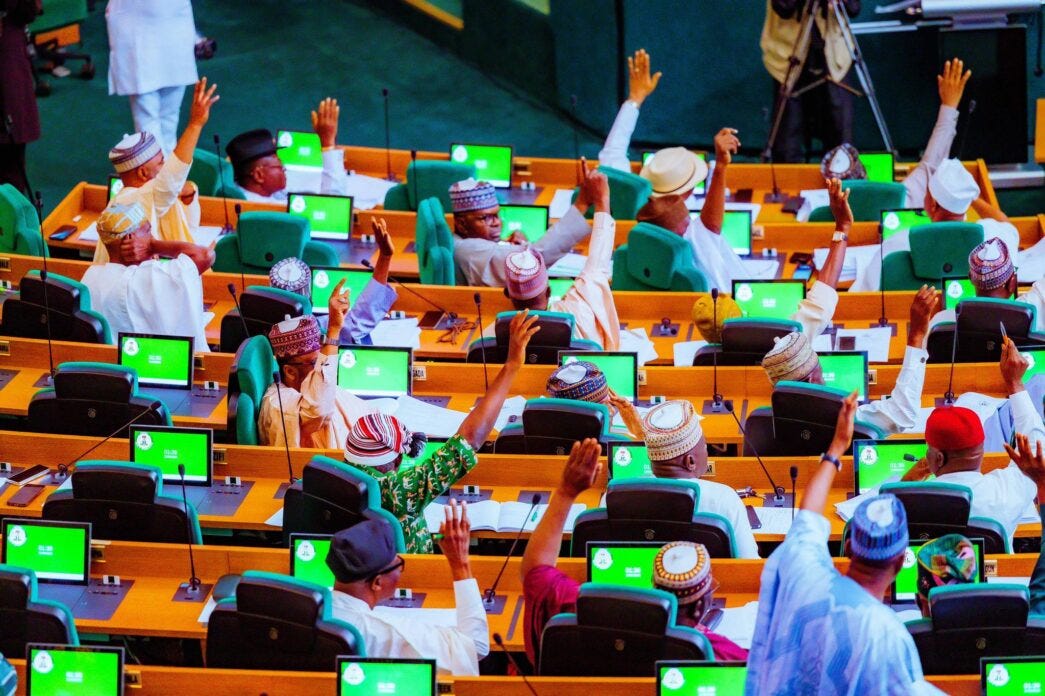
Lawmakers approved the request during Tuesday’s plenary on November 24, following consideration of a report by the House Committee on Aids, Loans and Debt Management.
The approval authorises the Federal Government to raise ₦10.79 trillion, equivalent to approximately $7.707 billion at the exchange rate of ₦1,409 to the dollar.
The funds form part of the external borrowing component already captured in the 2026 Appropriation Act. The President had explained that the request was necessary to secure legislative approval for the terms and conditions of the external loans, as required under the Debt Management Office Act, 2003.
The government may source the funds through several channels, including concessional and commercial facilities from multilateral and bilateral institutions, International Monetary Fund (IMF) facilities, bridge financing, loan syndication and Eurobond issuance.
Tinubu had indicated that the government would place greater emphasis on Eurobond issuance because it could provide access to larger amounts of funding within a shorter period. However, the final interest rates, repayment periods and other conditions will depend on prevailing market conditions when the loans are negotiated.
The President said the borrowing would support projects and programmes in defence and security, transportation, agriculture, power, education and healthcare. He also argued that the funds would strengthen Nigeria’s external reserves and support the naira.
To strengthen oversight, the House directed the Federal Government, through the Debt Management Office (DMO), to submit periodic reports to the National Assembly. These reports must state the amounts borrowed, financing sources, interest rates, repayment periods, fees and other loan conditions.
The House Committee on Local and Foreign Debts was also mandated to monitor the borrowing programme, including the actual release and use of funds and compliance with approved terms.
The approval also covered a separate supplementary external borrowing plan of $20.52 billion and €1.04 billion for the 2026–2027 fiscal period. This means lawmakers endorsed two distinct borrowing proposals, not just the $7.7 billion facility highlighted in the headline.
The distinction is important because the $7.7 billion request relates to external financing already provided for in the 2026 budget, while the larger supplementary plan covers additional projects and programmes across the two fiscal years.
The approvals come as Nigeria continues to rely heavily on borrowing to finance public expenditure. The 2026 budget provides for approximately ₦29.22 trillion in new borrowing, comprising ₦18.43 trillion domestically and ₦10.79 trillion externally.
The Federal Government has defended the borrowing as necessary to fund infrastructure, strengthen security and sustain economic reforms. But the country’s growing debt obligations raise questions about repayment costs, revenue generation and the government’s capacity to convert borrowed funds into productive investments.
The immediate beneficiaries could include contractors, businesses and communities that receive funding for projects in transportation, agriculture, healthcare, education, power and security. However, taxpayers will ultimately carry the repayment burden, while future administrations will inherit the financial obligations.
The conditions attached by lawmakers offer some safeguards. Yet, their effectiveness will depend on whether the National Assembly actively monitors disbursements and publishes meaningful details about how the money is spent.
Bottom Line: The House has approved more than a $7.7 billion borrowing request, endorsing a separate supplementary loan plan worth $20.52 billion and €1.04 billion. The bigger question is whether Nigeria can turn these borrowing commitments into lasting economic value before repayment becomes another burden on public finances.