


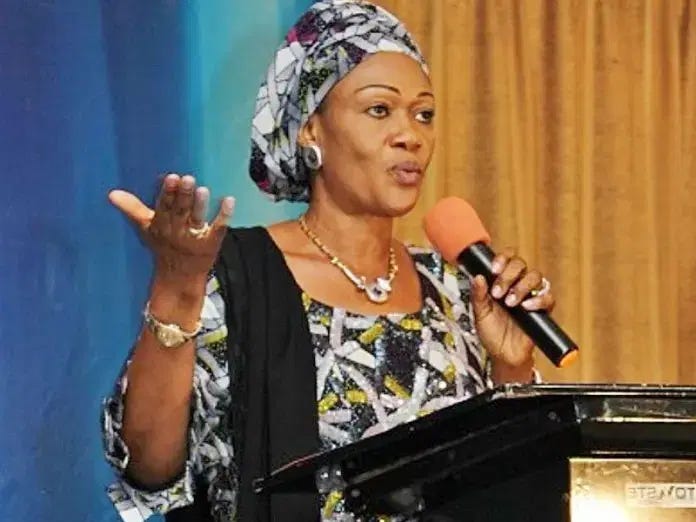
First Lady Oluremi Tinubu has appealed to leading Afrobeats artists, including Damini “Burna Boy” Ogulu, David “Davido” Adeleke and Ahmed “Asake” Ololade, to increase their support for the country’s less privileged citizens. Speaking at the launch of a national community food bank in Lokoja, Kogi State, on Saturday, Mrs Tinubu emphasised that while personal success is laudable, there is a pressing need for influential figures to contribute to social welfare.
Citing Akon’s philanthropic work as a benchmark, she encouraged artists to establish foundations to assist people experiencing poverty directly. “The burden on the government is huge; you can still help,” Mrs Tinubu stated, noting that music stars have the means to make a significant impact. She added that this support could directly assist those engaged in micro-enterprises, such as selling peppers, vegetables and traditional foodstuffs.
Addressing public reaction to her previous comments on the informal economy, the First Lady reiterated the importance of valuing honest labour. She recounted the success of a young graduate in Abuja who, unable to find formal employment, began selling akara (bean cakes). After receiving additional equipment through a support programme, his business expanded to support 12 employees.
During the event, Mrs Tinubu announced a fresh phase of the ‘Renewed Hope’ initiative. A donation of ₦100 million has been made to the office of the First Lady of Kogi State to provide ₦50,000 grants to 2,000 small-scale traders. The initiative aims to support these entrepreneurs in recapitalising their businesses and improving their economic independence.
The First Lady’s comments sit at the intersection of celebrity culture, wealth inequality and governance in Nigeria. Burna Boy, Davido and Asake are among the country’s most successful musical exports, with combined fortunes that run into billions of naira. Their wealth is a testament to Nigerian talent and global appeal. But it also raises uncomfortable questions about the distribution of that wealth and the responsibilities that come with it.
The government’s own record on poverty alleviation is mixed. The ‘Renewed Hope’ initiative, while well-intentioned, is a drop in the ocean compared with the scale of Nigeria’s poverty crisis. The First Lady’s appeal to artists is a recognition that the government cannot do it alone. But it is also a deflection: a way of shifting responsibility from the state to private citizens.
This echoes the 2010s debate about celebrity philanthropy in Nigeria, when figures like D’banj and Don Jazzy were called upon to do more for the less privileged. The mechanism then was different, but the result was the same: a conversation about wealth, responsibility and the limits of government.
The winners: the 2,000 small-scale traders who will receive grants. The losers: the millions of Nigerians living in poverty who will not receive grants, and the government, which continues to rely on private charity to fill the gaps in public welfare.
Bottom Line: The First Lady wants Burna Boy, Davido and Asake to help the poor. That is a reasonable request. The question is whether the government is doing enough to help the poor itself.