


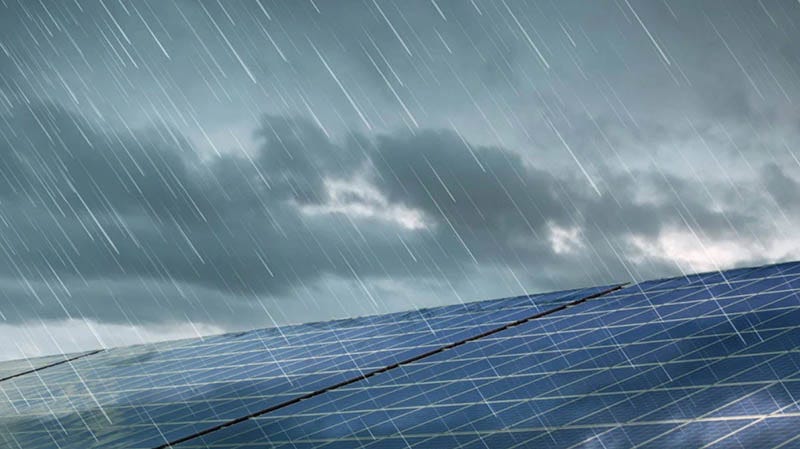
Every rainy season, Chuka Matthew’s home in Lagos begins to experience power rationing. Not because his solar panels are faulty, but because the sun has disappeared. The civil servant invested over ₦8 million in a rooftop solar system to escape Nigeria’s unreliable grid, but weeks of cloudy weather mean his batteries cannot last through the night.
“Due to insufficient sunlight, my solar panels are currently not performing at their best,” Matthew told BusinessDay. “Even when they charge, they cannot power my appliances for long. They need sunlight.”
Matthew is one of thousands of Nigerians finding themselves in the same predicament. Weeks of cloudy weather and frequent rainfall across much of the country have reduced the solar radiation reaching photovoltaic panels, leaving homes and businesses with depleted batteries, shorter power supply and, in many cases, a return to petrol generators.
When the sun is shining, his solar panels can fully charge and efficiently power his large freezer. But Lagos has experienced four consecutive days of heavy rain, flooding homes and cars and even forcing some shops to close, while dark clouds have dimmed the sun. Solar panels do not stop generating electricity when it rains. The problem is that thick cloud cover reduces the solar radiation reaching the photovoltaic cells, meaning batteries take longer to charge and often fail to reach full capacity after several cloudy days.
As off-grid solar adoption has rapidly expanded across Nigeria, the challenges have grown with it. Rising electricity tariffs for unmetered customers, poor grid reliability, and falling solar equipment prices have driven households and businesses to invest in rooftop solar systems in both urban areas and rural communities. Millions of small businesses now rely almost entirely on solar to reduce the operating costs associated with petrol and diesel generators.
Hybrid systems, which combine solar, battery storage and either the national grid or backup generators, are increasingly becoming the preferred option among commercial users seeking uninterrupted electricity throughout the year. But while solar remains one of the country’s most abundant renewable energy sources, seasonal weather patterns mean that standalone systems require adequate storage capacity and realistic expectations for performance throughout the year.
The Nigerian Meteorological Agency forecast at the beginning of the year indicated a longer-than-normal rainy season for Lagos, delayed cessation, and average rainfall volumes up to 1,965mm. The forecast adds severe mid-season breaks in August and a persistent risk of flash flooding in coastal and low-lying areas.
For businesses already battling high operating costs, the timing could not be worse. Heavy rainfall and flooding have a reputation for damaging electrical infrastructure, reducing transmission reliability, and slowing maintenance work, in addition to causing lost sunlight. Only recently, the Transmission Company of Nigeria declared force majeure on two strategic substations in Lagos after floods crippled a critical electricity transmission facility, cutting several communities from power. “The Transmission Company of Nigeria hereby declares force majeure on Oworonshoki 132/33kV and Lekki 330/132kV Transmission Substations as a result of flooding caused by continuous rainfall in Lagos,” TCN said.
Owing to grid unreliability, many are returning to petrol generators after months of reduced fuel consumption, eroding some of the financial savings that initially justified investing in solar.
This mirrors the situation in India, where researchers are trying to understand the science of absorbing sunlight to convert it into energy for solar panels in sunlight-starved regions. As dark clouds continue to blanket much of the country, many Nigerians who invested in solar to leave generators behind are now looking for ways to store up sunlight and are turning once again to the familiar hum of backup engines as they wait for the sun to return.
The winners: generator sellers, who are seeing renewed demand, and hybrid system providers, who offer the most reliable solution. The losers: Nigerians who invested heavily in standalone solar systems and are now forced to return to generators, and the environment, which suffers from increased emissions.
Bottom Line: Solar works when the sun shines. When it rains, Nigerians go back to generators. That is not a solution. That is a cycle.