


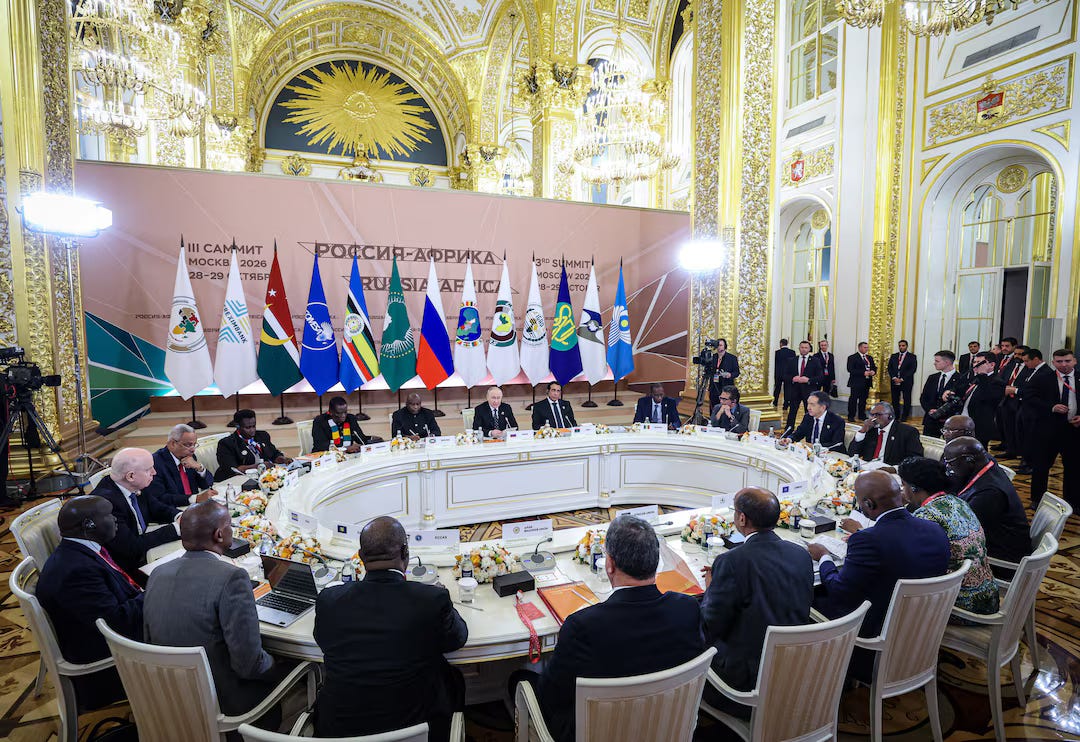
Vladimir Putin hosted the third Russia-Africa Summit in Moscow this week. Delegations from 48 African countries attended. Twenty-two were represented by heads of state. Putin used the platform to present Russia as the alternative to Western partnership. He accused Western states of trying to ensnare Africa in “debt slavery”. He said Russia offers technology transfer, local production and infrastructure support rather than raw material extraction.
The first Russia-Africa Summit held in Sochi in 2019. The second followed in St Petersburg in 2023. Both were framed as a revival of Soviet-era ties. The USSR trained hundreds of thousands of African specialists and supported liberation movements. Modern Russia has far less economic weight on the continent than China, the EU or the US. Its leverage has come through security, energy and disinformation. The Africa Corps, formed from Wagner’s remnants, has expanded to seven additional countries in 2026, reaching about 6,180 personnel . The summit is part of Moscow’s push to convert military presence into political and commercial influence.
Putin spoke at the plenary session of the Russia-Africa Economic and Humanitarian Forum. “There are active attempts by Western states to drive Africans back into debt bondage,” he said. “To impose on them much-needed financial resources at extortionate terms, which subsequently force them to repeatedly overpay to service and close the debt to the detriment of long-term development plans” . He said Russia was involved in efforts to ease Africa’s debt burden. He also said trade relations were developing despite Western sanctions and pressure on Russia’s partners.
The pitch included concrete offers. Putin said Russian grain and fertiliser reach more than 40 African countries. Russia exported 13 million tonnes of food products to the continent in the first nine months of 2026. Over 30 energy projects are underway in 16 African nations . He offered access to Russian expertise in artificial intelligence, cybersecurity and digital public administration. He called for more trade in national currencies and for payment systems less exposed to sanctions .
The summit produced agreements. The African Union Commission and Russia’s Foreign Ministry signed a Plan of Action for 2027-2029 covering technology, education, agriculture and security . Russia’s VEB.RF and the Sahel States Alliance’s investment bank signed a memorandum to identify projects in Burkina Faso, Mali and Niger. Rosatom signed a nuclear cooperation memorandum with Togo. Russia’s transport ministry signed a road infrastructure agreement with Mozambique . Ethiopia’s Prime Minister Abiy Ahmed said Russia had delivered 12 Su-35 fighter jets ahead of schedule, with S-400 systems to follow.
Burkina Faso’s Prime Minister Rimtalba Jean Emmanuel Ouedraogo praised cooperation with Moscow as transparent. He contrasted it with his country’s previous relationship with France. Mali’s Assimi Goita attended. DR Congo’s Felix Tshisekedi attended. Kenya’s William Ruto attended .
Winners: Putin, who gains a platform to challenge the West. African leaders seeking alternatives, who gain leverage. Russian state companies, which gain agreements. The Africa Corps, which gains legitimacy through state endorsement. Losers: Western lenders, who face criticism. France, which loses influence in the Sahel. Ukraine, which sees Russia expand its diplomatic reach. African citizens in countries signing security deals, who may see resources pledged against future obligations. The summit’s smaller participants, who gain less than the major players.
Bottom Line: Putin offered Africa a partnership framed against the West. The debt accusation resonates because the grievance is real. The offers are tangible but modest relative to Africa’s needs. Russia’s economic footprint remains small. Its security footprint is growing. The summit is a signal. Africa is a contested space. Russia intends to be present. Whether it delivers development or extraction is the test.