


Nigeria’s two largest listed palm oil producers, Presco Plc and Okomu Oil Palm Plc, are investing billions of naira in plantations, mills and processing facilities. They are betting that Africa’s largest food market will face a structural edible oil deficit for years to come.
The two companies recorded a combined profit of ₦72.86 billion in the first quarter of 2026, up from ₦69.32 billion in the same period last year. But instead of distributing the windfall, both companies are reinvesting most of their cash into expanding production.
The bet reflects a growing conviction that domestic consumption will continue to outpace local supply. Nigeria, Africa’s most populous country, consumes about 2.1 to 2.2 million metric tonnes of edible oil annually but produces only about 1.9 million tonnes, creating a supply gap that is filled by imports estimated at over $600 million per year.
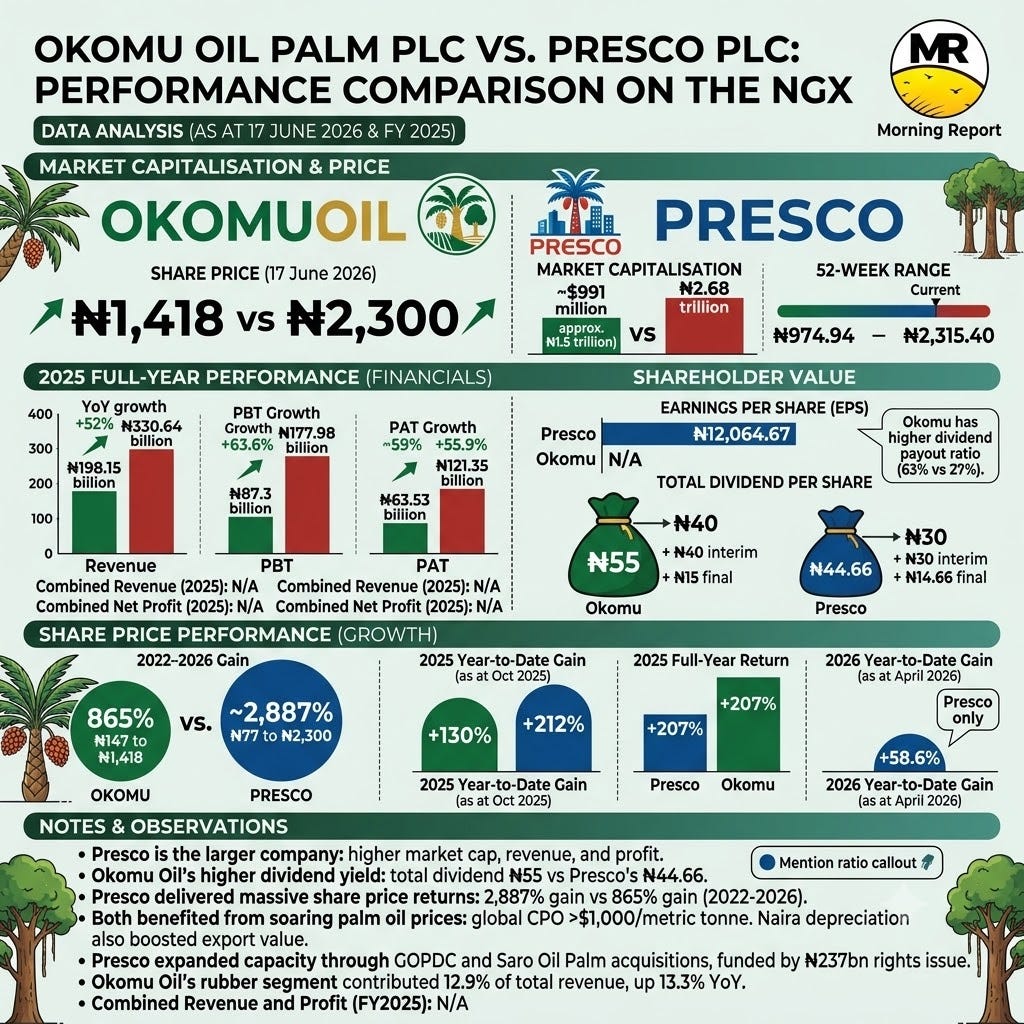
Presco’s operating cash flow in the first quarter was ₦62.7 billion, nearly three times Okomu’s ₦21.5 billion. Presco spent about ₦6.4 billion on property, plant and equipment during the quarter, more than double its investment in the same period last year. Okomu invested nearly ₦1 billion in capital projects.
The balance sheets show the scale of the commitment. Presco reported biological assets valued at almost ₦125 billion as of the end of March, representing investments in oil palm plantations that will bear fruit over several decades. Inventories stood at nearly ₦59 billion, while cash balances reached ₦136.5 billion despite ongoing investment. Okomu reported biological assets of ₦85.4 billion, inventories approaching ₦40 billion, and cash holdings of ₦31.8 billion.
But long-term optimism masks growing stress across the wider industry. Smaller growers say a wave of cheaper palm oil entering Nigeria has pushed domestic prices below production costs. Alphonsus Inyang, president of the National Palm Produce Association of Nigeria, said palm oil prices had fallen by about 50 percent in less than two months, leaving many producers unable to recover their production costs. “Currently, at the price we are selling palm oil in this country, we are selling below production cost,” Inyang said.
The winners: Presco and Okomu, which are positioning themselves for long-term dominance. The losers: smallholder farmers who cannot compete with cheaper imports and are selling below production cost.
Bottom Line: The big players are betting on long-term demand. The small players are bleeding. That is not a market. That is a consolidation.